
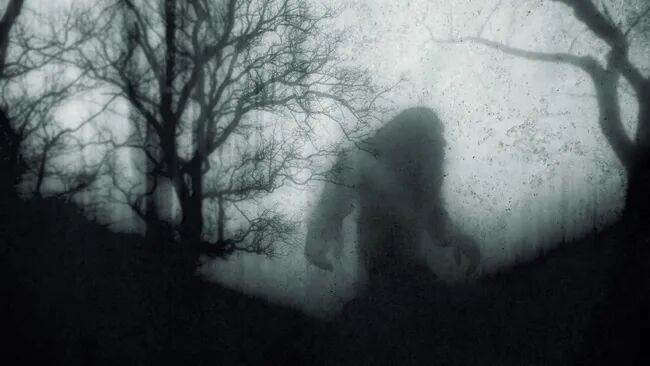
© David Wall via Getty Images
A former lawman has spent the last 17 years searching for the best evidence related to Bigfoot. He has come up with a theory that won't make anyone comfortable.
In the universe of so-called fringe science subjects, the different factions researching, say, poltergeists, UFOs, or Bigfoot and other mystery creatures don't get along all that well. They tend to regard the other subjects as a little crazy and want nothing to do with them. Former cop Dave Paulides spent nearly three years working on a documentary film that seems to link those topics together.
"Bigfoot" is the nickname that caught on. Sasquatch is just one of the names given to the legendary beasts by Native American nations.
"I think I have 100 different names from different tribes and First Nations groups about what they call hairy man, Bigfoot, (other names not transcribed correctly)," Paulides told 8 News Now Chief Investigator George Knapp.
It runs the gamut. The bottom line is, almost every tribe believes it's another tribe of people. They don't think it's an animal.
The small number of scientists who have investigated the legend, along with Bigfoot research groups, mostly believe the elusive creatures are an offshoot of a long-extinct ape-like species that somehow survived into the twenty-first century without being caught, captured, or confirmed.
Paulides, who spent 20 years in law enforcement, had no particular interest in Sasquatch until his employers coaxed him into applying his skills as a cop to the legend. He started his digging at the Hoopa reservation in Northern California. That tribe told him Sasquatch was real, and was considered to be another tribe of flesh and blood beings. Paulides brought in Harvey Pratt, a highly regarded FBI-trained forensic artist who interviewed Hoopa witnesses.
The sketches were stunning. The faces looked human.
"At the end of that first day, Harvey looked at me, and his wife is a special agent as well, and they both said, Dave, this isn't anything like we've always heard," Paulides said.
These don't look like apes and gorillas. And after every drawing, the witness would say, "that's exactly what they look like."
Before the name Bigfoot was popularized, newspapers most often referred to the beings as wild men or hairy men. Paulides found hundreds of old news articles: one from the UK which described a 7-foot-tall hairy man, others from 19th century Australia, Ireland in the 1800's, and the Reno Gazette Journal in 1882. Nevada's Virginia City Gazette in 1890 dubbed the creature as "king of the wilderness."
Sasquatch is most often associated with deep forests, but there have been sightings almost everywhere. One government witness saw a huge hairy creature zip across the road leading into the Nevada test site, home to hundreds of atomic detonations. It happened in 1980, confirmed in a news release from the test site.





[Link]