

© Graphic created by Google Gemini,The Daily Caller
Conservatives seemed enthusiastic to welcome Silicon Valley elites into the fold, including Elon Musk, namely because they promised to use their cutthroat management skills and startup expertise to trim the fat of the federal bureaucracy and make the government more efficient and cost-effective. It was a compelling argument: the federal government was, and still is, despite the efforts of DOGE, woefully sclerotic, incompetent, and wasteful.
I argue that this tradeoff might not be worth it in the long run; it might have actually been detrimental to the health of our republic and our constitutional rights. In the name of fighting wokeness and bloated government bureaucracy, MAGA opened up their arms to a vast, powerful network of elites. The short term deal was a reduction of waste; the long term outcome seems increasingly like mass surveillance, and government policy not by the people, but by ruthlessly efficient private contractors.
One company, in particular, seems to capture the toxicness of this implicit deal: Palantir.
Throughout 2025, the Trump administration has drastically expanded its work with Palantir, a tech behemoth co-founded by right-wing billionaire Peter Thiel in 2004. If you are unfamiliar with Palantir, a 2018 Bloomberg article breaks down the company and what they are capable of doing.
"The company's engineers and products don't do any spying themselves; they're more like a spy's brain, collecting and analyzing information that's fed in from the hands, eyes, nose, and ears. The software combs through disparate data sources — financial documents, airline reservations, cellphone records, social media postings — and searches for connections that human analysts might miss," Bloomberg reported.
Palantir's software then takes all that data and creates easy-on-the-eye graphics that could be extremely useful for government or military officials, for example, to get a picture of criminals, fraudsters, or enemy combatants. Numerous law enforcement agencies have already relied on Palantir, including the FBI and DHS. It was even used in the Department of Health and Human Services to detect instances of Medicare fraud.

© Odd Anderson / AFPAn activist of the group Campact! dressed as US President Donald Trump stands next to a wooden horse symbolising a Trojan Horse with the lettering "Palantir" in front of the Chancellery in Berlin where is taking place the German cabinet's weekly meeting on September 3, 2025. Activists protested against the German Interior Ministry's intention to pave the way for the nationwide use of the data mining Palantir software, that was developed by a company co-founded and chaired by Trump supporter Peter Thiel.
As Bloomberg reported, Palantir's software "frequently ensnar[es] in the digital dragnet people who aren't suspected of committing any crime." This net is so big that law enforcement agencies now have the power to "identify more than half the population of U.S. adults," according to the outlet.
It's no wonder that the Trump administration has heavily relied on Palantir. Since the beginning of 2025, the administration has rewarded Palantir with over $113 million in federal spending. Palantir has worked with the IRS to unify the agency's data, while also contracting with ICE to coordinate the administration's deportation blitz. In April, the administration contracted Palantir for $30 million to track illegal immigrants who were self-deporting from the country. And the following month, the Pentagon awarded Palantir with a whopping $795 million. Palantir also enjoys a very close partnership with Israel, which uses its technology in "war-related missions."
Even Trump has acknowledged their vast influence within our government, saying at an AI summit in July, "We buy a lot of things from Palantir. Are we paying our bills? I think so."
Palantir executives have also benefited from a revolving door between the company and the administration. Trump has hired Palantir's former head of intelligence and investigations, Gregory Barbaccia, as the federal chief information officer. The president nominated Jacob Helberg, a former Palantir senior adviser, who now serves in the State Department as the top economic and trade official. The revolving door worked in the other direction, of course, with Palantir hiring Machalagh Carr, the wife of Trump's FCC Chairman Brendan Carr, as head of global policy in February. Former Republican Rep. Mike Gallagher has worked as Palantir's head of defense business since 2024.
However, a much, much darker side to Palantir and its technology lurks beneath the surface. Writing in The Guardian in August, Juan Sebastian Pinto, a former Palantir employee, sounded the alarm about their "largely invisible" technology that is quietly influencing wars abroad in Gaza and Ukraine, while chipping away at our civil liberties here at home.
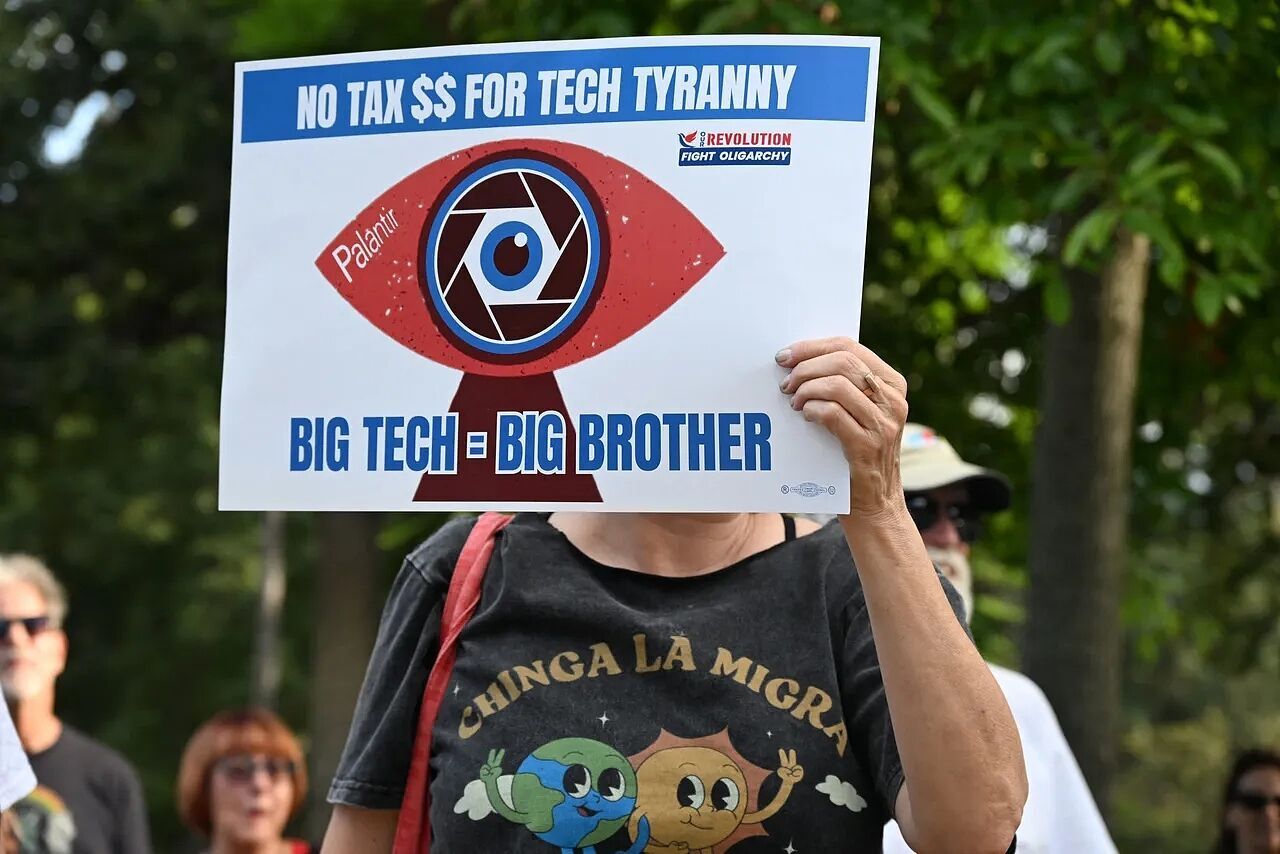
© Robyn Beck / AFPA person holds a sign featuring a graphic of an eye with the company name "Palantir" at a "People's Block Party" gathering organized as part of a national day of action on Labor Day to protest 'the billionaire takeover,' on September 1, 2025 in Elysian Park in Los Angeles, California. Rather than marching or demonstrating, the small group gathered to dance and listen to speakers, poetry and musical performances.
As Bloomberg outlined in its 2018 article about innocent civilians getting swept up in law enforcement or military operations, Pinto writes that these "'AI kill chains' pull us all into a web of invisible tracking mechanisms."
"They appear to violate first and fourth amendment rights: first, by establishing vast and invisible surveillance networks that limit the things people feel comfortable sharing in public, including whom they meet or where they travel; and second, by enabling warrantless searches and seizures of people's data without their knowledge or consent," Pinto argues.
And he's right. Palantir's surveillance technology mirrors the National Security Administration's massive, warrantless, illegal surveillance program that violated citizens' constitutional rights by knowingly collecting private cell phone data.
But there is already a growing sense of hubris among Silicon Valley elites, particularly Palantir's CEO, Alex Karp, because they successfully lobbied the president and gained access to the administration. They seem to think they are immune to criticism, and because they are brilliant engineers and scientists, they should not be shackled by ordinary restraints and regulations - not even by the Constitution itself.
In a recent interview with Wired, Karp complained about pushback from the "woke right," presumably due to his company's ties to Israel. In reality, though, the pushback goes far beyond Israel.
"Our competition is political," he told the outlet. "The woke left and the woke right wake up every day, figuring out how they can hurt Palantir. If they get into power, they'll hurt Palantir ... Or the right woke wing, which is like, everything is a conspiracy, any use of technology is actually going to only be used to eviscerate and attack us? Palantir is literally the hardest software to abuse in the world, but they don't seem to want it. If you don't want meritocracy, you hate Palantir. That is our competition."

© Kevin Dietsch/Getty ImagesAPRIL 30: Alex Karp (R), CEO of Palantir Technologies, speaks on a panel with Jacob Helberg, Co-Founder, Hill & Valley Forum, titled Power, Purpose, and the New American Century at the Hill and Valley Forum at the U.S. Capitol on April 30, 2025 in Washington, DC. The Hill and Valley Forum brings together lawmakers, tech CEO and venture capitalists for discussion on technology and national security.
So, according to tech elites like Karp and Andreessen, we as Americans shouldn't be concerned by a giant surveillance program that threatens our constitutional rights? We shouldn't be alarmed that AI technology might not be all that it's cracked up to be, that it may be a bubble, and that data centers may end up dotting our landscape, unpowered and abandoned? That makes us "woke"?
In a separate State of the Day piece, I took a look at how corporations that privately funded Trump's inaugural funds and East Wing ballroom project were essentially engaging in a pay-to-play scheme. For a $1,000,000 donation - what amounts to a pledge of allegiance - a Big Tech company like Meta or Google could see a federal investigation disappear or a landmark antitrust case be ruled in their favor. In these cases, no direct evidence of a quid pro quo exists; but nevertheless, this development has serious political and ethical implications. Even the fact that the ballroom funds were raised privately, not publicly, allowed the administration to dodge authorization from Congress and a public debate on whether Americans actually want a gilded ballroom in their White House. If it's not publicly funded, the public has no say.
And if Congress continues to abdicate its responsibilities - namely, the power of the purse and its constitutional authority to declare war and levy tariffs - to the executive branch, what will stop the corporate actor from simply buying off the president? Apple, for example, was able to secure a tariff carveout thanks to its relationship with Trump. Shouldn't the American people have a say about which companies should be given carveouts? Shouldn't this issue of tariffs be debated in Congress, in full transparency?
All of this ties in to Palantir's influence. America's government is being contracted out to private corporations like Palantir, piece by piece, by the executive branch and its various agencies. In doing so, the American people are no longer participants in government. We are mere passive observers, watching a new elite accumulate more and more power, without any rigorous oversight or accountability to the public.
If a future president's agenda gets hamstrung by our constitutional checks and balances, what will stop him or her from simply raising a privately-funded army, for example, or launching a privately-funded surveillance program to spy on political enemies? These presidents will not answer to the people; they will only answer to those elites who cut the check.
MAGA and the Trump administration's embrace of Big Tech and contractors has unfortunately accelerated this dangerous trend. It is not too late to stop it, though. Yet, it is also not tremendously difficult to imagine a future in which Congress is utterly neutered and its responsibilities fully outsourced to private companies that supersede the authority of the Constitution simply because they can.
This article was adapted from the Daily Caller's new Substack, State of the Day.












At the same time, in my view, Trump is pragmatic. The globalist power structure has used technology for money laundering, surveillance of political influencers and governments, election fraud, censorship, and was moving toward implementing the human body as part of the "internet of things", smart cities, and perhaps even kill chips. How do you combat that use of technology? Laws? Regulations? Committees? Ban its use? This could be the new cold war, because you have to consider other governments and technology corporations.
The DOGE use of the technology allowed for the dismantling of USAID and the identification of extensive fraud in the Social Security and Medicaid systems. Technology can be used for good, and at the same time it needs to have checks and balances to prevent it from eliminating or enslaving humanity.