
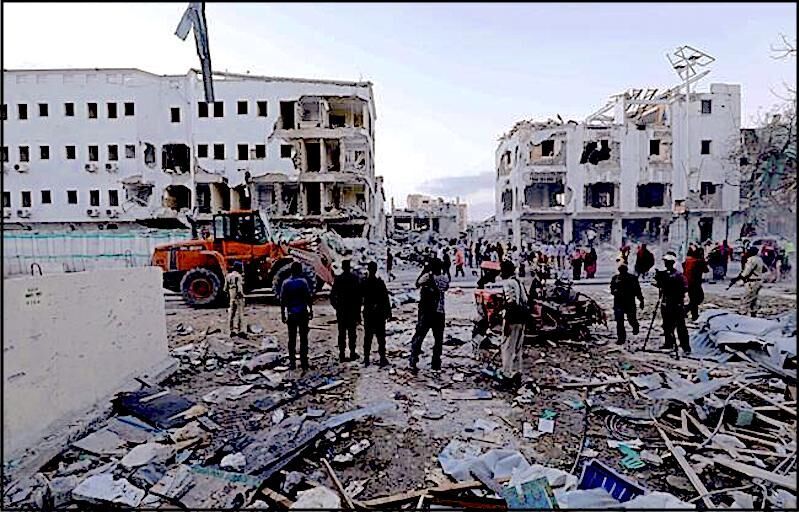
© Reuters/NY TimesPrior US strike aftermath
AFRICOM said that the strikes targeted the ISIS affiliate in Somalia's northeastern Puntland region, to the southeast of the port city of Bossaso. The command offered no further details, as it has stopped sharing estimates of casualties or assessments of potential civilian harm.
AFRICOM confirmed to Antiwar.com in an email that the latest attack marked the 51st US airstrike in Somalia of the year, putting the Trump administration on track to easily break the annual record, which President Trump set at 63 in 2019. Antiwar.com is also seeking details on casualties from AFRICOM, but so far hasn't received a figure.
The US has been backing local Puntland forces against ISIS in battles in the Cal Miskaad mountains in Puntland's Bari region. Puntland Counter-Terrorism Operations announced on Sunday — the day the US launched two airstrikes — that it was conducting a "clearance operation" against ISIS remnants in the mountains and said the area being targeted was "last used by terrorists as a hideout with their foreign women and children."
Puntland's forces announced a new military operation on June 30 against ISIS-affiliated militants, and since then, the US has launched at least four airstrikes in the area. The ISIS affiliate in Somalia started in 2015 as an offshoot of al-Shabaab, a group the US has also been bombing in southern and central Somalia.
In the war against al-Shabaab, the US is backing the Mogadishu-based Federal Government, which controls little territory inside Somalia's internationally recognized borders. Somali media reported on Tuesday that government forces killed 15 al-Shabaab fighters in the central Hiraan region, an operation that was supported by "international partners," likely a reference to US AFRICOM.
Al-Shabaab has been making significant gains against the government and reportedly captured a town in the Hiraan region on Monday. Fighting has also been ongoing in the southern Jubaland region, where the US carried out multiple airstrikes from June 27 to June 30 to support a battle that the government claimed killed 50 al-Shabaab fighters.
Al-Shabaab's offensive has been successful enough that US officials recently discussed the possibility of Mogadishu falling to the militant group.
The New York Times reported on April 10 that State Department officials suggested closing down the US embassy in Mogadishu and evacuating most US personnel due to the threat. But other officials, including Sebastian Gorka, the top counterterrorism official on the National Security Council, called for the US to escalate in Somalia and double down on its policy of propping up the government, and they appear to have won the internal debate.
Hawks who favor continued intervention in Somalia portray al-Shabaab as a major threat to the US due to its size and al-Qaeda affiliation, but it's widely believed the group does not have ambitions outside of Somalia.
Al-Shabaab was born out of a US-backed Ethiopian invasion in 2006 that toppled the Islamic Courts Union, a coalition of Muslim groups that briefly held power in Mogadishu after ousting CIA-backed warlords. Al-Shabaab was the radical offshoot of the Islamic Courts Union. The group's first recorded attack was in 2007, and it wasn't until 2012 that al-Shabaab pledged loyalty to al-Qaeda.





ChatGPT: "1. Overall Strategy in Somalia under Obama The Obama administration viewed Somalia as a key front in the global war on terror , particularly against al-Qaeda affiliates . Somalia was part of a broader shift toward: Light-footprint warfare Drone strikes and special forces raids Working "by, with, and through" local forces and regional partners (e.g., African Union Mission in Somalia— AMISOM ) The approach focused on minimizing U.S. troop presence while leveraging airpower, intelligence, and proxies ."
"3. Diplomatic and Policy Shifts In 2013 , the Obama administration formally recognized the Somali government for the first time since 1991, legitimizing deeper military cooperation. In 2016 , Obama quietly approved a broader legal authority to conduct airstrikes in Somalia under Title 10 (conventional military authority), not just covert CIA missions."
"4. Justification and Framing The Obama administration justified military action in Somalia under the 2001 Authorization for Use of Military Force (AUMF) , citing al-Shabaab's ties to al-Qaeda. Publicly, Obama emphasized precision warfare and the avoidance of large-scale occupations , calling drone strikes a “just war” of self-defense."
" President Obama’s Somalia policy was part of his broader counterterrorism doctrine: low-visibility, high-tech, and reliant on drones, proxies, and special forces. Under his leadership: ✅ Drone strikes began and escalated
✅ al-Shabaab leadership was significantly degraded
✅ U.S. advisers embedded with Somali forces
✅ Somalia became more central in U.S. counterterrorism strategy"
It does not look like policies have changed under Trump. Does that mean these operations are run from the military or CIA? What was the intent of Obama's Somalia policy?