
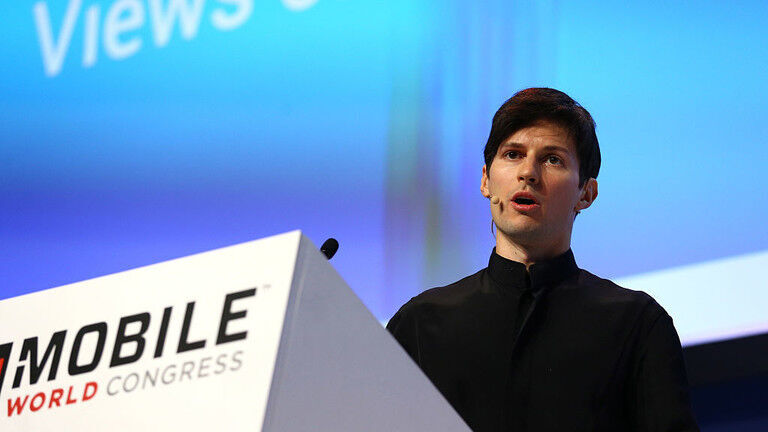
© Getty Images / Getty ImagesTelegram CEO Pavel Durov at the Mobile World Congress in Barcelona, Spain, February 23, 2016.
The arrest of Telegram founder Pavel Durov, when he had decided to take a little trip to Paris, has caused a stir in various spheres - from the business and tech world to media and politics. We will focus on the latter, especially as the incident is becoming another milestone in a wider political reorganization.
Durov comes from a niche that claims transnational status above all else. Information and communication technologies seem to have turned the world into a common space and abolished sovereign jurisdiction. The enormous influence that the IT giants have acquired has been converted into gigantic amounts of money, which has in turn increased their influence further. Transnational corporations have always existed - in areas such as mining, engineering, and finance. But despite their international character, they were still tied to particular states and their interests. The global communications industry, and its associated innovation sector, has dared to break that link.
The period of globalization that lasted from the late 1980s to the late 2010s favored this sort of attitude. It encouraged the creation of a level playing field on which the most developed countries had a clear advantage. They benefited the most. The costs associated with the techno-giants' growing ability to manipulate societies - including their own in the West - were not seen as critical.
The crisis of liberal globalization has led to a change in the international reality (you could also invert that statement and say the reverse without changing the essence). Thus, the willingness to play by common rules has rapidly and universally diminished. What is fundamental is that this applies even where these laws were originally written, in the leading states of the Western community.
The previous era has not disappeared without a trace. The world has become fiercely competitive, but it remains closely interconnected.
Two things hold it together. The first is trade and production, the logistical chains for which were created during the globalization boom and have qualitatively transformed the economy. They are extremely painful to break. And the second is a unified information field, thanks to 'nationally neutral' communications giants.
But there is something strange that separates us. It is not a desire to grab more of the pie - in the sense of what Lenin called the expansionist "imperialist predators" - but rather a sense of internal vulnerability that is growing in various states.
Paradoxically, this is more of a factor in the bigger and more important countries, because these are the powers that are involved in the biggest game. This explains their impulse to minimize any factor that might affect internal stability. First and foremost, this pertains to the channels that serve as conduits for influence (read: manipulation), either from outside or from certain internal forces.
Structures that operate transnationally - understandably - immediately look suspect. The view is that they should be 'nationalized', not through ownership but in terms of demonstrating loyalty to a particular state. This is a very serious shift, and in the foreseeable future this process could dramatically weaken the second pillar of the current global interconnectedness.
Durov, a committed cosmopolitan liberal, is a typical representative of the 'global society'. He has had tensions with all the countries he has worked in, starting with his homeland and continuing throughout his more recent travels. Of course, as a big businessman in a sensitive industry, he has been in dialectical interaction with the governments and intelligence services of different countries, which has required maneuvering and compromise. But the attitude of avoiding any national entrenchment persisted. Having passports for all occasions seemed to widen his scope for action and increase his confidence. At least for as long as this very global society lived and breathed, calling itself the liberal world order. But it's now coming to an end. And this time the possession of French nationality, along with a number of other things, promises to exacerbate rather than alleviate the predicament of the accused.
The 'transnational' entities will increasingly be required to 'ground' themselves - to identify with a particular state. If they do not want to, they will be affixed to the ground by force, by being recognized as agents not of the global world but of specific hostile powers. This is what is happening now with Telegram, but it's not the first and it will not be the last such instance.
The struggle to subjugate the various actors in this sphere, thus fragmenting a previously unified field, is likely to be a key component of the next global political phase.
The tightening of control over everything to do with data will inevitably increase the degree of repression in the information sphere, especially since it is not easy in practice to block unwanted channels. But if relatively recently it seemed impossible to dig up the world's information superhighway and make it unusable for travel, this no longer seems so far-fetched.
The most interesting question is how the likely shrinking of the global information realm will affect trade and economic connectivity, the remaining pillar of world unity. Judging by the pace of change, there will soon be newsworthy developments there too.
This article was first published by Russia in Global Affairs, translated and edited by the RT team








Likelihood of Political Motivation:
From a neutral perspective, the likelihood of political motivation behind such an arrest could be considered moderate to high, given the following:
History of Conflicts:
Telegram’s history of refusing access to user data for many governments, combined with Durov’s reported selective cooperation, suggests there might be frustration and a desire to leverage political or legal means to gain compliance.
Precedents: There have been precedents where tech leaders and companies were targeted or pressured due to non-compliance with government requests (e.g., Apple’s standoff with the FBI over iPhone encryption).Current Geopolitical Climate: In the current climate, where actions perceived as aligning with adversarial states can draw significant scrutiny and action, the motivations could very well be politically charged.
Moral and Liberty Implications
Freedom of Speech: Telegram is known for its stance on privacy and free speech. Arresting its founder over user actions could be seen as a threat to these principles. It raises concerns about whether platforms can maintain a neutral stance on content moderation without facing legal repercussions.
Privacy vs. Security Debate: This situation brings back the debate between privacy and security. Telegram's encrypted nature is designed to protect user privacy, but this also makes it challenging to monitor illegal activities. Arresting Durov might suggest a preference for security over privacy, potentially undermining the principle that individuals have the right to private communication.
Chilling Effect on Innovation: If platform owners are held liable for user actions, this could stifle innovation. Entrepreneurs might become wary of creating new platforms or tools that could be misused, fearing legal consequences. This could ultimately harm the tech industry and limit new services or features that could benefit society.
Implications for Digital Rights: The arrest could have broader implications for digital rights, suggesting that governments are willing to intervene more forcefully in digital spaces. It could lead to increased surveillance, less privacy, and more governmental control over online communication tools.