
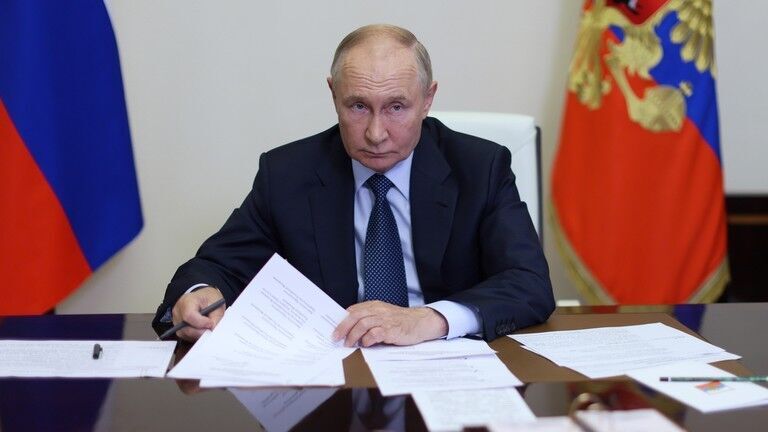
© Sputnik/Gavriil GrigorovRussian President Vladimir Putin chairs a meeting with members of the government via videoconference at the Novo-Ogaryovo state residence, outside Moscow, Russia.
Ukrainian forces have attempted to strike the Kursk Nuclear Power Plant (NPP) in Russia, President Vladimir Putin has said during a cabinet meeting.
Kiev sent thousands of troops into Russia's Kursk Region earlier this month, attempting to reach the town of Kurchatov, where the nuclear facility is located. Moscow has declared the incursion an act of terrorism and has deployed additional troops to repel the invaders.
"Last night, the enemy attempted to strike the atomic power plant," Putin said at a cabinet meeting on Thursday afternoon. "The International Atomic Energy Agency [IAEA] has been informed. They promised to come themselves and send specialists to assess the situation. I hope they actually do so."
The IAEA already has observers working at the Zaporozhye NPP, Europe's largest such facility. The mission was deployed in the summer of 2023, as Ukrainian troops attempted to seize the plant. Earlier this month, a Ukrainian drone attack set one of the cooling towers at the plant on fire.
Rosatom CEO Alexey Likhachev has discussed the situation at both power plants with IAEA director Rafael Grossi, and invited him to visit Kursk to personally assess the situation, according to the Russian media.
Grossi has accepted the invitation and is planning to visit Kursk next week, an IAEA spokesman told AFP. Afterwards, he will visit Kiev and speak with Ukrainian leader Vladimir Zelensky.
According to Grossi, the IAEA is very concerned about any combat operations near Kursk NPP, since it operates the same kind of reactors as the infamous Chernobyl NPP.
"They don't have a protective dome around them, just the normal roof, which means that the reactor's core is pretty exposed," Grossi said. The presence of troops within artillery range "is a source of enormous concern to me and the agency," he added, without specifying which forces he meant.
Moscow has repeatedly criticized the international agency for never identifying the perpetrator of the attacks on nuclear facilities, even though the IAEA staff has known perfectly well that Kiev is to blame.




Comment:
In another article from today, Nord Stream was 'legitimate target' for Ukraine - EU country's president there was from the Czech President, Petr Pavel, former General and Chair of the NATO Military Committee (2015-2018): In the above case, it is safe to say that the sabotage increased energy prices which affected both EU citizens and businesses. If that is so, civilian concerns do not seem to be a major concern at the moment. Therefore, if what was unthinkable a few years ago now is okay, why should a nuclear power plant, a bridge, a tunnel, a communication cable, be any less if a potential target than a pipeline? See also this article: West could be helping Ukraine with 'dirty nuke' - ex-MEP But will one of the results eventually be: Ukrainians will soon realize the West 'used them' - Lukashenko