
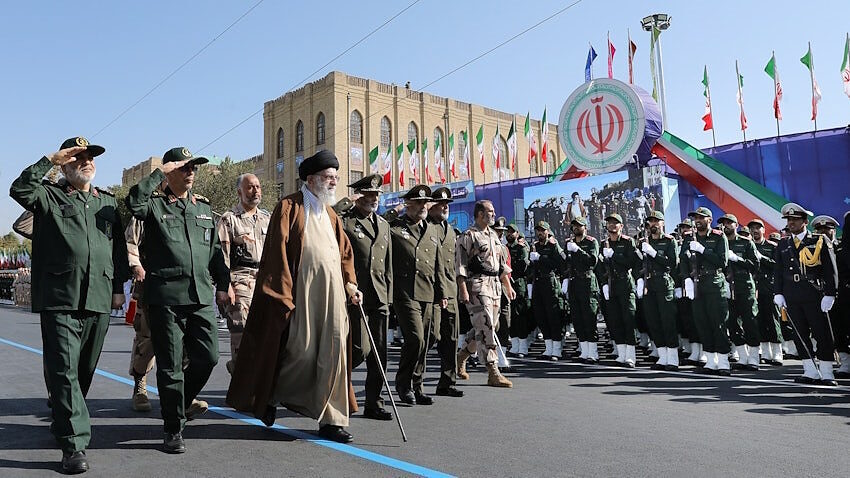
© Iran's supreme leader's websiteIran's Supreme Leader Ayatollah Khamenei at a graduation ceremony for armed forces officers at the Imam Ali academy in Tehran, Iran on Oct. 10, 2023.
Speaking on condition of anonymity, a high-ranking Iranian source told Amwaj.media that Khamenei's remarks — his first since the Hamas offensive — may have been sparked by "him seeing the direction of the Israeli public diplomacy campaign." Rejecting concerns of an impending Israeli attack as Khamenei's underlying motive, the source said the supreme leader's comments are "pre-emptive" as opposed to reactive.
Addressing the rare decision by Khamenei to be so vocal in his rejection of an Iranian role in the Palestinian blitz, a second senior source in Tehran told Amwaj.media, "Give me one reason why he should do otherwise." Also speaking anonymously given the sensitivity of the matter, he continued, "Why should one give them the perfect justification they need for an attack?" At the same time, the source dismissed the notion that being so explicit in rejecting a role in the Hamas attack indicates a sense of weakness on the part of Iran.
Meanwhile, on the diplomatic front, Iran has joined Iraq in calling for an emergency session of the Organisation of Islamic Cooperation (OIC) to address the Israel-Hamas war. This comes as Tehran has also warned of a "destructive response" to any move against it.
The coverage: Iran's supreme leader attended a graduation ceremony for cadets in Tehran on Oct. 10, flanked by top military commanders.
- Khamenei strongly emphasized that Iran was not involved in the Oct. 7 blitz on Israeli communities near Gaza by the Hamas movement. He said that some "present Islamic Iran as behind this move, but they are wrong."
- Khamenei continued, "Of course, we defend Palestine and its struggle...but those who say the work of Palestinians stems from non-Palestinians don't know the Palestinian nation and underestimate it...this is where their error lies and where they miscalculate."
- While underscoring that "all of the Muslim world is dutybound to support Palestine, and with God's will, it will support them....this action [Oct. 7 attack] is the work of the Palestinians themselves."
- Khamenei blamed Israel for the Hamas-led operation, arguing that the "Zionists brought this misery on themselves."
Meanwhile, in a rare instance of agreement among Iran, Israel and the US, senior American and Israeli officials also say there are no indications that Iran was involved in the Hamas offensive.
- US Secretary of State Antony Blinken on Oct. 9 said, "In this specific instance, we have not yet seen evidence that Iran directed or was behind this particular attack, but there's certainly a long relationship."
- Israel Defense Forces (IDF) spokesperson Brig. Gen. Danny Hagari on Oct. 9 also reportedly said that there is no indication of Iranian involvement in the war in Gaza.
- Republican US Senator Lindsay Graham on Oct. 8 also accused Iran of orchestrating the Hamas blitz, urging the White House to prevent Hezbollah from joining the conflict. Referring to Khamenei as a "religious Nazi," Graham warned, "If this war escalates, it's coming to Iran."
Comment: Graham has never met a war or potential war he didn't like. Scum.
Iranian Foreign Ministry spokesman Nasser Kanani on Oct. 9 warned that any "stupid" move against Iran would result in a "destructive response."
- "Whoever threatens Iran should know that any stupid move against Iran will lead to a destructive response," Kanani told reporters during his weekly press briefing.
- The Iranian official emphasized that the Palestinians "have a right" to attack "a regime that has violated" their rights for decades.
- Kanani reiterated Tehran's call on Muslim nations to "make more efforts" and use their political weight to support the Palestinians.
- Iran's chief diplomat described Hamas's Operation Al-Aqsa Flood as a "spontaneous" move and insisted that it was a "legitimate response" to years of Israeli "crimes."
- In a separate conversation with his Omani counterpart Sayyid Badr Albusaidi on Oct. 9, Amir-Abdollahian proposed an "emergency meeting of the foreign ministers of Islamic countries."
The context/analysis: Iran has been open about its support for Palestinian groups fighting Israel, including supplying weapons. However, in the aftermath of the recent Hamas offensive, top Iranian officials have insisted that the Gaza-based movement acted independently. The apparent effort to distance the Islamic Republic from the Palestinian offensive may be geared to lower tensions.
- As Amwaj.media previously reported, Iran's Mission to the United Nations on Oct. 9 strongly dismissed any Quds Force involvement in decision making on the Hamas offensive.
- While hailing the Hamas offensive as a "decisive operation" and "a real example of legitimate defense against a criminal regime," Ali Shamkhani — a political advisor to Iran's supreme leader who served as national security advisor until May — on Oct. 8 also notably described the "Palestinian resistance" as an "independent movement."
- The Iranian denials notably follow a report in the Wall Street Journal which alleged that Iranian "security officials" helped plan the Hamas blitz and "gave the green light" at an Oct. 2 session in Beirut with Hamas, Hezbollah, and Palestinian Islamic Jihad (PIJ). Of note, the report also claimed that Iran's foreign minister "attended at least two of the meetings."
- Observers have suggested that the Hamas offensive could strongly impact normalization efforts, if not entirely torpedo the Israeli-Saudi initiative.
- As recently as Oct. 3, Khamenei warned Arab leaders against normalizing relations with Israel, which he described as "betting on a losing horse."
- Mohammad Baqeri, the chief of staff of the Iranian Armed Forces, wrote in a message on Oct. 8 that the Hamas operation had "proved" that "desperate attempts" such as normalizing relations with Arab states "cannot delay or slow down" Israel's "decline and collapse."
The future: Retaliatory military action against Iran over the Hamas offensive does not appear probable. However, a wider regional conflagration may be triggered by a direct conflict between Hezbollah and Israel.
- An Israeli attack on Hezbollah could trigger a multi-front armed conflict possibly involving other regional allies of Iran.
- In the absence of military action against Iran, Israel's western allies may resort to further sanctions against Tehran over its support for Palestinian groups.
- To put pressure on the Islamic Republic, Israel may step up covert operations targeting sensitive military and nuclear facilities inside Iran. Further down the escalatory cycle, Tel Aviv may also target Iranian military commanders in third countries.



Reader Comments
to our Newsletter