
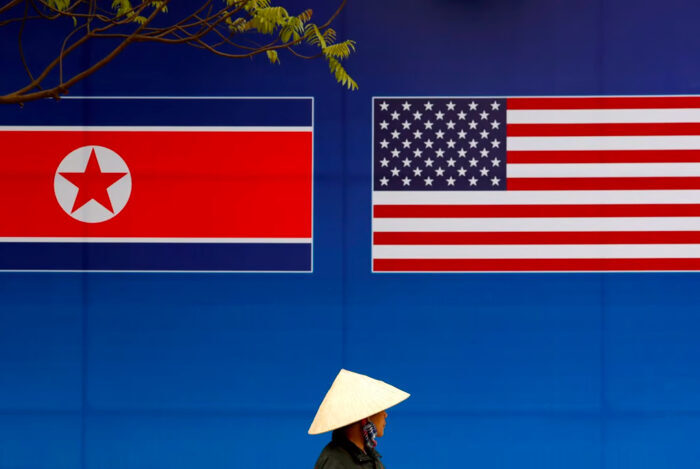
© ReutersHanoi, North Korea • 2019
Provocative military actions by the US were bringing the Korean peninsula closer to a nuclear conflict, said an unnamed spokesman of North Korea's Ministry of National Defence in a statement carried by the official KCNA news agency.
The report also cited the use of US reconnaissance planes and drones and said Washington was escalating tensions by sending a nuclear submarine near the peninsula.
"There is no guarantee that such a shocking accident as the downing of a US Air Force strategic reconnaissance plane will not happen" in waters east of Korea, the spokesman said.
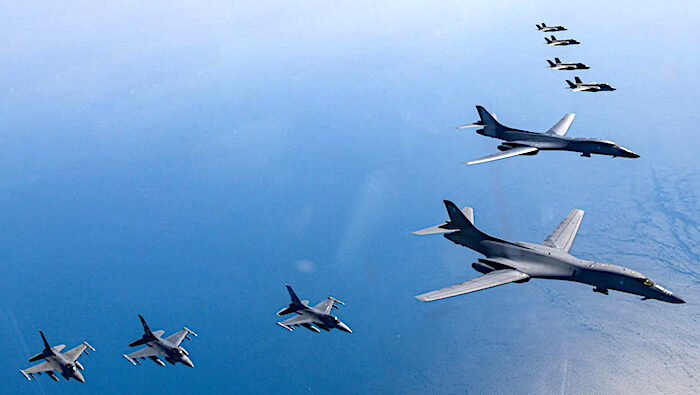
© South Korean Defence Ministry/ReutersUSAF B-1B bombers, F-16 fighter jets and S. Korean Air Force F-35A jets
Joint drill above the Korean Peninsula in March
Joint drill above the Korean Peninsula in March
The statement cited past incidents of the North shooting down or intercepting US aircraft at the border with South Korea and off the coast. North Korea has often complained about US surveillance flights near the peninsula.
There was no immediate response from the US military stationed in South Korea to a request for comment.
The moves by the United States to introduce strategic nuclear assets to the Korean peninsula is "the most undisguised nuclear blackmail" against North Korea and regional countries and presents a grave threat to peace, KCNA said.
"Whether the extreme situation, desired by nobody, is created or not on the Korean peninsula depends on the future action of the US, and if any sudden situation happens ... the US will be held totally accountable for it."US and South Korean forces have been conducting air and navy drills this year that involved a US aircraft carrier and heavy bombers. A US nuclear-powered cruise missile submarine also made a port call at Busan in South Korea last month.
The North's statement denounced what it called a US move to deploy a strategic nuclear submarine carrying nuclear warheads to the Korean peninsula for the first time since 1981.
In April, the leaders of South Korea and the United States agreed a US Navy nuclear-armed ballistic missile submarine will visit South Korea for the first time since the 1980s but no timetable has been given for such a visit.
It was part of a plan to boost the deployment of American strategic assets aimed at a more effective response to North Korea's threats and weapons tests in defence of its ally South Korea.
In June, a US B-52 strategic bomber took part in air military drills with South Korea in a show of force following North Korea's failed launch of a spy satellite at the end of May. South Korean President Yoon Suk-yeol said it was time to show "the international community's determination to deter North Korea's nuclear weapons programme is stronger than North Korea's desire to develop nuclear weapons," in written comments published on Monday.
Yoon is scheduled to attend the Nato summit in Lithuania this week where he is expected to seek greater cooperation with Nato members over North Korea's nuclear and missile threats, his office has said.
North Korea has fired off more than 90 ballistic missiles over the past 18 months as leader Kim Jong-un rolls out new weapons capable of delivering a nuclear attack on the US mainland and America's key allies in the region, South Korea and Japan.






Because they’re all broken?