
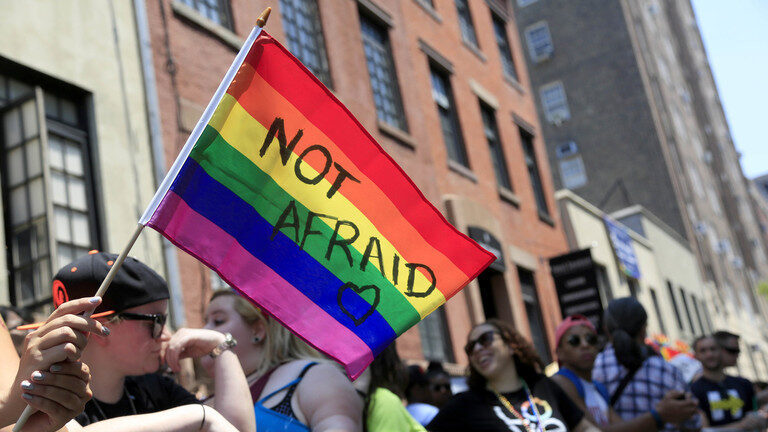
© AP / Seth WenigFILE PHOTO: A woman holds a rainbow flag during the NYC Pride Parade in New York City, June 26, 2016
The Centers for Disease Control and Prevention's annual report of 17,232 students found that in 2021, about three-quarters of teens between the ages of 14 and 18 claimed to be attracted only to the opposite sex.
Of the remaining respondents, nearly 12% considered themselves bisexual, just over 3% were either gay or lesbian and 9% marked "other" — which could include those who identify as pansexual or asexual or have "questioned" their sexuality.
The latest figures marked a record number of youngsters who do not identify as straight — approximately 1 in 4 students.
The number of LGBTQ people continues to rise every year. A Gallup poll released in February showed that 7.2% of adult Americans are "something other than heterosexual," the highest concentration of which belonged to Gen Z.
Comment: The rise of the non-hetero tracks a similar rise in mental health issues. Coincidence?
But the uptick in queer youth may not mean that fewer people are heterosexual — rather, it indicates that more people are comfortable with being openly honest about their sexual orientation and identities. This seems to be especially true among the younger generation, who are chronically online.
Comment: A favorite pet theory of the LMNOP+ crowd is that everyone is actually secretly gay or bisexual. They just aren't willing to accept or admit to it anyone, themselves most of all. It doesn't match up to reality, but that's where the ideology leads and so that's what must be true.
"Social media has added to this visibility that there are options that were not previously available," Ritch Savin-Williams, a developmental psychology professor at Cornell, previously told The Post. "In a positive sense, it sort of says, 'Hey, look, you don't have to fit into these boxes.'"
Comment: There were other ways to exist outside of a stereotypical male or female role that existed long before the advent of social media. Those ways were arguably much healthier than what exists today because they involved accepting the reality of one's body instead of mutilating it to fit one's ineffable and ever-changing "feelings".
Despite arguments that being queer is a passing fad, Savin-Williams noted that it's "not that the absolute number of people" who identify as non-heterosexual has grown, it's that more people are willing to express and "declare" it.
Comment: Savin-Williams doesn't know this and he knows it. But it's okay that he's lying because it's for the greater good of making the medicine of "tolerance" go down easier.
Yet, the trend toward tolerance could be dashed away in places like Florida, where the "Don't Say Gay" bill is expanding thanks to state legislators, while concerned parents and activists argue that it makes queer youth feel less welcomed.
In its Youth Risk Behavior Surveillance System, the CDC urged schools to create a "more inclusive" environment for queer teens, recommending initiatives such as gender and sexuality alliances, curating safe spaces and enforcing anti-harassment policies.
The agency also found that nearly 70% of LGBTQ students "experienced persistent feelings of sadness or hopelessness" and more than half endured poor mental health.
LGBTQ students were more likely to experience sadness and hopelessness, poor mental health, substance abuse, sexual violence, bullying and suicidal thoughts or behaviors.
When compared to past years, many of the categories trended upward in the wrong direction.
Comment: Well, ain't that interesting!
"As in previous reports, we continue to see disparities [in mental health between] students who identify as lesbian, gay, bisexual, questioning or another non-heterosexual identity, or who have had any same-sex sexual partners, [and] their peers," the CDC report says.

















Comment: More from RT: