
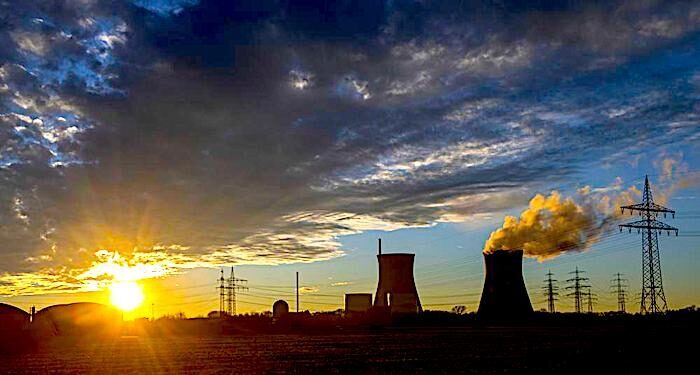
© Stefan Puchner/dpa via APNuclear plant in Gundremmingen, Bavaria, Germany to be shut down.
The decision to phase out nuclear power and shift from fossil fuels to renewable energy was first taken by the center-left government of Gerhard Schroeder in 2002. His successor, Angela Merkel, reversed her decision to extend the lifetime of Germany's nuclear plants in the wake of the 2011 Fukushima disaster in Japan and set 2022 as the final deadline for shutting them down.
The three reactors now being shuttered were first powered up in the mid-1980s. Together they provided electricity to millions of German households for almost four decades.
One of the plants — Brokdorf, located 40 kilometers (25 miles) northwest of Hamburg on the Elbe River — became a particular focus of anti-nuclear protests that were fueled by the 1986 Chernobyl catastrophe in the Soviet Union. The other two plants are Grohnde, 40 kilometers south of Hannover, and Gundremmingen, 80 kilometers (50 miles) west of Munich.
Some in Germany have called for the decision on ending the use of nuclear power to be reconsidered because the power plants already in operation produce relatively little carbon dioxide. Advocates of atomic energy argue that it can help Germany meet its climate targets for reducing greenhouse gas emissions. But the German government said this week that decommissioning all nuclear plants next year and then phasing out the use of coal by 2030 won't affect the country's energy security or its goal of making Europe's biggest economy "climate neutral" by 2045.
Renewable energy sources delivered almost 46% of the electricity generated in Germany in 2021. Coal accounted for more than 51%, while nuclear power provided over 13%, according to the Fraunhofer Institute. Economy and Climate Minister Robert Habeck said:
"By massively increasing renewable energy and accelerating the expansion of the electricity grid we can show that this is possible in Germany."Several of Germany's neighbors have already ended nuclear power or announced plans to do so, but others are sticking with the technology. This has prompted concerns of a nuclear rift in Europe, with France planning to build new reactors and Germany opting for natural gas as a "bridge" until enough renewable power is available, and both sides arguing their preferred source of energy be classed as sustainable.
Germany's remaining three nuclear plants — Emsland, Isar and Neckarwestheim — will be powered down by the end of 2022. While some jobs will be lost, utility company RWE said more than two-thirds of the 600 workers at its Gundremmingen nuclear power station will continue to be involved in post-shutdown operations through to the 2030s. Germany's nuclear power companies will receive almost $3 billion for the early shutdown of their plants.
Environment Minister Steffi Lemke has dismissed suggestions that a new generation of nuclear power plants might prompt Germany to change course yet again. "Nuclear power plants remain high-risk facilities that produce highly radioactive atomic waste," she told the Funke media group this week. A final decision has yet to be taken about where to store the most potent nuclear waste produced in German power plants. Experts say some material will remain dangerously radioactive for 35,000 generations.



Reader Comments
Like a climate or infrastructural disaster that would endanger hundreds af square miles if this power plant were still operative.
And don't forget the deagel.com forecast for 2025, which predicted a population of about 20 million (out of 83 million !) for Germany.
A full NATO exercise happened in the ninteys, to check the nuclear chemical and biological responses simultaneously. The UK’s operation was run from Swindon. The only European country to pass the nuclear test, in achieving shutdown, was Ireland, and only because Ireland has no nuclear power plants to shut down.
With the incoming binary twin due soon, I wonder what sort of mess will ensue as a consequence of failing to take appropriate action beforehand. Perhaps this is what Germany is actually preparing for.
An observation: Trawsfynydd lost a lot of nucleides in a carbon dioxide coolant leak in February 1986. This is mapped showing the contamination only up to a certain contour height, yet blamed on Priyapat’s Chernobyl plant, only two months later. The initial nuclides which landed in Mid Wales, have never been declared. Chernobyl was detonated by driving the graphite rods into a hot mix of Pu 238 & 239. It looks like Chernobyl was done to intentionally cover up the leak at Trawsfyndd.
It doesn’t surprise me that France ( Rothschild), is not intending a shut down.
My wife, being born less than 200 miles away (fortunately in the "right" direction) told me stories about the aftermath, as the general population experienced it. But I'm pretty sure it was so, or to that effect. Deliberate sabotage.
I understand that the whole scenario which I have described above can be perceived as extremely far fetched. However, I live in a valley in Mid Wales, where I am reading plutonium decay on rocks all around this valley. Before he died, I was in contact with a man employed by the MAFF to monitor the initial hot fall out, and not the layer wind dispersions. This area is so hot that if your hands go into Lyn Gynon for half an hour, your hand tingle for three days afterwards. It has never been officially declared, which it should have been. Forests contaminated with plutonium are sent to power stations to be burnt as wick in South Wales, and livestock sent to market for human consumption.
Trawsfyndd leaked in excess of ten tonnes of Co2, and it was blown inland to the east. As Co2 is heavier than air, and accounts for the contamination map of N.Wales. Initially the MAFF went to all farms in North Wales, scanning the sheep for contamination, and this was before the Chernobyl disaster. Low lying farms were found to be contaminated. The Welsh farmers are fully aware that not only did the contamination come from Trawsfyndd, but also that the official story that it came from Priyapat, is a complete lie. This is also proved by radio nuclide identifiers ( Riid’s), used privately in the aftermath.
Perhaps you may not like to know that Ukraine’s top government scientist and his assistant were called to the site immediately. Within hours both were dead, one by shotgun and the other by induced heart attack in front of a television that he had never used. The death of Russia’s scientist a few years afterwards is also telling of the need at a high level to ensure deniability.
Remember now some recent history for a supranational perspective of who possesses Nations. Rothschilds did the French Revolution, the Crimea War, the South African Wars, the First World War, the Russian Revolution, the Second World War, the Chinese Cultural Revolution, the Korean War, Vietnam. Afghanistan, Iran, etc. As the hidden head of the British and Russian States, setting Chernobyl off would have required a mere snip of a Rothschild finger to the relevant functionaries, to do his bidding.
But I know there are plenty of them, in almost every location. I read about it some years ago, but forgot most of the details, though. Again, not doubting it for a second - I know the official story is BS. Notwithstanding the fact that every official story is BS.
I got into researching nuclear history about two decades ago, after reading books from non-mainstream researches about the Nazi efforts to build nuclear devices (another area were the official story is total BS). Mainly because my region of origin had quite substantial Uranium and Thorium deposits, and played an important role in this game.
Key take-away is, most nuclear powerplants were build mainly for preparing and enriching weapons grade nuclear materials. The energy output was just a welcome side effect. As such, they were strategic military objects, not just powerplants. I know. International politics is but a stage play for the masses. I am only not sure how much of the involved actors are aware of that. I mean politicians, "leaders", and their high-ranking henchmen. Most of them are handled on a need-to-know basis.