
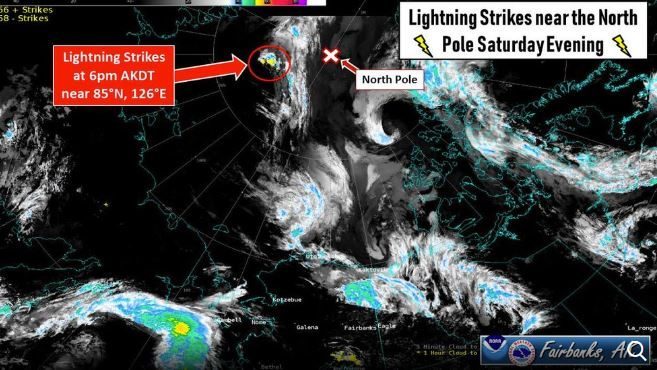
© National Weather Service/Fairbanks, Alaska
The lightning flashes were recorded within 300 miles of the North Pole, at 85 degrees north latitude, between 4 p.m. and 6 p.m. AKDT, according to the National Weather Service in Fairbanks, Alaska. That's about 700 miles north of the Lena River Delta in Siberia.
This was a rare event and one of the most northerly lightning strikes in the memories of Alaskan forecasters, the NWS said.
Lightning does occur each summer north of the Arctic Circle (66.6 degrees north latitude), including occasionally over southern portions of the Arctic Ocean.
It's uncertain how many lightning strikes in history have occurred as far north as Saturday's event, but based on the worldwide lightning climatology map shown below, they are hardly seen in that region of the Arctic.
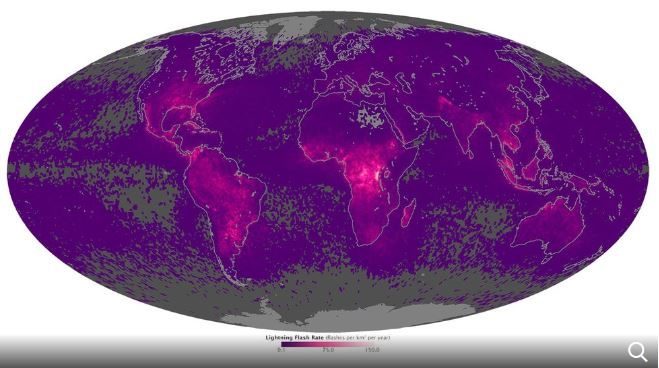
© NASAAverage annual lightning flashes per square kilometer around the world (1995-2013). Gray and purple indicate locations with the fewest flashes per year, and bright pink depicts locations that see the most lightning.
Notice how the the density of lightning strikes drops off rapidly toward the colder Arctic region in the Northern Hemisphere, as well as the Antarctic region in the Southern Hemisphere.
Saturday's lightning strikes near the North Pole were most likely from elevated thunderstorms, which develop when there is a layer of unstable air in the middle portion of the atmosphere. That's in contrast to how most thunderstorms in the middle latitudes form in summer, with the sun's heating of the Earth's surface making the atmosphere grow unstable at lower altitudes.



Comment: A couple of weeks ago record lightning strikes were reported in Iceland. In March this year an anomalous lightning storm hit Southern California producing more than 1,200 bursts in five minutes. In December 2018 the sky over New York City lit up with mysterious blue light.
Could the base level electric charge in the atmosphere be changing? See also:
- Changing atmosphere: Red sprites and a blue jet seen above Europe's stormy skies
- Electric universe: Lightning strength and frequency increasing
Also check out SOTT radio's: