
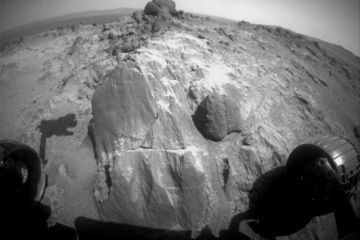
© NASA/JPL-CaltechNASA's Mars rover Opportunity is taking a close look at the strange flat-faced rock near the center of this view, captured on March 3, 2015.
The intriguing rocks lie atop a hill overlooking a site dubbed Marathon Valley — so named because Opportunity will have traveled the marathon distance of 26.2 miles (42.195 kilometers) on Mars by the time it gets there. As of Thursday (March 5), the rover's odometer read 26.139 miles (42.067 km), leaving it just 140 yards (128 meters) short of the milestone.
"We drove to the edge of a plateau to look down in the valley, and we found these big, dark-gray blocks along the ridgeline," Opportunity Project Scientist Matt Golombek, of NASA's Jet Propulsion Laboratory in Pasadena, California, said in a statement. "We checked one and found its composition is different from any ever measured before on Mars. So, whoa! Let's study these more before moving on." [Opportunity's Latest Mars Photos]
The examined rock is rich in silicon and aluminum, and its composition is different than anything observed by Opportunity or its twin, Spirit, on the Red Planet, NASA officials said.
Spirit and Opportunity landed a few weeks apart in January 2004 to search for signs of past water activity on Mars. The golf-cart-size rovers found plenty of such evidence, helping reshape researchers' understanding of the Red Planet and its history.
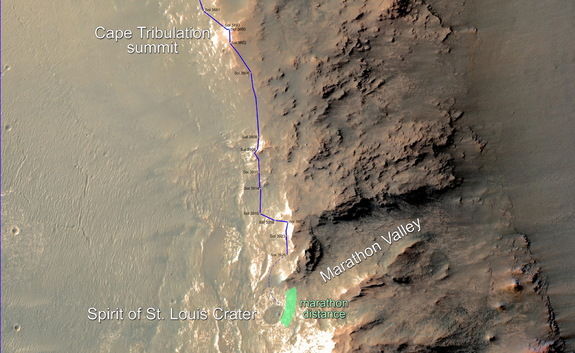
© NASA/JPL-Caltech/Univ. of ArizonaIn February 2015, NASA's Mars Exploration Rover Opportunity approached a cumulative driving distance on Mars equal to the length of a marathon race. Image released Feb. 10, 2015.
For example, Opportunity's robotic arm has long been a bit arthritic, and the rover recently began experiencing problems with its flash memory, the kind that can store information when the power is off. Indeed, Opportunity's handlers have operated the rover in a mode that avoids using its flash memory since late last year.
Engineers have uploaded new flight software intended to fix the issue, but Opportunity's memory will have to be reformatted before the rover can resume using its flash memory.
"After reformatting, the operations team will avoid use of the rover's arm for several days to make sure the flash file system is fixed and no longer causes resets," NASA officials said. "A reset during the use of the rover's arm would require a complex recovery effort."
Opportunity holds the record for greatest distance traveled on the surface of another world. Second place belongs to the Soviet Union's Lunokhod 2 lunar rover, which covered 24.2 miles (39 km) on the moon in 1973.





An interesting alloy with interesting physical properties. Don't know the ratios but the Silicon/Aluminum combination have electrical properties ( [Link] ), and mechanical properties ( [Link] ), ( [Link] ) which are of benefit here on Earth.
Also and perhaps more interestingly our Moon contains a great deal of this mineral combination. According to Donald Sadoway, a Professor of Materials Chemistry at MIT, what you see on the moon "is made up of oxides of iron, aluminum, calcium, magnesium, silicon, and titanium. The white matter is made up of the oxides of calcium, aluminum and silicon. The whole backside of the Moon is also believed to be made of anorthosite, a whitish mineral." ( [Link] ).
So, are these naturally occuring formations on Mars and the Moon? It will be interesting to compare information between Lunar and Martian rock composition.