

© Credits: Amolf/TremaniArtist's impression of the plasmoelectric effect. An ultrasensitive needle measures the voltage that arises if a laser illuminates a metal nanocircuit consisting of a square matrix of miniscule holes in a thin gold film.
The AMOLF-Caltech team, which has worked together for many years, calls the newly discovered effect the 'plasmoelectric effect'. Albert Polman, leader of the AMOLF part of the team: "This is an entirely new way of converting light into electricity. We have now demonstrated that an electrical voltage can be generated; the next step is to see whether we can also collect electrical current and generate electrical power."
Small particles of precious metals such as copper, silver and gold are known to emit colourful spectrums if they are illuminated. A well-known example is stained-glass windows in old churches in which the colours are formed by small metal nanoparticles that have been enclosed in the glass. The light that shines on these particles is converted into plasmons: oscillations of the free electrons in the metal. That results in strong absorption and diffraction of certain colours of light.
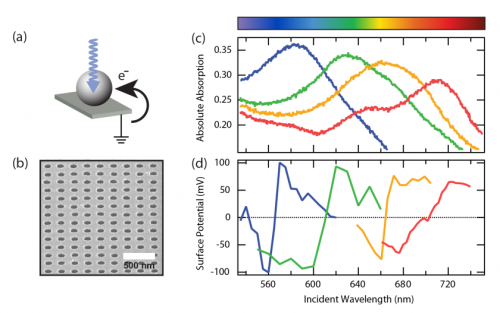
The newly discovered plasmoelectric effect. (a) Schematic representation of a metal nanosphere that becomes electrically charged when illuminated with light. (b) Electron microscope image of the metal nanocircuit made up from a matrix of ultra-small holes in a thin gold film. (c) Optical absorption spectra measured for metal nanocircuits with varying distances between the holes (175, 225, 250 and 300 nanometres). (d) Electrical potential of the nanocircuits in (c), as a function of the wavelength of the incident light. The potential measured varies from -100 millivolt to +100 millivolt as the wavelength changes from blue to red light.
Inspired by this initial result the team manufactured metal nanocircuits, consisting of a square matrix with miniscule holes with a diameter of 100 nanometres in a thin gold film. Just like the nanoparticles, these matrixes exhibited clear plasmon resonances, for which the distance between the holes determined the colour. If the circuits were illuminated with a laser and the colour of the light was gradually changed from blue to red, first a negative potential arose (-100 millivolts, blue light) and subsequently a positive potential (+100 millivolt, red light).
The researchers subsequently developed a theoretical model with which the phenomena measured could be well described. The incident light elicits small temperature fluctuations that provide a thermodynamic force for the exchange of electrical charges on the switch. That results in the potentials measured.
More information: Plasmoelectric potentials in metal nanostructures Published Online October 30 2014 Science DOI: 10.1126/science.1258405



Reader Comments
to our Newsletter