
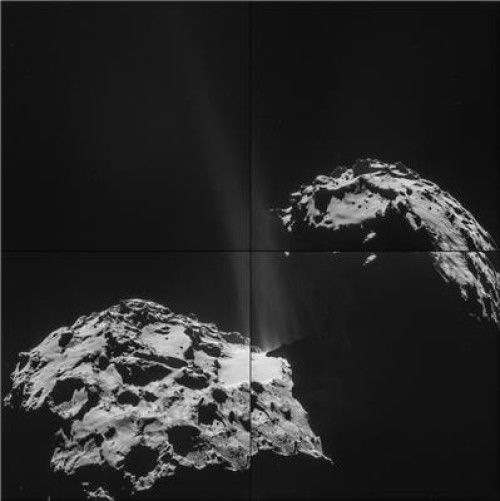
© ESA/Rosetta/NAVCAMImage taken on 26 September from a distance of 26.3 km from Comet "Chury." The image shows the spectacular region of activity at the « neck » of the comet with ices sublimating and gases escaping from inside the comet.
While this doesn't probably make a very attractive perfume, remember that the density of these molecules is still very low and that the main part of the coma is made up of sparkling water (water and carbon dioxide molecules) mixed with carbon monoxide. "This all makes a scientifically enormously interesting mixture in order to study the origin of our solar system material, the formation of our Earth and the origin of life," says Kathrin Altwegg from the Center of Space and Habitability (CSH) of the University of Bern. "And after all: it seems like comet Churyumov was indeed attracted by comet Gerasimenko to form Churyumov-Gerasimenko, even though its perfume may not be Chanel No 5, but comets clearly have their own preferences"
The idea was that at distances outside of 3 astronomical units (450 Mio km) the comet would mostly sublimate the very volatile molecules: carbon dioxide and carbon monoxide. However, apart from all these smelling ingredients ROSINA is detecting many more molecules already at large distances from the Sun which comes quite as a surprise. A quantitative analysis will show how the comet compares with other comets where data are available mostly from remote sensing. This comparison will reveal if Churyumov-Gerasimenko being a Kuiper belt comet differs from the better known Oort cloud comets and this will then shed light on the solar nebula from which our solar system emerged.



Reader Comments
to our Newsletter