

© Allesio Mesiano/flickrGrandjean's studies of children in the Faroe Islands, in the North Atlantic, found reduced learning abilities in children exposed to mercury in the womb. His work helped trigger U.S. health guidelines for mercury in fish and United Nations efforts to curb mercury pollution.
According to some scholars, toxic exposures contributed to the collapse of the Roman Empire. Roman rulers were poisoned by water cisterns and food containers fashioned from lead. These extreme exposures could have gradually made the Patrician families deranged and infertile - leaving no competent leaders to run the Empire. A similar fate seems to have befallen the Samurai regime in Japan. When bones from a castle burial were analyzed, lead concentrations in the children suggested severe lead poisoning. With damaged mental abilities, the Samurai descendants would likely have been incapable of dealing with political crisis, possibly contributing to the downfall of the Shogunate.

© Philippe GrandjeanChildren in Ecuador await neuropsychological testing. Research by Grandjean and colleagues linked pesticide exposure in the womb to effects on children's motor skills and memory.
Only recently has it become clear that the brain is extremely vulnerable, especially during its development in the womb and during infancy. In my early career, I encountered some surprises that medical school had not prepared me for, surprises that were fundamental to our understanding of the frailty of the human brain. According to the medical tradition, the fetus is well-protected inside the pregnant mother's womb. But contrary to this comforting notion, the placenta allows many toxic chemicals to seep through, and some of these compounds can damage the brain's sensitive developmental processes. The mother may escape unscathed, but for her child, such damage can be catastrophic.
Our highly sophisticated brains start out as a tiny strip of cells. A couple of weeks after conception, these cells are ready to multiply. At its peak, about 12,000 cells are generated every minute - 200 per second. Most do not remain in the same place, but move to specific locations within the developing brain. Overall, our brains develop by multiplication, migration, maturation and messaging - complex steps, each of which has to happen in a specific fashion, in the correct order and at the right time.
We are beginning to appreciate that this intricate timetable of closely connected and complex processes is very sensitive. If some disruption happens, brain development will be incomplete or abnormal, and there will be little, if any, time and opportunity for repair. Thus, the final product, our mature brain, will not express the full potentials that we inherited from our parents. Chemical damage that occurs early on will likely remain throughout our lifespan.
In the United States, one of every six children has a neurodevelopmental delay or a neurological disease. No one knows how many of those children faced environmental exposures that contributed to their problems. Chemical brain drain appears as a silent pandemic that is almost impossible to quantify. Economists have calculated that the value of lost IQ points in children exposed to chemical brain drainers worldwide are worth hundreds of billions of dollars per year. Having studied brain toxicity for 30 years, I realized that I must speak up. The adverse impacts on developing brains are serious enough to demand a loud response. In my book Only One Chance, I conclude: We get only one chance to generate a nervous system, so developing brains need vigorous protection.
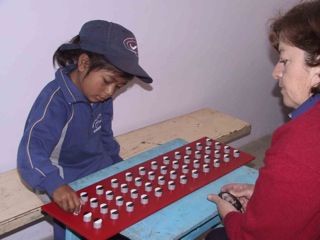
© Philippe GrandjeanA child in Ecuador undergoes a dexterity test as part of Grandjean's research that linked impaired motor skills to pesticides.
But brain drain is not just a matter of a few annoying substances. When I scrutinized the scientific and medical literature, I was able to identify more than 200 industrial chemicals that had caused toxicity to the human brain one way or another, although mostly in poisonings of adults. Due to the vulnerability of developing brains, chemicals that are toxic to adult brains are probably even more of a threat to young brains - and at much lower doses. However, to scientifically document this chemical brain drain, evidence must be collated from meticulous studies of exposed children as they grow up.
Unfortunately, our research methods are inefficient tools to obtain the documentation we desire. Proper proof may take decades to gather for each individual chemical, one by one. Thus, useful knowledge has been accumulated only for a small number of the thousands of environmental chemicals, and for the others, we do not know the potential for causing brain drain. Our knee-jerk demand for proof leaves the brainpower of the next generation in harm's way.
In the 1700s, the Duke of the German state of Württemberg decreed capital punishment for lead poisoning of his citizens. While that is unreasonably harsh, we need similar courage to act against chemical brain drain. A precautionary approach to regulating chemicals would seem appropriate. Still, the precautionary principle has been ridiculed by the American Chemistry Council (ACC) in statements such as: "It's no secret that [ACC doesn't] think the precautionary principle is either precautionary or a principle. It's a blunt instrument being used by a number of organizations to essentially ban chemicals." While we should not institute indiscriminate bans on chemicals, neither should we expose the next generation to likely brain drainers while we wait for significant damage to be documented.

© Philippe GrandjeanMotor function tests like this have linked some environmental chemicals to neurological effects in children.
We use a specific part of our brains to plan for the future. Because some chemicals affect very specific brain functions, my recurring nightmare is that exposures during brain development are reducing our ability to plan for the future, leaving us unable to prevent even more chemical brain drain. It's a vicious circle, and hopefully it is just a nightmare. But to quote Jonas Salk, "I have had dreams and I have had nightmares, but I've conquered my nightmares because I've had dreams." Protection against chemical brain drainers should no longer be a dream. We need to make it happen.
About the author
Philippe Grandjean is author of Only One Chance: How Environmental Pollution Impairs Brain Development - and How to Protect the Brains of the Next Generation. He is a professor and chair of environmental medicine at the University of Southern Denmark and an adjunct professor of environmental health at Harvard School of Public Health. He has spent his career studying how environmental chemicals affect children's brain development. His studies helped trigger an international response that led to a United Nations agreement to control mercury pollution. He has studied children in the U.S., Denmark and the Faroe Islands, as well as parts of South America and Asia, and has published about 500 scientific papers on his findings. He blogs at www.chemicalbraindrain.info.



Reader Comments
to our Newsletter