
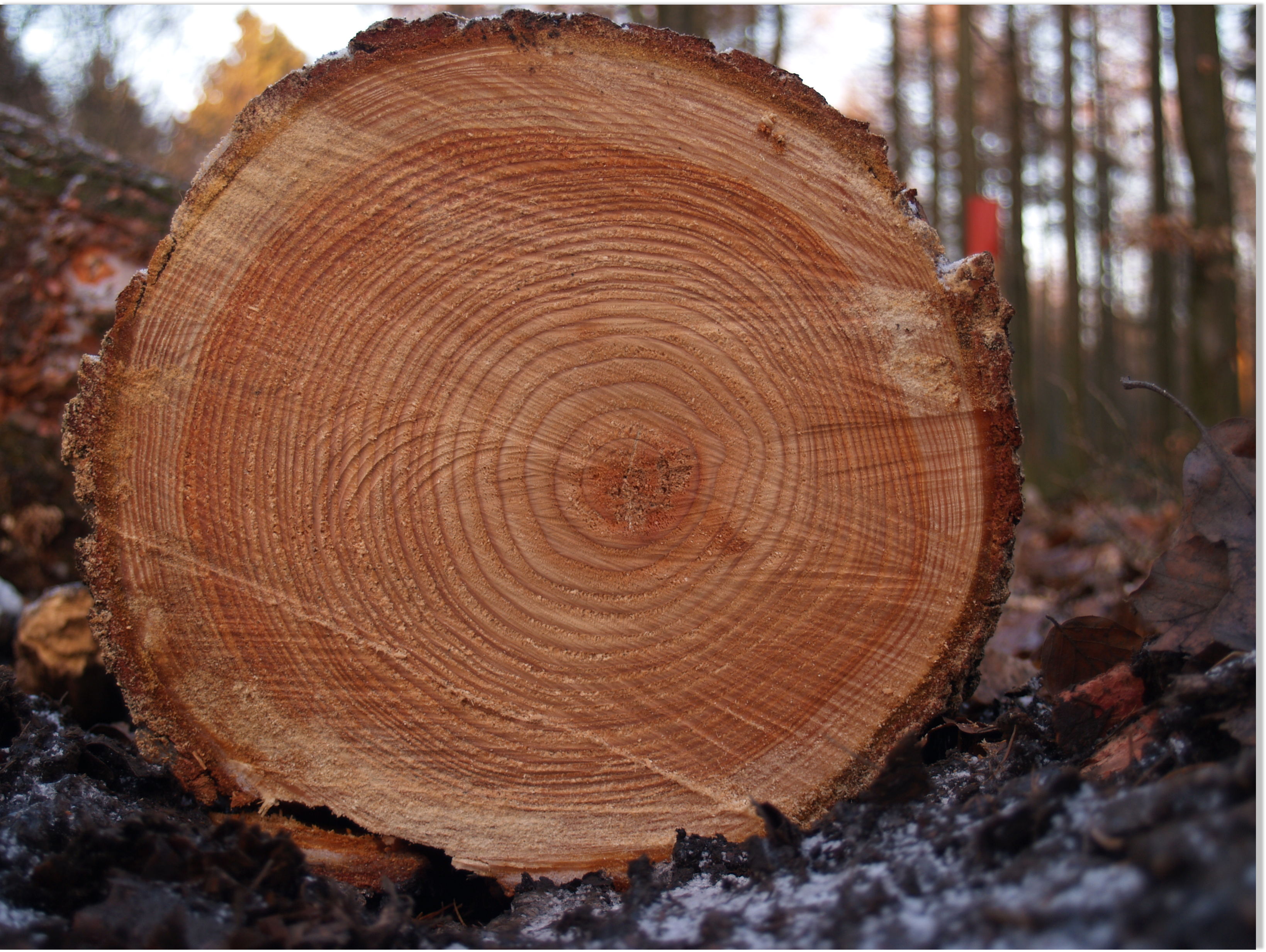
© wikipediaTree rings seen in a cross section of a trunk of a tree
Pederson, an ecologist with the U.S. Geological Survey in Bozeman, was the lead author of a paper published last week in Science magazine detailing the decline in snowpack observed by examining tree rings from the watersheds of the Columbia, Missouri and Colorado river basins dating back more than 800 years.
His findings: Not only has snowpack declined compared to past climate fluctuations, but there's also been a "decoupling" of precipitation in the Colorado River basin and that of the Northern Rockies.
What this means is the tendency for the north to have high snowpacks when the south is experiencing meager ones, and vice versa, has shifted to declining snowpack across the West. The long-term implications of reduced snowpack in the West, which provides water to an estimated 70 million people in just the three drainages Pederson studied, portends huge challenges for water managers in the future, he said.
Because the paper's publication has come during an unusually wet spring in many areas of the United States, Pederson has garnered a lot of interest from the media, including National Public Radio and the Canadian Broadcasting Corp.
"It's actually rather fortunate timing if you have an intention or desire to re-emphasize what weather and climate is," Pederson said. "I saw it as an opportunity to teach people."
There is ample historical evidence that climate fluctuates. What some call the Little Ice Age occurred roughly between 1150 and 1850 in many regions of the Northern Hemisphere. Prior to that, the Medieval Warm Period extended from about 950 to 1250; this was when the Vikings settled in Iceland. They eventually abandoned the region when the cooler climate returned.
In the American West, however, there was no one writing down the fluctuations in weather during these time periods. That's why Pederson and his fellow researchers examined tree rings for clues. In wet years, trees grow more, and the space between the rings is wider. In dry years, there's less growth and the rings are more closely spaced. By examining a large collection of tree ring samples and crunching the data, Pederson and colleagues found that the Columbia and Missouri river drainages saw sustained low snowpack between 1300 and 1330 and from 1511 to 1530. Those were the only two historical periods that were comparable to the declines seen between 1900 and 1942 -- which included the Dust Bowl era -- and from 1980 to present.
"What we're showing here is that 20th century snowpack conditions across the Northern Rockies are unusually low compared to the last 800 years," Pederson said.
The study showed periods of high snowpack in the Northern Rockies between 1695 and 1735 and from 1845 to 1895. Montana history buffs will remember that a large portion of the state's free-ranging cattle were killed in the tough winter of 1886-87.
What makes the trend that Pederson has tracked since the 1980s significant is the reduction in snowpack across all of the Rocky Mountains. In the past, the snowpack would bounce back and forth between good years for the Northern Rockies -- caused by events like this year's La Nina, or cooling of the eastern Pacific Ocean -- versus bad years for the Northern Rockies, or El Nino years, when the Southern Rockies would benefit from more snow. Pederson said that pattern, while still evident in years like this one when Montana is drowning and Arizona is on fire, has seen more of the moisture coming as rain rather than snow. With the trend toward warmer-than-average temperatures showing up as earlier springs and later falls, the snow that does fall is melting sooner.
"What was pretty fascinating is that we're seeing synchronous declines across the West, and that trees through their changes in growth are painting the same picture as our measured and modeled records of snowpack," Pederson said.



Reader Comments
to our Newsletter