
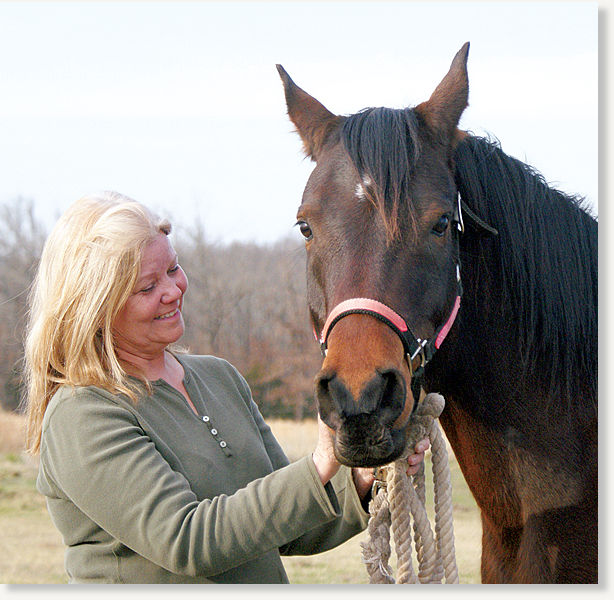
© Charlotte Marsch Debbie Zimmerman of Half Way strokes her horse, Danny, thankful he is alive. He was rescued from an ice-covered pond nearly three weeks ago. Zimmerman credits the heroic work of first responders and a veterinarian for Danny’s survival.
Wind Dancer - or "Danny," for short - is a three-quarters Arabian horse who survived a fall into an ice-covered pond Feb. 12. The low temperature that night recorded in Bolivar was 22 degrees.
When Zimmerman arrived home that evening, she was unable to locate the horse. With at least a foot of snow on the ground, she went looking for him that evening but her four-wheeler got stuck in the snow.*
She never dreamed he might have ended up in the pond on the back part of her property. During the 28 years she has lived there, her horses have always stayed away from the pond.
The next morning, she found him stuck in the pond that had a six-inch layer of ice.
"When I yell for him, he always nickers," Zimmerman said. "We knew where he was as soon as we got down to the clearing. I still don't know how he could have been in that pond all night and survived."
She immediately called E-911 to report the emergency. Zimmerman said the dispatcher knew just what to do by calling both rescue volunteers and offering to contact her veterinarian.
Pleasant Hope Fire and Rescue had seven responders on scene: Chief Greg Wood and his wife, Tammy, Jake Agee and his wife, Tamra, Loyd Mincks, Doug Marshall and Paul Erickson. Half Way Fire and Rescue responder Tommy Morris drove the department's four-wheel-drive brush truck that was used during the rescue.
"We were lucky he wasn't out in the deep part of the water," Agee said. "He maybe was in more mud than water."
Responders first put a halter and lead rope on Danny before using a chain saw to cut a path through the ice. Responders had to pick up the 6-inch-thick ice chunks and move them out of the way.
Because the responders could not pull the horse out of the mud, they hooked him up to a four-wheel-drive vehicle to help pull him out.
Once rescue workers pulled the horse to safety, which took about 45 minutes to an hour, veterinarian Jason Wooderson with Countryside Vet Clinic in Bolivar spent several hours providing medical treatment.
"He had severe hypothermia," Wooderson said. "He was going into shock. He went down on us in the stall."
His first recorded temperature was 92 degrees, though Wooderson estimates his temperature probably had been as low as the upper 80s before that. A normal temperature for a horse is 101 or 102 degrees.
They wrapped the horse in blankets to dry him off and help him warm up.
"I think I used every towel and blanket in my house," Zimmerman said. It was a flannel sleeping bag that Zimmerman says warmed him up the most.
Because of dehydration and nutritional deficiencies, Wooderson started an IV that helped warm up Danny internally, too, through his veins. Starting the IV was not easy, though.
"I had to almost guess where the vein was," he said. "You could barely hear his heartbeat."
After dealing with shock and hypothermia came dealing with trauma - something the horse is still recovering from nearly three weeks after the incident.
"The rest of his body had to catch up," Wooderson said. "He's still fighting the trauma, but he looks quite a bit fuller."
Though Wooderson was there to treat the horse the day of the rescue, he credits Zimmerman's care since then for Danny's long-term recovery.
"She's the one that did all the after care, and she's done a great job," he said.
Zimmerman is quick to thank everyone who helped with the rescue, tears forming in her eyes as she says thank you.
"You all are awesome," Zimmerman said to Wooderson and four of the responders Wednesday afternoon. "I'm just glad you guys were so fast and so quick because it was all so hard. I just wanted to thank you guys because I knew we couldn't get him out.
"It was a miracle - definitely."



Reader Comments
to our Newsletter