
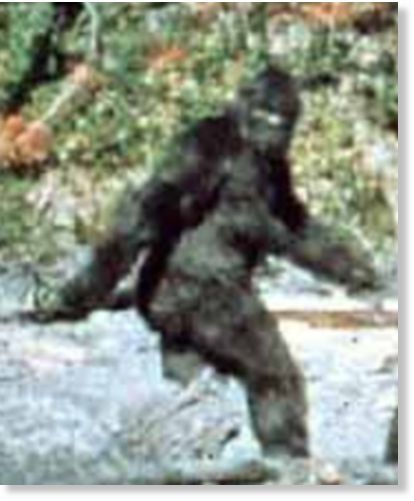
© Unknown
I believe that eventually and before too long one of these primates will be captured or killed. I know of many men currently on the hunt here on our continent. The first person who bags a Sasquatch will become rich and internationally famous, though reviled in certain circles. The second person who does so will probably go to jail, because in between the first and second incidents, the species will be scientifically anointed as real and protective laws will, I hope, be passed. My research, and that of others in the field, seeks to put in place as much infrastructure of knowledge as possible before that fateful day, so that once the world at large comes to recognize the existence of this elusive primate and begins its inevitable hungry clamor for information, the data, the stories of human-Sasquatch interaction, will be ready.
2/ Since entering the spec-science or -anthropology branch of writing, do you feel your writerly worth to be defined in any way by your readers' credulity, i.e. does your success depend on the validation of Bigfoot's existence in circles outside the literary?
I don't think of my book as being primarily a "literary" work, but rather a natural history study; my hope is that the sheer level of detail and persuasiveness of the first-person testimonials by the "habituators" coupled with their still photos, video and audio clips, will be enough to convince most readers who have not already been convinced by decades' worth of track finds and eye-witness accounts throughout North America. As far as I am concerned, the existence of Sasquatch has been proven years ago, and it's just a matter of time before this proof is augmented by the kind of evidence (such as a dead body) that will persuade the scientific community. Most books and documentaries to date have willingly entered into the prevailing dynamic of the debate: Is Sasquatch real or not? They make use of competing evidence pro and con and leave the reader or viewer to make up his or her own mind. My book, on the other hand, declines to join this debate; rather, it simply picks sides, taking the existence of this primate as its starting-point and proceeding from there, focusing on the efforts of ordinary people, over long years of patient interaction, who have been attempting to soften this creature's ancient, instinctual inhibitions, to breach, on occasion the thick barrier that this species has found it necessary to maintain between itself and homo sapiens.
3/ Do you feel personally driven toward verification of the mysterious?
Not toward verification of the mysterious per se, no. For instance, I'm fine with leaving ghosts and UFOs alone. But the case seems different when it's a rare flesh-and-blood creature, a fellow member of the animal kingdom. I've always felt driven, yes, since childhood, to learn more about Sasquatch, since I first saw the Patterson Film, in 1973. Over the years, this subject continued to capture my imagination, and it served me in the way of an elusive psychic deity, like quicksilver, like the horizon, lush because ungraspable, the way C. S. Lewis came to love what the imagination wants, what he describes in his autobiography Surprised by Joy as an unsatisfied desire which is itself more desirable than any other satisfaction. The fact that they are both beast and human-like grabs me. They seem to exhibit both a striking kinship with us, and a profound otherness. And, I don't know, strange to say, but sometimes the available categories of reality seem insufficient. After all, what exists for us be with, here? It seems to fall into just three realms: the human, the animal, and the divine. Sasquatch fits snugly into none of these, yet manifests qualities of all three, transcending any categorization, opening up some fourth place. If the Judeo-Christian divine is too abstract, as it is for me, then the mind may turn to notions from mythology. This is what Sasquatch reminds me of: the gods of Mount Olympus. They are part of nature yet stand beyond nature, too: they cannot be circumscribed and contained. They seem to travel wherever they will, like quicksilver, otherwise known as Mercury, otherwise known as Hermes, fleet of foot, messenger between realms, shape-shifter, trickster, dweller on the threshold. They occupy their own dimension, yet occasionally visit our own, when it suits their purpose, to give us clues, glimpses, gifts, to play with us their oblique and capricious games. They are profoundly and irreducibly Other, yet many (as featured in my book) find that in the grace of their presence, they feel more themselves, in an expanded sense. And for folks who have never been with them, why else would they spend decades stomping through wilderness, straining after even a glimpse? Many compromise their home lives in hopes of contact, of a moment of ecstasy: to stand outside oneself. One of the principal figures in my book describes those moments when you cross an invisible border in the woods, when you suddenly get that sizzle: "You know," he says, the sense that I've been here before, but I haven't? It's the deja vu that lets you into a new old territory, resting on home ground for the first time. It's as though you're coming face to face with what you once knew, perhaps eons ago, a recollection of the whole story. On top of thirty-five years of daydreaming, what has happened for me during these past three years, in researching people's accounts, more amazing, more quickening, I find, than any stories from literature, and in experiencing my own small fortune of direct contact, is an odyssey of dramatic proportions A good friend once warned me, seeking to curb this folly of mine, "Don't forget, this is the only life you have." I remember.
4/ Most Americans believe that Bigfoot sightings are limited to the Pacific Northwest, apparently because Paterson's footage is so well-known. In fact, the phenomenon is ancient and global. Creatures with corresponding traits are described in the Bible and even the Sumerian texts that prefigured it. In your opinion, what is the relationship of these creatures to mankind, both literally and figuratively?
Most native peoples in North America possess ancient stories of the Sasquatch, though of course they all give it different names. Many see this creature as an Elder or Big Brother figure, who shows himself to humans to warn us, when the balance of nature has somehow been thrown off. The Lakota, or western Sioux, call Bigfoot "Chiye-tanka" (Chiha-tanka in Dakota or eastern Sioux); "chiye" means "elder brother" and "tanka" means "great" or "big." In English, though, the Sioux usually call him "the big man." In his book In the Spirit of Crazy Horse, a nonfiction account, author Peter Matthiessen recorded some comments about Bigfoot made by traditional Sioux people and some members of other Indian nations. Joe Flying By, a Hunkpapa Lakota, told Matthiessen, "I think the Big Man is a kind of husband of Unk-ksa, the earth, who is wise in the way of anything with its own natural wisdom. Sometimes we say that this One is a kind of reptile from the ancient times who can take a big hairy form; I also think he can change into a coyote. Some of the people who saw him did not respect what they were seeing, and they are already gone."There is your Big man standing there, ever waiting, ever present, like the coming of a new day," Oglala Lakota Medicine Man Pete Catches km told Matthiessen. "He is both spirit and real being, but he can also glide through the forest, like a moose with big antlers, as though the trees weren't there... I know him as my brother... I want him to touch me, just a touch, a blessing, something I could bring home to my sons and grandchildren, that I was there, that I approached him, and he touched me."
5/ What do you think about speculation of an extraterrestrial origin for these creatures?
I've seen no evidence of this connection.



Reader Comments
to our Newsletter