Science & TechnologyS


Mars

NASA releases stunningly detailed photograph of Mars basin 'favorable' to life

Clays of Ladon Basin
© JPL-Caltech/Univ. of Arizona / NASAClays of Ladon Basin
NASA has released a stunningly detailed photograph of the Ladon Basin on Mars, providing valuable new insight on an area it believes could have been favorable for life on the Red Planet thousands of years ago.

The region is hugely interesting to Mars researchers because it shows significant signs of ancient lakes and rivers. The area features a huge impact crater, which was filled in with deposits left behind by a major ancient river called the Ladon Valles.

Magnify

Autolykiviridae: Never-before-seen viruses with weird DNA were just discovered in the ocean

ocean
The ocean is crowded. As many as 10 million viruses can be found squirming in a single millilitre of its water, and it turns out they have friends we never even knew about.

Scientists have discovered a previously unknown family of viruses that dominate the ocean and can't be detected by standard lab tests. Researchers suspect this viral multitude may already exist outside the water - maybe even inside us.

"We don't think it's ocean-specific at all," says environmental microbiologist Martin Polz from MIT.

Polz and his MIT team, together with researchers from the Albert Einstein College of Medicine in New York, analysed three months' worth of ocean water samples collected off the Massachusetts coast.

Gear

Synthetic incompatibility: Scientists are creating GMO species that can't survive

CRISPR
© Futurism
Gene editing technologies are rapidly advancing. Tools like CRISPR-Cas9 have the potential to help us reverse and even eradicate diseases such as HIV, cancer, and so much more. However, as we genetically modify organisms, we run the risk of them mating with their non-modified counterparts, which could irreparably change wild species and disrupt whole populations and ecosystems.

"This is a problem that has been recognized for a while," said Maciej Maselko, a postdoctoral researcher at the BioTechnology Institute and the University of Minnesota's (U of M) College of Biological Sciences (CBS), in a U of M news release.

While previous attempts to prevent this breeding have centered on quarantining the modified organisms, Maselko has developed a tool that could prove to be more successful as it makes it impossible for modified species to effectively breed with their wild versions. He calls it "synthetic incompatibility."

Comment: Read more about synthetic incompatibility: New technology can prevent GM organisms from breeding with their natural counterparts


Cloud Grey

Nasa satellite photo reveals the criss-cross wake patterns that ships leave clouds

stmophere ship tracks nasa
© NASA/Jeff Schmaltz, LANCE/EOSDIS Rapid ResponseThe stunning image reveals the impact that ships passing through the Atlantic Ocean have on the clouds above
A stunning image captured by a Nasa satellite reveals the impact that ships passing through the Atlantic Ocean have on the clouds above.

The image shows a patchwork of bright, criss-crossing cloud trails off the coast of Portugal and Spain, known as ship tracks.

Ship tracks form when water vapour condenses around tiny particles of pollution that ships emit as exhausts. These incredible clouds typically form in areas where low-lying stratus and cumulus clouds are present.

Moon

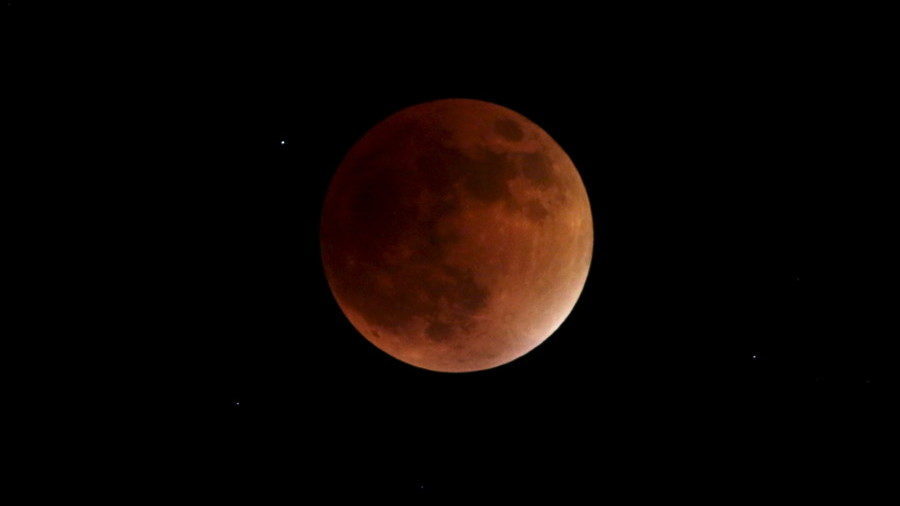
First time in 150 years: RT's guide to the 'super blue blood moon' event

Blood moon
© Andrea De Silva / Reuters
Stargazers in North America will get their reward for labouring through the January blues with a lunar event 150 years in the making at the end of this month.

A rare confluence of a blue moon, a supermoon, a blood moon and a total lunar eclipse will be visible in the sky over parts of the US and Canada on January 31 - the first time a 'super blue blood moon' has happened since March 31, 1866.

What is a 'super blue blood moon' anyway?

Supermoons, which occur when the moon is full at the same time it is at its closest approach to the Earth, appear 14 percent bigger and 30 percent brighter than normal full moons. The forthcoming supermoon is the last in a trilogy that began on December 3 with the second visible on New Year's Day. The third is now due to arrive at the end of the month. However, because it is the second full moon in the same month, the phenomenon is also a "blue moon."

HAL9000

Google Home identifies Buddha, Muhammad, but not Jesus or God

Google Home
© Reuters/Beck DiefenbachGoogle Home
Internet users are posting videos that show Google products refusing to answer questions about Christian figures, when the same products have no problem answering similar question about other religions and deities.

In a Facebook live video uploaded Wednesday, television producer and author David Sams asked his Google Home personal assistant a simple question: "Who is Jesus?"

"Sorry, I don't know how to help with that yet," the smart audio assistant replied.


Sams then asked the same question about God, and received a similar answer.

"Sorry, I can't help with that yet," Google Home answered.

Rose

Not socially constructed: Wild chimp 'girls' play with 'dolls' too

Nature and nurture may both influence gender-based toy choices.

young chimpanzee
© Michael Poliza, National Geographic/Getty ImagesA young chimp in Mahale Mountains National Park, Tanzania (file picture).
It's almost Christmas, and, as the song goes, Barney and Ben hope for Hopalong boots and a pistol that shoots, while Janice and Jen would like dolls that will talk and go for a walk.

Now new research suggests that such gender-driven desires are also seen in young female chimpanzees in the wild - a behavior that possibly evolved to make the animals better mothers, experts say.

Young females of the Kanyawara chimpanzee community in Kibale National Park, Uganda, use sticks as rudimentary dolls and care for them like the group's mother chimps tend to their real offspring. The behavior, which was very rarely observed in males, has been witnessed more than a hundred times over 14 years of study.

"The stick serves no immediate function, they just carry it - sometimes for a few minutes, other times for hours," study leader Richard Wrangham, a biological anthropologist at Harvard University, said via email.

Comment: Today's post modernists want you to believe gender is a social construct and claim biology has nothing to do with it. Yet the facts remain the same, there are 2 sexes and hardwired differences inherent in them. As these examples show, they can't simply be explained away as something created only by society and culture. See also: Rooted in our biology: Revealing insights on behavioral sex differences from our primate cousins


Music

Music really is a universal language

Close encounters of the third kind
© YouTube
It turns out that your high school band teacher, in all his wide-eyed, bleeding heart optimism, was right-music really is the universal language, and science has just proved it.

In the "Form and Function in Song" study published today in Current Biology, researchers show that vocal songs that manage to trigger emotional reactions like soothing a crying child or expressing love to a partner all sound similar to each other, despite coming from different parts of the world. Because of this, people in over 60 countries arrived at similar feelings about those types of songs based only of 14-second audio clips. This confirms the existence of universal links between form and function in music.

"Why do songs that share social functions have convergent forms?" asks the study. "If dance songs are shaped by adaptations for signaling coalition quality, their contextual and musical features should amplify that signal. The feature ratings in [our second experiment] support this idea: dance songs tend to have more singers, more instruments, more complex melodies, and more complex rhythms than other forms of music."

"If lullabies are shaped by adaptations for signaling parental attention to infants, their acoustic features should amplify that signal. The feature ratings in [our second experiment] also support this idea: lullabies tend to be rhythmically and melodically simpler, slower, sung by one female person, and with low arousal relative to other forms of music."

Target

'Conductive concrete' found to shield electronics from EMP attack

Concrete shields
© ABC Group LLC/Craig Chandler, University Communications, University Of Nebraska-LincolnUniversity of Nebraska engineers Christopher Tuan (left) and Lim Nguyen are standing beside a test structure at Nebraska's Peter Kiewit Institute in Omaha. • ABC Group built and tested prototype structure in Lakeland, Florida.
An attack via a burst of electromagnetic energy could cripple vital electronic systems, threatening national security and critical infrastructure, such as power grids and data centers.

Nebraska engineers Christopher Tuan and Lim Nguyen have developed a cost-effective concrete that shields against intense pulses of electromagnetic energy, or EMP. Electronics inside structures built or coated with their shielding concrete are protected from EMP.

The technology is ready for commercialization, and the University of Nebraska-Lincoln has signed an agreement to license this shielding technology to American Business Continuity Group LLC, a developer of disaster-resistant structures.

Electromagnetic energy is everywhere. It travels in waves and spans a wide spectrum, from sunlight, radio waves and microwaves to X-rays and gamma rays. But a burst of electromagnetic waves caused by a high-altitude nuclear explosion or an EMP device could induce electric current and voltage surges that cause widespread electronic failures.

Telescope

Scientists viewing neutron star collision don't understand why X-ray glow keeps getting brighter

neutron star collision
© CI LAB/NASA’S GODDARD SPACE FLIGHT CENTER
More than 100 days after two neutron stars slammed together, merging into one, new telescope images have revealed that the collision's lingering X-ray light show has gotten brighter. And scientists don't fully understand why.

NASA's orbiting X-ray telescope, Chandra, previously picked up the X-rays 15 days after gravitational waves from the cataclysm reached Earth on August 17, 2017 (SN: 11/11/17, p. 6). The merged remnant then spent several months too close to the sun for its X-rays to be seen.

When the remnant reemerged from the sun's veil on December 4, it was about four times brighter than when it was last spotted, Daryl Haggard of McGill University in Montreal and her colleagues report January 18 in Astrophysical Journal Letters.

The glow may be tapering off. The XMM-Newton space telescope found on December 29 that the X-ray signal may be starting to weaken, according to a paper published January 18 at arXiv.org.

"The plot is about to thicken," says Haggard. Chandra has collected new data to look for a drop in brightness.

Scientists are debating how to explain the enduring X-rays. Neutron star collisions are expected to emit bright jets of material, creating X-rays that fade quickly. The long-lasting X-rays might be explained by a "cocoon" of debris (SN Online: 12/20/17), among other possibilities.