Welcome to SOTT.net. Be sure to bookmark this page - and don't miss our RSS feeds!
Sat, 21 Nov 2009     SuperSearch Help

Science & Technology


Missing Legs of 900-year-old Buddhist Statue Found in Cambodian Jungle
An archaeology professor has discovered the missing legs of a 900-year-old Buddhist statue deep in the Cambodian jungle, rewriting history in the process.

According to a report in The Independent, the professor in question is Dr Peter Sharrock, a senior teaching fellow in the art and archaeology of Southeast Asia at London's School of Oriental and African Studies.

Sharrock was at a conference in Cambodia in July when he decided to spend a day searching the forest around the ruins of Angkor.

His aim was to locate the missing giant legs of an eight-headed, three-metre high sandstone statue of Hevajra, the war-like, tantric Buddhist deity.

The statue's intricately carved bust was excavated and salvaged in 1925 by French archaeologists, who sold it to the Metropolitan Museum of Art in New York, where it has been on display ever since.
Dinosaur Prints Found on New Zealand's South Island
© Greg Browne
Scientist Greg Browne sits next to one of six 70 million-year-old footprints found in various locations in the Nelson region.
Scientists have discovered the first evidence that dinosaurs roamed the South Island of New Zealand with 70-million-year-old footprints found in six locations.

They are the first dinosaur footprints found in the country although bones, mostly vertebrae, have been discovered in two North Island locations.

The footprints were found by scientist Greg Browne in the remote Whanganui Inlet in the northwest of Nelson at the top of the South Island.

They are spread over 10 kilometres and in one area there are up to 20 footprints, Browne said.

Browne, a sedimentologist, believes the footprints belonged to sauropods -- plant-eating dinosaurs which were among the largest animals to have lived, growing up to six metres (yards) in length and weighing several tonnes.
Unusual meteorite found by time-lapse camera observatory
© Phil Bland, Imperial College
Time-lapse image taken over one night of a fireball travelling across the sky. It was taken from a fireball camera network or observatory in Western Australia.
An unusual meteorite with an interesting orbit has been tracked to the ground using a photographic observatory that records time-lapse images of fireballs traveling across the sky.

The network of cameras is in the Nullabor Desert in Western Australia. It allows scientists to track a fireball path, formed by a meteorite as it travels through Earth's atmosphere, and then work out where the meteorite comes to rest.

The fireball camera network project was set up by Dr Phil Bland from Imperial College London and scientific associate of the Natural History Museum, along with colleagues from Ondrejov Observatory in the Czech Republic, and the Western Australia Museum, in 2006. This is the first meteorite recovered using the network.

The cameras recorded the fireball that ultimately produced the meteorite in 2007, and the fragments that fell to Earth were named Bunburra Rockhole after a local landscape feature near to where they landed.
Was life founded on cyanide from space crashes?
© P. H. Schultz, Brown University and AVGR
Cyanide impact
Life may have been built on a foundation of cyanide formed in the fiery wakes of asteroids plunging through Earth's atmosphere, high-speed impact experiments suggest.

Earth was probably not born with much in the way of organic material - the complex molecules containing carbon that life requires. It formed too close to the sun for such compounds to condense from the swirling primordial disc of gas and dust.

One possibility is that organic matter formed on Earth after the planet coalesced, for example in chemical reactions induced by lightning arcing through the atmosphere, as experiments by Stanley Miller at the University of Chicago in the 1950s suggested. But the chemical reactions in this process could happen only in an early atmosphere full of methane and hydrogen, and later studies of the ancient geological record have suggested that was unlikely.

Others have suggested the building blocks came from comets and asteroids that struck Earth, because these objects are known to contain high concentrations of organic material. But the tremendous heat of impact would have burned up much of that material, converting it into simpler molecules like carbon dioxide.
Mass extinction blamed on fiery fountains of coal
© Joel Sartore/NGS/Getty
Another thing to pin on fossil fuels
Fossil fuels have a new crime to live down. A frenzy of hydrocarbon burning at the end of the Permian period may have led to the most devastating mass extinction Earth has ever seen, as explosive encounters between magma and coal released more carbon dioxide in the course of a few years than in all of human history.

Around 250 million years ago, the so-called "Great Dying" saw 70 per cent of species wiped out on land and 95 per cent in the oceans. A clue to what may have triggered this disaster lies in solidified magma from this time, which is widespread in an area of Siberia where coal is also abundant.

One suggestion is that the heat of the magma could have baked many billions of tonnes of CO2 out of the coal over a geologically brief period of a few thousand years (New Scientist, 8 December 2007, p 42). The ensuing climate change and ocean acidification would account for the extinctions. Now Norman Sleep and Darcy Ogden, both of Stanford University in California, think the trigger for the Great Dying may have been even swifter and more terrifying.
Carbon Atmosphere Discovered On Neutron Star
© NASA / CXC
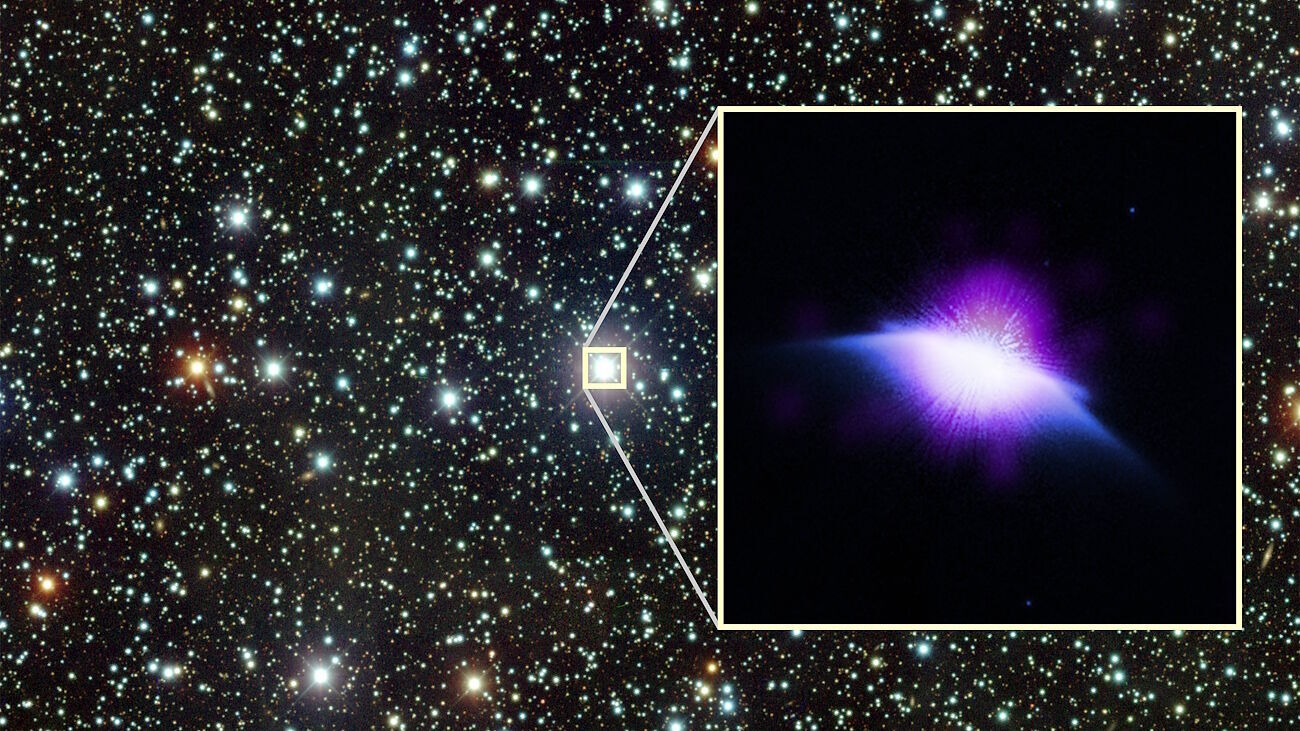
Evidence for a thin veil of carbon has been found on the neutron star in the Cassiopeia A supernova remnant. This discovery, made with NASA's Chandra X-ray Observatory, resolves a ten-year mystery surrounding this object.

"The compact star at the center of this famous supernova remnant has been an enigma since its discovery," said Wynn Ho of the University of Southampton and lead author of a paper that appears in the November 5 issue of Nature. "Now we finally understand that it can be produced by a hot neutron star with a carbon atmosphere."

By analyzing Chandra's X-ray spectrum -- akin to a fingerprint of energy -- and applying it to theoretical models, Ho and his colleague Craig Heinke, from the University of Alberta, determined that the neutron star in Cassiopeia A, or Cas A for short, has an ultra-thin coating of carbon. This is the first time the composition of an atmosphere of an isolated neutron star has been confirmed.
Nanoparticles could damage DNA at a distance, study suggests
© Getty Images
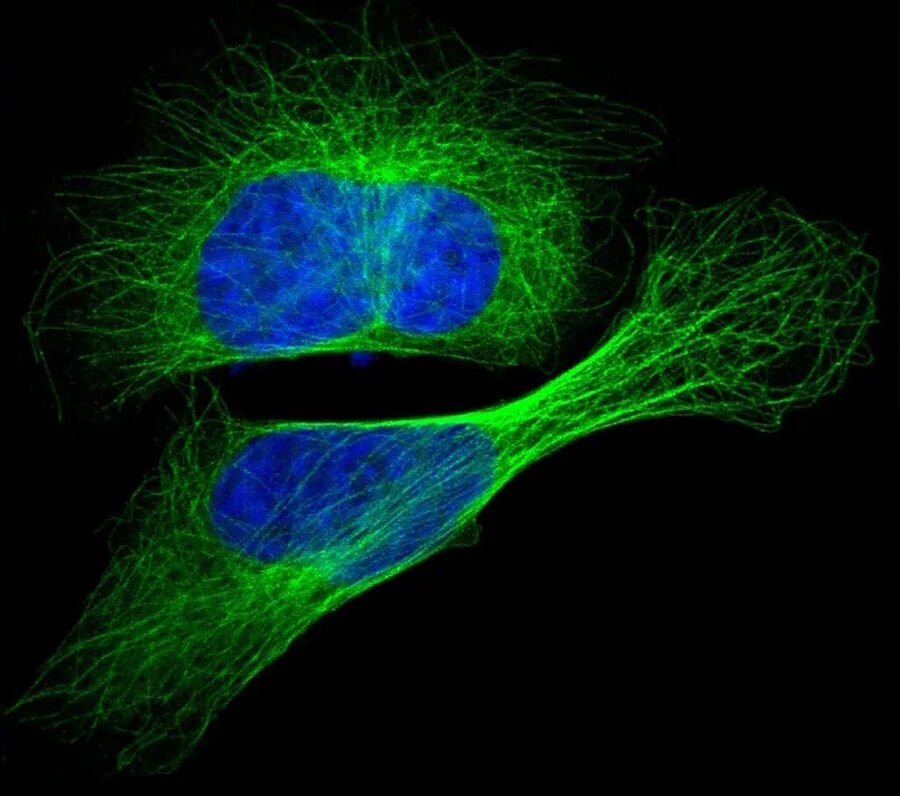
Nanoparticles of metal can damage the DNA inside cells even if there is no direct contact between them, scientists have found. The discovery provides an insight into how the particles might exert their influence inside the body and points to possible new ways to deliver medical treatments.

The preliminary work also raises questions about the safety of nanoparticles - which are a thousand times smaller than the width of a human hair and used in everything from sunscreens to electronics - though the researchers point out that the doses they used in their study were higher than anything a person might come into contact with.
Invisibility Uncloaked
Cloaking
© Cary Wolinsky and Rick Kyle
Cloaking devices would steer light or other electromagnetic waves around them like water around a stone in a smooth stream, leaving nary a ripple of difference in the flow.
In race to make things disappear, scientists gain ground on science fiction

Ulf Leonhardt is riding high these days, with a new award from the Royal Society of Great Britain to further develop his ideas on how to make things in plain sight disappear.

Born in East Germany and now occupying the theoretical physics chair at Scotland's University of St. Andrews, Leonhardt is among the leaders of the worldwide race to realize an old dream of science fiction: cloaking devices. They would steer light or other electromagnetic waves around them like water around a stone in a smooth stream, leaving nary a ripple of difference in the flow. Such things, letting light swish past like a boxer ducking every punch, would be invisible.

"Cloaking device" is a common term in technical literature. It also deliberately evokes myth and popular fiction. Allusions include the Romulan technology that first amazed TV viewers of the old Star Trek in the episode "Balance of Terror," when hostile Bird of Prey fighting vessels just disappeared, poof. One finds cloaking in J.K. Rowling's novels about the young wizard Harry Potter with his invisibility cape. Farther back, H.G. Wells' novel The Invisible Man (and the movie of the same name, along with its sequel The Invisible Woman) toyed with much the same idea. J.R.R. Tolkien assigned similar power to The One Ring in his tales of hobbits. Inspiration for the ring apparently came from way back - the magical ring that the shepherd Gyges recovered from an earthquake-spawned chasm in Plato's The Republic.
Signature of Antimatter Detected in Lightning
Fermi telescope finds evidence that positrons, not just electrons, are in storms on Earth.

Designed to scan the heavens thousands to billions of light-years beyond the solar system, the Fermi Gamma-ray Space Telescope has now recorded some more down-to-Earth signals. During its first 14 months of operation, the flying observatory has detected 17 gamma-ray flashes associated with terrestrial lightning storms.

The flashes occurred just before, during and immediately after lightning strikes, as tracked by the World Wide Lightning Location Network.

During two recent lightning storms, Fermi recorded gamma-ray emissions of a particular energy that could only have been produced by the decay of energetic positrons, the antimatter equivalent of electrons. The observations are the first of their kind for lightning storms. Michael Briggs of the University of Alabama in Huntsville announced the puzzling findings November 5 at the 2009 Fermi Symposium.
New Type of Supernova Explosion Reported; Predicted by Theoretical Physicists

These are orbiting white dwarf stars.
A new class of supernova was discovered by scientists at Berkeley and may be the first example of a new type of exploding star. A team of astrophysicists at UC Santa Barbara had predicted this kind of explosion in their theoretical work.

Lars Bildsten, professor at UCSB's Kavli Institute for Theoretical Physics (KITP), and colleagues, predicted a new type of supernova in distant galaxies that would be fainter than most and would rise and fall in brightness in only a few weeks.

The discovery, led by UC Berkeley postdoctoral fellow Dovi Poznanski, who is also with Lawrence Berkeley National Laboratory, is reported in the Nov. 5 Express edition of Science Magazine. Bildsten first heard from Poznanski last August when he was organizing the conference "Stellar Death and Supernovae."


185,524 people have viewed this page since Fri, 26 Jan 2007

A Course in Knowledge and Being
NEW! Available now!
Éiriú Eolas

Featured Book:

The Wave Book 7 - Almost Human

NEW! Available Now!

Pentagon Strike logo
Over 1 BILLION Served!


Disease logo

PICTURE OF THE DAY

QFG Bookstore: The Future is an Open Book

Donate to SOTT.net
Donate once - or every month!
Click here to learn how you can help!

Signs on You Tube

Boycott Israeli products

911 Ultimate Truth

Promote SOTT

Gulf Stream Watch

Gulf Stream Watch

Ark's Quantum Quirks

wife
Balance in all things is necessary