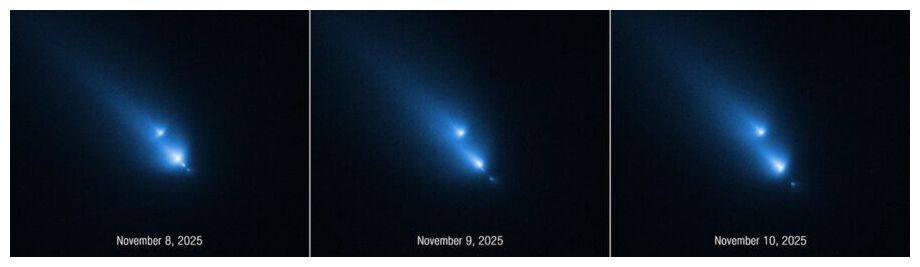
The Hubble Space Telescope caught a long-period comet breaking up just after it passed the Sun.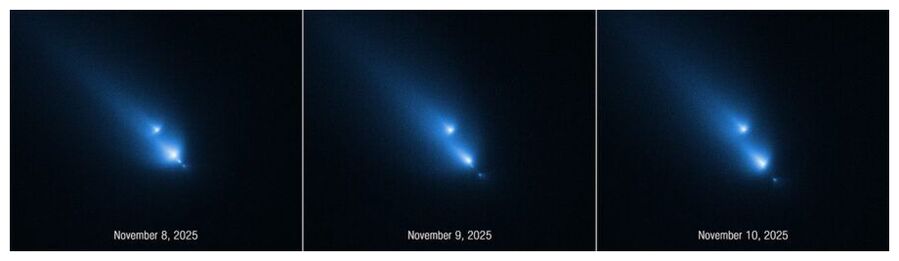
© NASA, ESA, Dennis Bodewits (AU); Image Processing: Joseph DePasquale (STScI)This series of images from the Hubble Space Telescope shows the progressive disintegration of Comet C/2025 K1 (ATLAS), or K1 for short, as seen over the course of three consecutive days in November 2025.
The Hubble Space Telescope is more than 30 years old and has just one functional gyroscope left to steer it, yet the iconic observatory is still making incredible findings.
Hubble has now caught a rare, close-up look at a comet that broke into several pieces during a close approach to the Sun. These observations have given us a unique front-row seat to the swan song of one of these icy wanderers.
Caching this event required a good deal of luck. The team of researchers behind the finding originally requested time to observe a different comet — the brightest at the time — but it was moving too fast for Hubble to track. When telescope operators asked for a backup target, the team suggested C/2025 K1 (ATLAS) simply because the comet was in the right place at the right time.
So when the researchers looked at the images, several days after they were taken, they were shocked to find five objects in the frame. The comet had broken apart.
"We were like, 'Whoa, what's that?'" says Dennis Bodewits (Auburn University), who led the study published in
Icarus. "It was both exciting and frustrating," he says, because while they'd clearly found a rare event, they couldn't turn Hubble fast enough to see more.
Even without Hubble, though, the team had other ways to look at the break-up. Ground-based telescopes had been tracking the comet, such as the 1-meter telescope at Las Cumbres Observatory Outbursting Objects Key (LOOK) Project. By combining Hubble's high-resolution images with ground-based data, they estimated the breakup started about eight days prior to when Hubble took the images.
Before it fragmented, K1 ATLAS was about 8 kilometers (5 miles) across, slightly larger than the average comet. Hubble captured three 20-second images, one each day starting on November 8, 2025. It witnessed one of K1 ATLAS's smaller pieces break up during that period.
As the comet broke apart, its brightness increased. "From the ground, they could see it was flaring up, and eventually the parts were separating, but we saw four or five different parts" with Hubble, Bodewits explains, "and they went on and off like little fireworks."