Science & TechnologyS


Meteor

Potentially Hazardous Asteroid 2002 AJ129 to make fly-by February 4th

asteroid 2002 AJ129
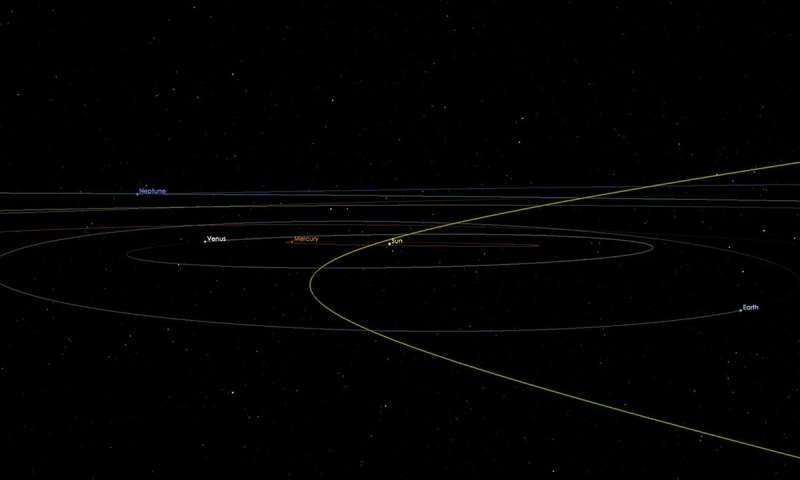
© NASA/JPL-CaltechAsteroid 2002 AJ129 will make its closest approach to Earth on Feb. 4, 2018, at 1:30 p.m. PST (4:30 p.m. EST). At the time of closest approach, the asteroid will be no closer than 10 times the distance between Earth and the moon.
Asteroid 2002 AJ129 will make a close approach to Earth on Feb. 4, 2018 at 1:30 p.m. PST (4:30 p.m. EST / 21:30 UTC). At the time of closest approach, the asteroid will be no closer than 10 times the distance between Earth and the Moon (about 2.6 million miles, or 4.2 million kilometers).

2002 AJ129 is an intermediate-sized near-Earth asteroid, somewhere between 0.3 miles (0.5 kilometers) and 0.75 miles (1.2 kilometers) across. It was discovered on Jan. 15, 2002, by the former NASA-sponsored Near Earth Asteroid Tracking project at the Maui Space Surveillance Site on Haleakala, Hawaii. The asteroid's velocity at the time of closest approach, 76,000 mph (34 kilometers per second), is higher than the majority of near-Earth objects during an Earth flyby. The high flyby velocity is a result of the asteroid's orbit, which approaches very close to the Sun-11 million miles (18 million kilometers). Although asteroid 2002 AJ129 is categorized as a Potentially Hazardous Asteroid (PHA), it does not pose an actual threat of colliding with our planet for the foreseeable future.


Comment: The skies have been noticeably active recently with an alarming number of space rocks:


Health

Killer viruses from outer space might be more common than we think

virus
Could an alien virus arrive from outer space and wipe out the human race? It may sound like the plot of a B-movie, but an international group of scientists is now formally exploring the possibility for the very first time.

In a study published in the journal Astrobiology next month, the group sets out its belief that while NASA continues to focus its search for extraterrestrial life on the hunt for other alien microorganisms, space viruses remain critically under-researched. The team, led by biologist Kenneth Stedman of Portland State University, is calling for scientists to develop strategies to detect these viruses - and to see if they can spread to humans from outer space.

Comment: Also See:


Cupcake Pink

If you are craving carbs, blame your brain says Japan study

neurons
© Dr Jess
Under pressure and gobbling pizza or chocolate? It may not be your fault, according to Japanese researchers who have isolated the neurons that drive a craving for carbs.

The team at Japan's National Institute for Physiological Sciences found that activating neurons known to respond to social stress increased the appetite in mice for carbohydrates. Rodents with the neurons activated ate high-carbohydrate food at a rate of three times the mice under normal conditions. They also roughly halved their intake of high-fat food, the study found.

The research is the first to demonstrate the way that the brain plays a role in the preference for carbohydrates or fats, said Yasuhiko Minokoshi, a scientist at the institute, who led the study. The teams said the study could help find a way to shift people away from gorging on sugary treats or unhealthy junk food.

Humans generally select what to eat based on taste, as well as the nutritional state of the body, but the exact mechanism involved in the selection has remained largely a mystery.

Meteor

Russia, Canada, Northern European countries identified as prime targets for Earth-bound meteorites

Meteor streaks over Novi Travink
© Dado Ruvic/ReutersA meteor streaks over the sky during the Perseid meteor shower at the Maculje archaeological site near Novi Travnik August 12, 2014.
Russia, Canada, and Northern European countries are the primary targets for asteroids and meteorites falling to Earth, Columbian scientists have found. But don't get packing just yet, because nowhere is really safe.

Scientists Jorge Zuluaga and Mario Sucerquia from the University of Antioquia in Medellin (Colombia), analyzed the probability of a space rock falling in different regions of the Earth using a process called "Gravitational Ray Tracing" (GRT).

The fact that the Tunguska and Chelyabinsk meteorites, over a century apart in time, were only separated by 2,300 kilometers (some 1,400 miles), led the Colombian physicists to conclude that some regions of our planet are more prone to this danger than others.

Cassiopaea

Another possible nova in constellation Circinus

Following the posting on the Central Bureau's Transient Object Confirmation Page about a possible Nova in Circinus (TOCP Designation: PNV J13532700-6725110) I performed some follow-up of this object through a TEL 0.43-m f/6.8 reflector + CCD from MPC Code Q62 (iTelescope Observatory, Siding Spring).

On images taken on January 20.6, 2018 I can confirm the presence of an optical counterpart with R-filtered CCD magnitude +8.09 & V-filtered CCD magnitude +8.33 at coordinates:

R.A. = 13 53 27.57, Decl.= -67 25 01.0

(equinox 2000.0; Gaia DR1 catalogue reference stars for the astrometry).

This transient has been reported to CBAT/TOCP by John Seach, Chatsworth Island, NSW, Australia. Discovery made with a DSLR with 50 mm f/1.2 lens.
Below my confirmation image (single unfiltered 60-sec exposure through a 0.43-m f/6.8 reflector + CCD; MPC Code Q62). Click on the image for a bigger version:

Nova in Circinus
© Remanzacco Blog

Comment: Possible nova in southern Constellation Musca


Rocket

Rocket launch over Japan appears similar to California UFO reports

japan rocket lauch UFO plasma
Rocket exhaust from Japanese space launch
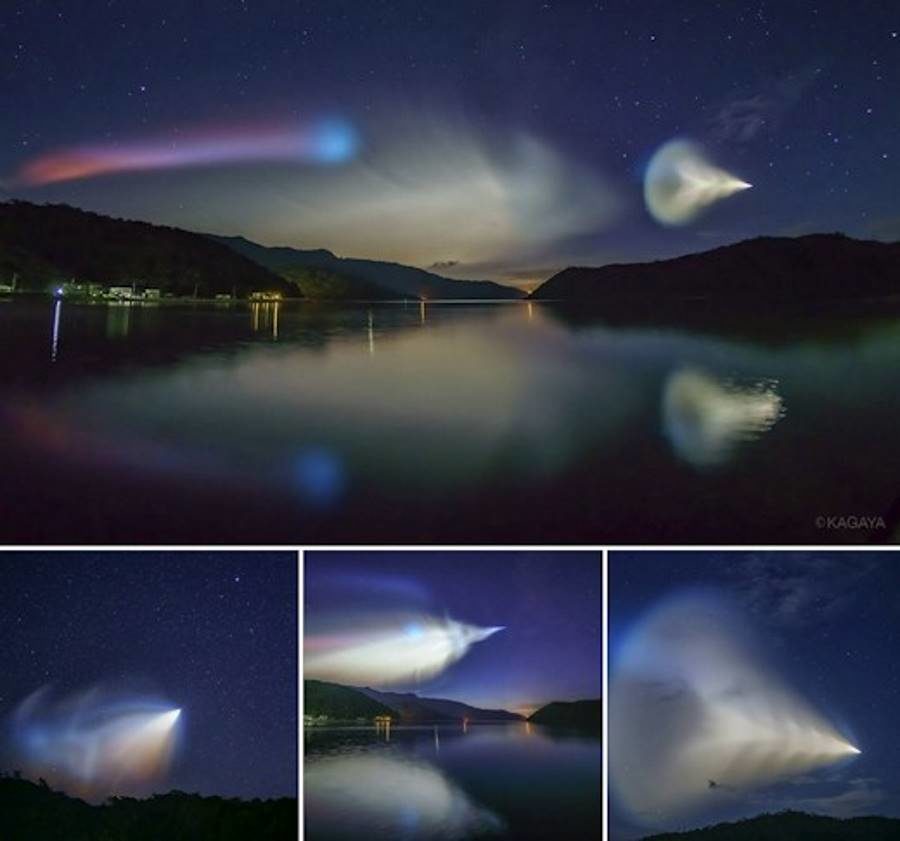
Remember when the pre-dawn SpaceX launch from Vandenberg just before Christmas created a flurry of UFO reports in Southern California? Now it's Japan's turn.

On Jan. 18th, the Japanese space agency JAXA launched a small rocket from the Uchinoura Space Center. It made a big display. Japanese artist and photographer Kagaya captured dramatic images of the rocket's exhaust glowing in the starry pre-dawn sky over the Pacific:

Comment: Notice the remark about noctilucent clouds. For ice crystals to form in the rocket exhaust, the surrounding air must be cool enough. Even up to thirty years ago noctilucent clouds formation was confined to the polar regions during the winter season. Now they are forming at lower latitudes. This is another bit of evidence our atmosphere is cooling. It is also evidence of increasing cosmic dust load.


Microscope 1

Mysterious microbiome: Treating disease by nudging the microbes inside us

Ecoli
Ecoli bacteria
We've spent centuries trying to kill bacteria. Now, scientists have shown that subtler approaches can work-at least in mice.

In the final decades of the 19th century, scientists showed in rapid succession that many of the worst diseases to afflict humanity were the work of bacteria-germs. Leprosy, gonorrhea, diphtheria, tuberculosis, plague, cholera, dysentery: Barely a year went by without assigning an infamous illness to a newly identified microbe. This concept, where one germ causes one disease, has influenced the way we think about infections ever since, and it implies an obvious solution: Remove the bug, and cure the sickness.

But the links between microbes and poor health can be more complicated. Our bodies are naturally home to tens of trillions of bacteria. Most are benign, or even beneficial. But often, these so-called microbiomes can shift into a negative state. For example, inflamed guts tend to house an unusually large number of bacteria from the Enterobacteriaceae family (pronounced En-ter-oh-back-tee-ree-ay-see-ay, and hereafter just "enteros"). There's no villain in this scenario, no single antagonist as there would be in the case of tuberculosis or cholera. The enteros are part of a normal gut; it's the same old community, just altered.

Jupiter

Jupiter's stunning storm clouds captured in latest Juno probe flyby

Jupiter
© NASA
The NASA space probe Juno has once again captured the jaw-dropping beauty of Jupiter in another breathtaking image of the gas giant posted to the space agency's Twitter feed Thursday.

The picture, which has been color-enhanced, was snapped by the Juno probe during its 10th flyby of the gas giant on December 16. The spacecraft was positioned just above the planet's south pole, meaning it effectively recorded the different strata of the planet from the bottom up.

Question

The question of when human life begins is still a point of contention for some

The science has been obscured in philosophy, but the question is settled.
fetus
© u3d/Shutterstock
The question of when a human life begins is a strictly scientific one and one for which the scientific community has had an empirical, internationally acknowledged answer for a very long time.

For more than a century, the field of human embryology has documented that in human sexual reproduction a new, whole, individual, living human being begins to exist at "first contact" between a sperm and an oocyte/"egg" (the beginning of the process known as fertilization.) Immediately when these two mere cells make first contact and fuse, organism proteins and enzymes specific to humans are produced. One new single-cell human being with his or her own new, unique, and complete set of human DNA begins to exist. This is an internationally recognized empirical fact that has been documented by the Carnegie Stages of Early Human Embryonic Development since 1942, and updated every year since then to the present by the international nomenclature committee (FIPAT). The 23 Carnegie Stages cover human development during the eight-week embryonic period, and a new human being is represented by Carnegie Stage 1a.

Blue Planet

Trees that need and miss the mammoths

Osageoranve, pod, sloth
© Mark Wells/Dxlinh/BallistaOsage-orange and seeds • Cassia grandis • giant ground sloth of North America
Trees that once depended on animals like the wooly mammoth for survival have managed to adapt and survive in the modern world.

Consider the fruit of the Osage-orange, named after the Osage Indians associated with its range. In the fall, Osage-orange trees hang heavy with bright green, bumpy spheres the size of softballs, full of seeds and an unpalatable milky latex. They soon fall to the ground, where they rot, unused, unless a child decides to test their ballistic properties.

Trees that make such fleshy fruits do so to entice animals to eat them, along with the seeds they contain. The seeds pass through the animal and are deposited, with natural fertilizer, away from the shade and roots of the parent tree where they are more likely to germinate. But no native animal eats Osage-orange fruits. So, what are they for? The same question could be asked of the large seed pods of the honeylocust and the Kentucky coffeetree.
trees pods
© MDC Discover NatureKentucky Coffee Tree • Honey Locust Tree
To answer these questions and solve the "riddle of the rotting fruit," we first need to go to Costa Rica. That is where tropical ecologist Dan Janzen of the University of Pennsylvania noticed that the fruits of a mid-sized tree in the pea family called Cassia grandis were generally scorned by the native animals, but gobbled up by introduced horses and cattle. Janzen, who received the Crafoord Prize (ecology's version of the Nobel) for his work on the co-evolution of plants and animals, had the idea that the seeds of Cassia grandis, and about 40 other large-fruited Costa Rican trees, were adapted to be dispersed by large mammals that are now extinct. He teamed up with Paul Martin, a paleoecologist at the University of Arizona, to develop the concept of ecological anachronisms.