Health & WellnessS


Info

Gut biota never recover from antibiotics: Damages future generations

Image
© healthfreedoms.org
The misuse of antibiotics is not only causing new, never-before known diseases like E. coli and MRSA, the flesh-eating bacteria, it's also destroying the gut biome with devastating effects on our ability to deal with infections and destroying our ability to absorb nutrients from food.

Emerging research shows that the harmful effects of antibiotics go much further than the development of drug resistant diseases. The beneficial bacteria lost to antibiotics, along with disease-inducing bacteria, do not fully recover. Worse, flora lost by a mother is also lost to her babies. The missing beneficial gut bacteria are likely a major factor behind much of the chronic disease experienced today. The continuous use of antibiotics is resulting in each generation experiencing worse health than their parents.

Martin Blaser, the author of a report in the prestigious journal Nature writes:
Antibiotics kill the bacteria we do want, as well as those we don't. These long-term changes to the beneficial bacteria within people's bodies may even increase our susceptibility to infections and disease.Overuse of antibiotics could be fuelling the dramatic increase in conditions such as obesity, type 1 diabetes, inflammatory bowel disease, allergies and asthma, which have more than doubled in many populations.

Health

Ayurvedic herbs treat brain and lung cancers: Some with 90% success rate

Image
© hiddenhealthcenter.com
With cancer cures seeping into mainstream media from natural health practitioners almost weekly now, it makes one wonder why anyone would subject themselves to chemotherapy and radiation, since there is growing evidence that it poisons the body and simply causes the cancer cells to become temporarily dormant only to return later in fuller force. While these treatments are often used unnecessarily to 'treat' cancer patients, there are other, less invasive cures being used by Ayurvedic clinics all over India and in other parts of the world - some solutions having as much as a 90% success rate.

In several clinics, lung and brain cancers have been treated with an over 90% success rate, and in almost every single case, the cancer was lessened. According to a clinical research test conducted in one Ayurvedic Clinic, lung cancers were minimized so effectively that only .09% of the participants in one 500-plus-person study still remained 'uncured'.

Comment: Learn more about the benefits of Ayurvedic herbs:

Holy Basil for Stress Relief
Why You Should Get To Know Neem
Cloves Are the Best Antioxidant, Says New Study
Embracing Health and Happiness through Ayurvedic Eating
Ancient herb proven to be a potential cure for Alzheimer's
Turmeric is the Anti-Aging, Anti-Oxidant, Anti-Inflammatory Super Spice


Magnify

What is Candida?

Image
Candida (Yeast) is a late sign of impaired gut health.
Candida is associated with craving simple carbs (white foods -pasta, bread, rice, and all sugars) which feed the yeast. Candida develops for many reasons. Basically, it is a 'helper' attempting to create balance in the gut, generally due to antibiotics, preservatives, heavy metal toxins and sterile foods.

We can make candida obsolete and unnecessary by rebalancing gut microbials. Antibiotics for mother or baby during pregnancy and birth (intrapartum antibiotics) are the most common sources of microbial imbalance leading to candida in children (and mother). The mother's exposures to mercury through (silver) amalgam fillings and vaccinations herself, and HER mother's mercury toxin exposures are other variables leading to candida overgrowth.

Our foods have "preservatives", which means chemicals that retard microbial and bacterial growth in the food product. Live foods have enzymes and microbials and spoil. If a food doesn't spoil at room temperature within a week, it has preservatives, essentially.

Red Flag

USDA Inspector General: Food safety and humane slaughter laws ignored with impunity

Image
Chinese workers process chicken meat at a Beijing meat production line in 2007. The United States announced Thursday it was asking the World Trade Organization to settle a dispute with China over Beijing's duties on US chicken imports
Repeat food safety violations are just the tip of the iceberg.

Two weeks ago, the USDA's Office of the Inspector General released a report that, once again, proves that our food system is broken: First, the Food Safety and Inspection Service doesn't meaningfully attempt to stop repeat violations of food safety laws. Second, it has allowed a 15-year-old pilot program with faster slaughter and fewer inspectors to proceed without review. Third, it all but ignores its humane slaughter mandate. Remarkably, unless you read Food Safety News or the agricultural media, you will have missed this extremely damning report.

Attention

The bitter truth about Splenda

Image
If you were told to ingest a biologically alien synthetic chemical whose presence on this planet did not predate 1976,and whose structure is only a few atoms away from the deadly pesticide DDT, and you knew that not only were there no long term human safety studies performed on it, but that it had been already proven in tests to have following adverse health effects:
  • Shrunken thymus glands (up to 40% shrinkage)
  • Enlarged liver and kidneys.
  • Abnormal histopathological changes in spleen and thymus
  • Increased cecal weight
  • Reduced growth rate
  • DNA Damage
  • Adverse changes to gastrointestinal bacteria
  • Abnormal Pelvic Mineralization
  • Decreased red blood cell count
  • Hyperplasia of the pelvis
  • Aborted pregnancy (Maternal & Fetal Toxicity)
  • Decreased fetal body weights and placental weights
  • Bowel inflammation/Crohn's Disease
  • Triggering migraine
  • Increase glycosylation of hemoglobin (HbA1c) for diabetics

    ...would you still consume it?

Yoda

Victory for Connecticut GMO labeling - other states, take note!

Image
Yesterday, Connecticut passed a law requiring foods with genetically engineered ingredients to be labeled - and it's all thanks to your grassroots activism!

Connecticut has taken a first important step. The House version of its Label GMO bill (which ANH-USA helped draft) passed the Connecticut Senate unanimously on Saturday, and passed the legislature 134 to 3 on Monday. Our hope is that this bill will inspire neighboring states to take similar action so the trigger can come into effect as quickly as possible.

Family

Childhood stomach aches linked with adult depression and anxiety

Image
The gut has its own nervous system—similar to that of the brain—and is hardwired to the brain by the vagus nerve, a nerve that runs from the brain to the internal organs. As a result of signals transferred back and forth, disturbances in the gut can impact the brain.
Many dismiss childhood stomach aches as a normal part of growing up. However research shows that chronic childhood stomach aches could result in anxiety and depression later in life.

A Stanford University researcher found that gastric irritation early in life could pave the way for lifelong psychological problems. Of course, not all childhood stomach aches will lead to adult depression and anxiety; genetic makeup and when the stomach aches occur developmentally are also important factors.

Researcher Pankaj Pasricha, MD, notes that 15 to 20 percent of people experience chronic pain in the upper abdomen, and are more likely to suffer from anxiety or depression than their peers.

Gut and brain hardwired together

Dr. Pasricha points to the connection between the gut and brain as an explanation for psychological issues related to childhood stomach aches. The gut has its own nervous system - similar to that of the brain - and is hardwired to the brain by the vagus nerve, a nerve that runs from the brain to the internal organs. As a result of signals transferred back and forth, disturbances in the gut can impact the brain.

To test whether chronic childhood gut problems could lead to adult anxiety and depression, researchers performed experiments on baby rats, irritating their stomachs for six days.

Comment: In order to re-balance your brain-gut neural network, check out the Éiriú Eolas program which stimulates the vagus nerve in a natural way to achieve homeostasis in brain chemistry and digestion. It is precisely for these reasons (among other things) that the program is so effective for depression and anxiety.

For more information on an anti-inflammatory diet, see Primal Body, Primal Mind by Nora Gedgaudas.


Display

Email 'raises stress levels'

Email is supposed to make modern life easier, but it is making workers more stressed than ever as they struggle to stay on top of hundreds of messages per day, according to researchers.
Image
© ALAMYResearchers believe that emails can add to stress levels.
Reading and sending emails prompts telltale signs of stress including elevated blood pressure, heart rate and levels of the hormone cortisol, a study found.

Researchers who followed a group of 30 government employees found that 83 per cent became more stressed while using email, rising to 92 per cent when speaking on the phone and using email at the same time.

Although receiving a single message was no more stressful than answering one phone call or talking to someone face-to-face, emails had a stronger effect overall because people received so many each day.

Stress levels, analysed by saliva samples as well as heart rate and blood pressure monitors over a 24-hour period, peaked at points in the day when people's inboxes were fullest, the study found.

Emails which were irrelevant, which interrupted work or demanded an immediate response were particularly taxing, while those which arrived in response to completed work had a calming effect.

Magnify

Some of my best friends are germs

Image
© Hannah Whitaker The New York Times.
I can tell you the exact date that I began to think of myself in the first-person plural - as a superorganism, that is, rather than a plain old individual human being. It happened on March 7. That's when I opened my e-mail to find a huge, processor-choking file of charts and raw data from a laboratory located at the BioFrontiers Institute at the University of Colorado, Boulder. As part of a new citizen-science initiative called the American Gut project, the lab sequenced my microbiome - that is, the genes not of "me," exactly, but of the several hundred microbial species with whom I share this body. These bacteria, which number around 100 trillion, are living (and dying) right now on the surface of my skin, on my tongue and deep in the coils of my intestines, where the largest contingent of them will be found, a pound or two of microbes together forming a vast, largely uncharted interior wilderness that scientists are just beginning to map.

I clicked open a file called Taxa Tables, and a colorful bar chart popped up on my screen. Each bar represented a sample taken (with a swab) from my skin, mouth and feces. For purposes of comparison, these were juxtaposed with bars representing the microbiomes of about 100 "average" Americans previously sequenced.

Here were the names of the hundreds of bacterial species that call me home. In sheer numbers, these microbes and their genes dwarf us. It turns out that we are only 10 percent human: for every human cell that is intrinsic to our body, there are about 10 resident microbes - including commensals (generally harmless freeloaders) and mutualists (favor traders) and, in only a tiny number of cases, pathogens. To the extent that we are bearers of genetic information, more than 99 percent of it is microbial. And it appears increasingly likely that this "second genome," as it is sometimes called, exerts an influence on our health as great and possibly even greater than the genes we inherit from our parents. But while your inherited genes are more or less fixed, it may be possible to reshape, even cultivate, your second genome.


Cookies

Is your brain on HFCS the same as your brain on cocaine?

Image
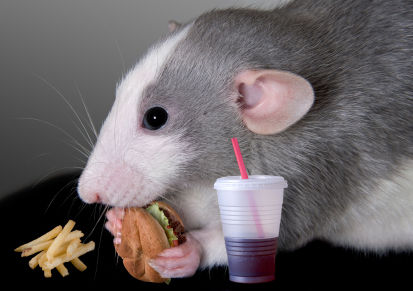
Does high fructose corn syrup make some of us behave like drug-addicted rats?

New research by an expert on addiction has found the same pattern of behavior in rats on cocaine and rats self-dosing on high fructose corn syrup.

Dr. Francesco Leri, an associate professor of neuroscience and applied cognitive science at the University of Guelph in Ontario, Canada, presented these findings at the annual meeting last week of the Canadian Association for Neuroscience.

Leri has observed his "food addiction hypothesis" in two previously published studies, both using Oreo cookies, but this time he used actual high fructose corn syrup, selected "because of the controversy (over it) in the literature," he told me in an interview.