Health & WellnessS


Top Secret

Biotech's Dark Promise: Involuntary cannibalism for all

Image


"Technological progress is like an axe in the hands of a pathological criminal." ~ Albert Einstein
Whereas the quote above could easily be dismissed as the 'progress-denying' sentiment of a disgruntled anti-GMO activist, the fact is that it came from a scientist representing the very epitome of Western rationality and accomplishment.

Perhaps Einstein was reflecting on the inevitable existential consequences of the so-called "technological imperative"- whatever can be done, will be done. Fundamentally amoral and irrational economic and political forces drive technology's feverish pace, infusing a certain arbitrary cruelty and disequilibrium into everything it touches.

In our continual drive to 'improve upon Nature' in the name of much-hyped, 'life-saving' biotechnological innovations, the line between humane and inhumane eventually is crossed, and there seems no going back. Biopollution from defective or dangerous GMO genes, for example, is virtually impossible to undo once unreleased into the biosphere; you can't "recall" a defective gene like you can an automobile. Nor can we remove from our bodies the surreptitious viruses (e.g. simian virus #40 (SV40)) that contaminated millions of first-generation polio vaccines. In many ways our moral fiber suffers from the same susceptibilities. Once we have crossed a certain line - be it theft, lying, or worse, etc., - it is difficult, if not impossible to 'go back' and regain our innocence. Such is the human condition. And this is why we must carefully consider the medico-ethical implications of new technologies, whose developments we must first be aware of in order to guide, regulate and sometimes terminate.

Heart

When heart disease is autoimmune

Image
Heart disease is the leading cause of death in the United States, affecting about 11 percent of the population. For the majority of people, heart disease is driven by diet and lifestyle factors, however research shows an increasing number of heart disease cases can also have an autoimmune component. This means the immune system is mistakenly attacking and destroying heart tissue, causing symptoms and weakening the heart.

Typically heart disease is linked with a diet high in processed foods, sugars and refined carbohydrates, lack of activity, and obesity. The good news is that means people who make the effort can ameliorate or reverse their condition through a whole foods diet and exercise.

However, when an autoimmune reaction is part of the picture, the approach is more complicated. If the autoimmunity has destroyed enough tissue, it can be too late to reverse the condition and its symptoms. With autoimmune rates exploding in recent years, hopefully more doctors will screen for autoimmunity so an autoimmune heart condition can be caught in time to manage it.

Comment: And this is only the tip of the iceberg. See Opening Pandora's Bread Box: The Critical Role of Wheat Lectin in Human Disease


Arrow Down

The air we breathe definitively and scientifically linked to cancer

Image
© Manfredxy/Shutterstock.com
Outdoor air pollution has been definitively linked to cancer and is officially classified as a carcinogen, according to research released Thursday by The International Agency for Research on Cancer (IARC), part of the World Health Organization.

"The air we breathe has become polluted with a mixture of cancer-causing substances," said Kurt Straif, head of the IARC's monographs section, which is tasked with ranking carcinogens.

The IARC's research found the toll of air pollution on public health worldwide is significant. In 2010 alone, exposure to ambient fine particles was recently estimated to have contributed to 3.2 million premature deaths, predominantly from cardiovascular disease, and 223,000 deaths from lung cancer. More than half of the lung cancer deaths attributable to ambient fine particles were projected to have been in China and other East Asian countries.

Sources of air pollution identified by the agency include emissions from motor vehicles, industrial processes, power plants and household heating and cooking fumes and while the chemical makeup of outdoor air pollution varies around the globe, the IARC was clear that "the mixtures of ambient air pollution invariably contain specific chemicals known to be carcinogenic to humans."

Ambulance

Post hysterectomy skeletal and anatomical changes

Image
I wonder if so many women would "choose" hysterectomy if they knew how it would affect their figure and internal anatomy. I know I would have told my once respected gynecologist "no way" and left never to return if I'd known just a smidgen of what I now know. Here are some of the anatomical and skeletal changes that occur post hysterectomy.

Ligament and Skeletal Changes Post Hysterectomy

An intact woman's figure has space between the rib cage and the hip bones commonly known as the waist. The waist gives her the curve in her lower back, the natural sway in her hips, her "elongated" torso that's proportionate to her extremities. This all changes after hysterectomy.

Four sets of ligaments hold the uterus in place. These ligaments are the "scaffolding" or support structures for the core (midsection). When the ligaments are severed to remove the uterus, the spine compresses causing the rib cage to gradually fall toward the hip bones and the hip bones to widen. This causes a shortened, thickened midsection, protruding belly, and loss of the curve in the lower back, giving the appearance of a flat derriere. In some women, these changes cause those hated rolls of fat (weight gain or not). In others, it looks more like a pregnant belly. This can be particularly distressing for women whose hysterectomies denied them the chance to have (more) children.

Arrow Down

Seawater bacteria kills 10 in Florida, but authorities say healthy Gulf swimmers should have no fear

Image
© AP Photo/Patty KonietskyThis photo provided by Patty Konietzky shows her husband's foot of what they thought was a bug bite on Sept. 22, 2013, in Ormond Beach, Fla. Patty and her husband, Henry "Butch" Konietzky, went crabbing in the Halifax River near Ormond Beach in September. Butch developed a sore which was later confirmed to be vibrio vulnificus. The bacteria spread quickly in his body and he died 60 hours later.
Patty Konietzky thought the small purple lesion on her husband's ankle was a spider bite. But when the lesion quickly spread across his body like a constellation, she knew something wasn't right.

After a trip to the hospital and a day and a half later, Konietzky's 59-year-old husband was dead.

The diagnosis: vibrio vulnificus (vih-BREE'-oh VUHL'-nihf-ih-kus), an infection caused by a bacterium found in warm salt water. It's in the same family of bacterium that causes cholera. So far this year, 31 people across Florida have been infected by the severe strain of vibrio, and 10 have died.

"I thought the doctors would treat him with antibiotics and we'd go home," said Konietzky, who lives in Palm Coast, Fla. "Never in a million years it crossed my mind that this is where I'd be today."

State health officials say there are two ways to contract the disease: by eating raw, tainted shellfish - usually oysters - or when an open wound comes in contact with bacteria in warm seawater.

Question

Medical Mystery: Man sheds tears of blood

Calvino Inman
© YouTube screengrab from mickeyblogs2Calvino Inman first noticed haemolacria - bleeding from the eyes - as a teenager in 2009.
A young man from Tennessee is living with an alarming medical condition - without warning, he begins to bleed from his eyes. And some of the best doctors in the country are completely stumped by his ailment.

What's more confounding is that the condition is very rare, but some of the only other people known to bleed from the eyes - a condition called haemolacria - are also from Tennessee.

At age 22, Michael Spann was walking down the stairs of his home in Antioch, Tenn., when he was gripped by an extremely painful headache. "I felt like I got hit in the head with a sledgehammer," he told the Tennessean. Moments later, Spann realized that blood was trickling from his eyes, nose and mouth.

The bleeding and headaches became a daily occurrence for Spann; now, about seven years later, they happen only once or twice a week. Though he's hampered by a lack of health insurance, doctors in Tennessee and at the Cleveland Clinic performed an exhaustive series of tests, but were unable to pinpoint a cause or recommend a treatment, according to news reports.

Beaker

New immune system discovered

Image
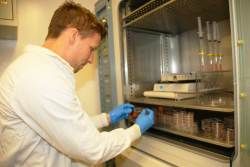
Jeremy Barr, a biology post-doctoral fellow, checks the health and growth of mucus-producing human tissue culture cells.
Mucus may be slimy and gross, but a San Diego State University research team, led by Jeremy Barr, a biology post-doctoral fellow, has discovered that it is also home to a powerful immune system that could change the way doctors treat a number of diseases.

In this previously undocumented immune system, researchers uncovered bacteria-infecting viruses known as bacteriophage, which shield the body from invading infection.

The discovery, made possible with funding from the National Institutes of Health, concentrates on the protective layers of mucus which are present in all humans and animals. It serves both as a home for large populations of beneficial microbes - which can include fungi, bacteria and viruses - and as an entry point for infection.

A new immune system

The researchers sampled mucus from animals and humans - ranging from a sea anemone to a mouse and a person - and found that bacteriophage adheres to the mucus layer on all of them.

They placed bacteriophage on top of a layer of mucus-producing tissue and observed that the bacteriophage formed bonds with sugars within the mucus, causing them to adhere to the surface. They then challenged these mucus cells with E. coli bacteria and found that the bacteriophage attacked and killed off the E. coli in the mucus, effectively forming an anti-microbial barrier on the host that protected it from infection and disease.

People

Home schooled children leaner than traditionally schooled kids

The results of a recent study show kids that are home-schooled are leaner than kids attending traditional schools. The results challenge the theory that children spending more time at home may be at risk for excessive weight gain.

The study was published in the journal Obesity and conducted by researchers from University of Colorado's Anschutz Health and Wellness Center (AHWC) and University of Alabama at Birmingham. It looked at both home-schooled and traditionally-schooled children between the ages of seven and 12 in Birmingham. Participants and their parents reported diet, the kids' physical activity was monitored and they were measured for body fat, among other things.

"Based on previous research, we went into this study thinking home-schooled children would be heavier and less active than kids attending traditional schools," said Michelle Cardel, PhD, RD, the study's lead author. "We found the opposite."

Ambulance

Non Celiac Gluten Sensitivity - A Case Study

Image
Non celiac gluten sensitivity is becoming a recognised health condition distinct from celiac disease, but in my observation is not yet recognised by many doctors. This is perhaps because much of the clinical literature is fairly recent.

Many people suffer a range of unexplained health problems, often similar to those suffered by celiac patients, for example gut issues, fatigue, foggy brain, aches and pains, joint inflammation, skin rashes, and associated auto-immune diseases, yet blood tests are negative for celiac disease. Many discover they are gluten sensitive by chance or through diet experimentation.

For example they may switch to a raw/ raw vegan diet (you can't eat raw wheat), a blood type diet (O in particular), strict Zone diet, low carb diet or a paleo diet, and get resolution of health problems.


Comment: You might want to abstain from the vegan option, it is the least healthy one. See Burying The Vegetarian Hypothesis and Lierre Keith on 'The Vegetarian Myth - Food, Justice and Sustainability' for more information.


This case study was published las year in the British Medical Journal, it is typical of the experiences of many of those who discover they are gluten sensitive. Here are some excerpts, this was written by the patient.

Non-coeliac gluten sensitivity, A patient's journey. (full text)

Health

The "Forgotten Organ": Gut flora and its role in immune function

Image
Although the main functions of the digestive system were once believed to include little beyond the breakdown of food into usable energy for the body and elimination of waste, the digestive tract is also home to 100 trillion microorganisms, known as the gut flora. The majority of these microorganisms are bacteria, with a small percentage consisting of fungi and protozoa. The functions of the gut flora are complex enough to resemble those of an organ, leading some researchers to refer to the gut flora as a "forgotten organ". Indeed, the gut flora plays a number of roles so vital to the human body that if the gut were to be sterilized, long-term survival would be unlikely.

Types of Gut Flora

There are three main categories of microorganisms found in the gut:

1.) Essential Flora: This is the "friendly" bacteria that is found in the gut. In the healthy individual, essential flora dominates and controls other types of less desirable microorganisms. When functioning normally, this type of flora is responsible for conducting numerous roles that keep the body healthy.

2.) Opportunistic Flora: This group of microbes is found in the gut in limited numbers that are strictly controlled by the essential flora in the healthy individual. This type of flora is capable of causing disease if the essential flora becomes compromised and is unable to control the growth and numbers of opportunistic flora.

3.) Transitional Flora: These are various microorganisms that are introduced into the body through eating and drinking. When the essential flora is healthy and functioning normally, this type of flora will pass through the digestive track without causing harm. However, if the essential flora is damaged, this group of microbes can cause disease.