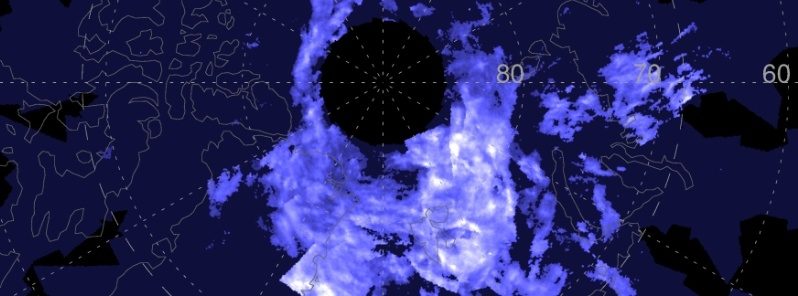
© NASA/AIM
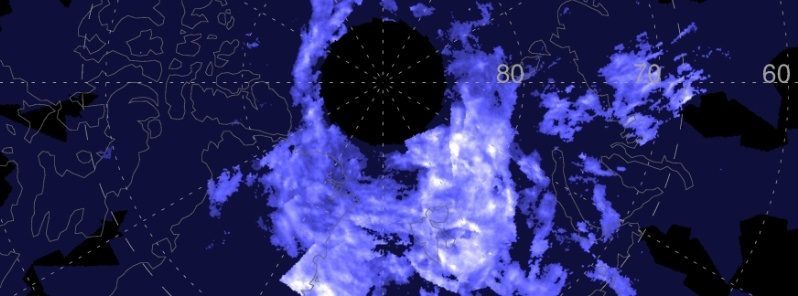
A huge blue cloud of frosted meteor smoke is pinwheeling around the Arctic Circle. NASA's AIM spacecraft spotted its formation on May 20th, and it has since circled the North Pole one and a half times, expanding in size more than 200-fold.
"These are noctilucent clouds," says Cora Randall of the AIM science team at the University of Colorado. "And they are going strong."
Noctilucent clouds (NLCs) in May are nothing unusual. They form every year around this time when the first wisps of summertime water vapor rise to the top of Earth's atmosphere. Molecules of H2O adhere to specks of meteor smoke, forming ice crystals 80 km above Earth's surface. When sunbeams hit those crystals, they glow electric-blue.
But these NLCs are different.
They're unusually strong and congregated in a coherent spinning mass, instead of spreading as usual all across the polar cap."This is most likely a sign of planetary wave activity," says Randall.




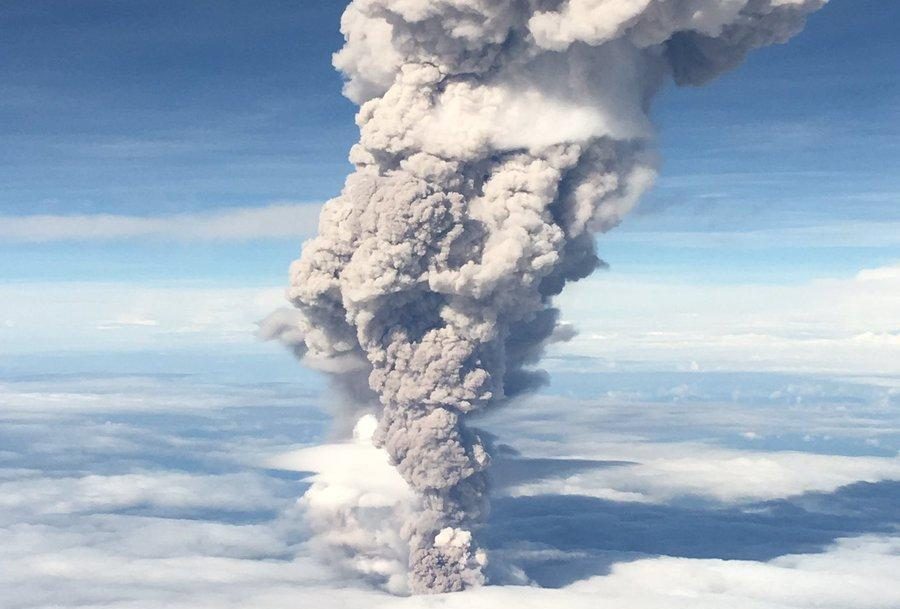






Comment: In July 2018 an English astronomer reported photographing more noctilucent clouds in six weeks than in the last three years. In August 2018 Noctilucent clouds TRIPLED compared to the previous year.
See also: Are noctilucent clouds increasing because of the cooling climate, and the rise of fireball and volcanic activity?
As explained in Pierre Lescaudron's book, Earth Changes and the Human-Cosmic Connection: See also: Chemtrails? Contrails? Strange skies