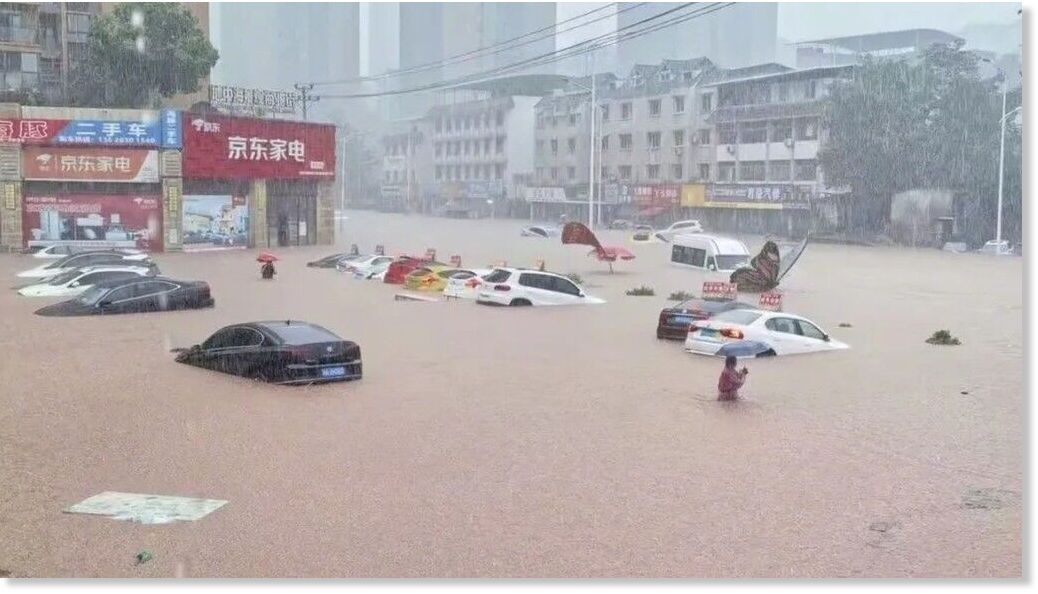
Heavy rain has caused severe flooding in parts of Chongqing, Guizhou and Guangxi, with water levels reaching up to two metres and submerging vehicles, authorities said.
The State Flood Control and Drought Relief Headquarters dispatched a working group to Chongqing on Sunday, urging enhanced emergency duty and strict implementation of 24-hour duty and leadership shifts.
The Ministry of Water Resources and the China Meteorological Administration issued a red alert for mountain torrents at 6pm on Sunday. From Sunday evening to Monday evening, parts of southwestern Hunan, northern Guangxi and southern Guizhou are at very high risk of mountain torrent disasters.
In Chongqing, a 500-600 metre section of road in the High-tech Agricultural Industry Avenue was flooded, with only vehicle roofs visible. A resident said rain started around 1am and by 7am water was about one metre deep, reaching over two metres by morning.
The Chongqing Hechuan District education authority confirmed that three college entrance examination venues are safely distanced from the worst-hit areas and have not been affected.
A powerful offshore earthquake struck southern Philippines on Monday, killing at least 32 people and injuring over 200.
The magnitude 7.8 earthquake also triggered tsunami waves exceeding a metre that impacted nearby coastlines.
The city of General Santos bore the brunt of the event, experiencing building collapses and significant damage to critical infrastructure. The bustling port city is home to some 700,000 people and a hub for the tuna export industry.
Tsunami damage was reported in at least one coastal village while smaller waves were observed as far afield as Indonesia, Palau, and southern Japan.
"It's a major earthquake and we're expecting damage," Teresito Bacolcol, the director of the Philippine Institute of Volcanology and Seismology, said.
Comment: Details of the 3 aftershocks from Earthquake Track available here, here and here.
A very strong magnitude 6.1 earthquake occurred in the North Pacific Ocean 107 km (66 mi) from Sakhalin Oblast, Russia, in the evening of Sunday, Jun 7, 2026 at 9.41 pm local time (GMT +11).
The quake had a shallow depth of 35 km (22 mi) and was reported felt by some people near the epicenter.
Pattaya Mail Pattaya Mail Wed, 03 Jun 2026 13:41 UTC
A waterspout moves from the sea toward the Laem Ngop coastline in Trat province, drawing the attention of residents as authorities assess potential damage.
Residents of Laem Ngop district were startled on June 2 when a waterspout formed over the sea before moving ashore near a coastal community, prompting authorities to monitor the situation and assess possible damage. According to a report from Laem Ngop Police Station, the phenomenon was observed at approximately 12:45 p.m. in the Laem Ngop area of Trat province.
Witnesses reported seeing the waterspout develop over the waters of Chong Chang before gradually moving toward shore and making landfall near the Laem Ngop community, creating concern among local residents who watched the dramatic weather event unfold.
Authorities said initial inspections were underway to determine whether any homes, fishing facilities, boats, or other property had been affected. No immediate reports of injuries were released. Relevant agencies are continuing to monitor weather conditions and evaluate the extent of any damage caused by the waterspout. Officials have advised residents in coastal areas to remain alert during periods of unstable weather and to follow updates from local authorities.
A three-month-old child has died Saturday morning after an alleged dog attack inside a home, according to the Richmond County Sheriff's Office.
Deputies said they were called to a residence in the 500 block of Hillwood Circle around 9:21 a.m., after receiving a report of a deceased infant who may have been attacked by a dog.
When deputies arrived, they found the infant, Zamora Robinson, dead inside the home. Officials said the scene was secured, and everyone inside the residence was safely removed.
Authorities say a Cane Corso was removed from the residence by Animal Services as part of the investigation.
According to the Richmond County Coroner's Office, Zamora was pronounced dead at 11:00 a.m. An autopsy has been scheduled.
The sheriff's office said the investigation remains active and ongoing. Investigators are continuing to conduct interviews and gather more information.
Minister of Natural Resources and Environment Suchart Chomklin ordered the Department of Marine and Coastal Resources to conduct an urgent investigation after millions of pink sea cucumbers washed ashore along Suan Son Beach in Tambon Phe, Mueang District, Rayong Province, on June 6, turning several hundred meters of coastline a vivid pink-red and drawing considerable attention from beachgoers.
The Minister directed the Department's Director-General, Dr. Pinsak Suraswadi, to dispatch officials to the site immediately to investigate the situation. A joint survey team from Marine and Coastal Resources Regional Office 1 confirmed the organisms are sea cucumbers—specifically the pink sea cucumber with the scientific name Cercodemas anceps. The species is a soft-bodied, cylindrical invertebrate that inhabits the seabed, identifiable by small surface spines and a color range from vivid pink to red-orange.
Marine experts explained that sea cucumbers play a vital role in marine ecosystems, processing and decomposing organic matter on the seafloor — a function that has earned them the designation "housekeepers of the sea" for their contribution to maintaining ecological balance in underwater environments.
Officials believe the phenomenon was caused by strong storm activity and heavy swells that dislodged the creatures from the seabed and drove them ashore, and described the occurrence as a rare natural phenomenon. The public has been advised to avoid direct contact with sea cucumbers, as some species release defensive secretions that may cause skin irritation in sensitive individuals. (NNT)
This is volcanic ash from today’s eruption of the Sakurajima volcano
Sakurajima Volcano unleashed one of its most intense eruptions on June 7, 2026, sending a towering plume of volcanic ash across Kagoshima City. What started as a clear June morning turned into a blanket of gray chaos within hours—visibility dropped to dangerous levels, ash coated streets, vehicles, and rooftops, and thousands of tourists found their summer vacation plans upended.
The eruption was no minor event. Japan Meteorological Agency (JMA) immediately raised alert levels, classifying it as high-intensity with ash plumes reaching kilometers into the sky. Residents and tourists received urgent warnings: stay indoors, wear masks, avoid all non-essential travel.
The timing couldn't have been worse. Summer tourism season was in full swing, and travelers from across the globe were converging on Kagoshima to experience one of Japan's most dramatic natural attractions.
Over the past 150 years, Earth's entire surface has been warming, except for one patch of the north Atlantic. Located south-east of Greenland, this area has cooled by as much as 1°C and is known as the "warming hole" or the "cold blob".
The AMOC carries warm, salty water from the Gulf of Mexico towards the north Atlantic, where it cools and sinks, flowing back south along the ocean floor. Scientists are concerned that the surge of freshwater from Greenland's melting ice is making this salty water less dense, so it sinks more slowly, weakening the circulation.
Some research suggests the AMOC could cross a tipping point within decades, locking in a future collapse that would freeze Europe and disrupt monsoon rains crucial for agriculture in Africa and Asia. But we only have 22 years of direct observation of AMOC strength, not enough to tease out a clear trend.
Climate modelling has suggested that a slowing AMOC is carrying less warm water to the north Atlantic, resulting in the cold blob. However, other modelling has placed most of the blame on the atmosphere.
Sadie Harley and Andrew Zinin phys.org Fri, 05 Jun 2026 10:44 UTC
Storm Dave, which swept across northern Europe over the Easter weekend, is an example of what new research from the University of Gothenburg has revealed. Spring storms forming over the North Atlantic have become more common than they were 80 years ago, and this is due to climate change.
In the Northern Hemisphere, storm seasons follow a seasonal cycle. Storms are weakest and least frequent in summer and most intense in winter. As a result of global warming, storm patterns and their course have changed, and several studies have indicated that winter storms appear to be occurring more frequently and with even greater intensity.
Less Arctic sea ice
"One factor that may be contributing to the formation of more storms is the reduction in Arctic sea ice. Open water can release more heat and moisture into the atmosphere than when there is a layer of ice covering the sea. The shrinking sea ice also means that storms can take new paths across the Arctic oceans," says Zhi-Bo Li, a researcher in climatology at the University of Gothenburg.
The eruption of the Shiveluch volcano on the Kamchatka Peninsula in Russia's Far East has sent a massive plume of ash 10 kilometers into the sky and triggered red-level aviation alerts for the area and nearby regions.
The ash cloud from Saturday's eruption stretched some 50 kilometers from the volcano as it traveled east toward the Bering Sea, according to the Volcanology and Seismology Institute of the Far Eastern Branch of the Russian Academy of Sciences.
A more powerful explosion that could send ash up to 12 kilometers into the sky "could occur at any time," the institute warned. A video recorded by scientists and published on social media showed a massive plume of grey smoke and ash rising high into the sky above the volcano.
Comment: Details of the 3 aftershocks from Earthquake Track available here, here and here.