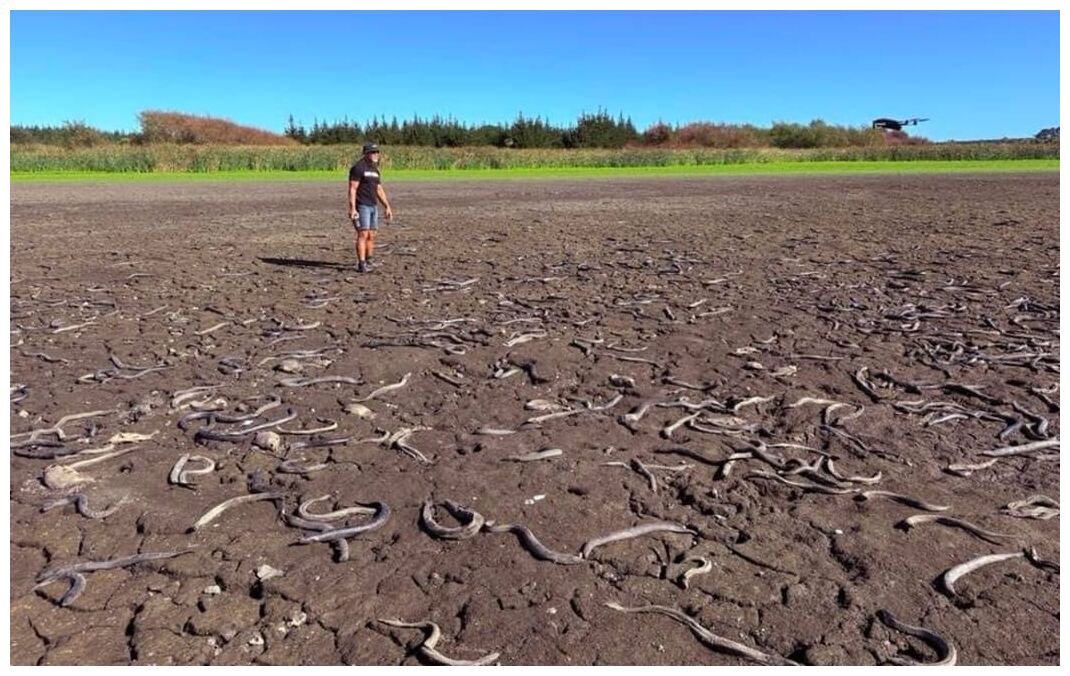
Thousands of eels are found dead in dried up Manawatū lagoon as questions mount over water use and a vanishing ecosystem.

© RNZThousands of eels were found dead after a Manawatū lagoon disappeared.
A grim mystery has unfolded in New Zealand waterways, with thousands of eels - the long, snake-like ancient survivors of our rivers - washing up dead.
And no one really knows why.
In the latest event, mud-caked,
lifeless bodies of the eels were found at the bottom of a Manawatū lagoon that disappeared.
"This one remains a mystery," RNZ field journalist Jimmy Ellingham tells
The Detail. "It could be something natural, or it could be something to do with land use, or a combination of both."At this point, we simply don't know, so that's the mystery at the moment at Pukepuke Lagoon."He says local council officials discovered that the water at Pukepuke Lagoon was gone earlier this month.
In its place: a wide, cracked basin of earth, and scattered across it, thousands of eels, which are typically among New Zealand's oldest survivors, living, sometimes, for more than a century.
They can usually endure low oxygen, burrow into mud, and wait out harsh conditions. But when the lagoon emptied, eels of all ages and sizes couldn't hold on.
"On that dry lake bed, there were hundreds, potentially thousands of dead eels, as well as some fish and some freshwater mussels as well," says Ellingham, who has been covering the devastating scenes and subsequent investigations.
"When I last checked, members from three local iwi had rescued about 3,000 eels from the dried-up lake and taken them to nearby waterways.
"But there were still hundreds, if not thousands, of bodies of dead eels, decomposing eels on the surface of where the lake once was."