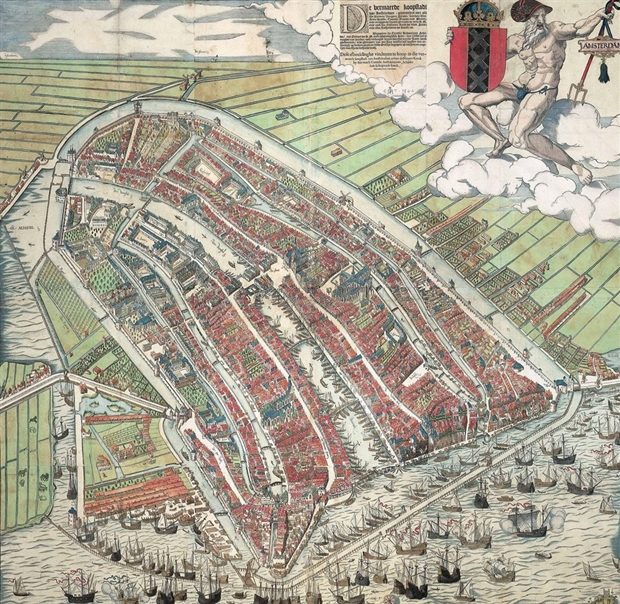
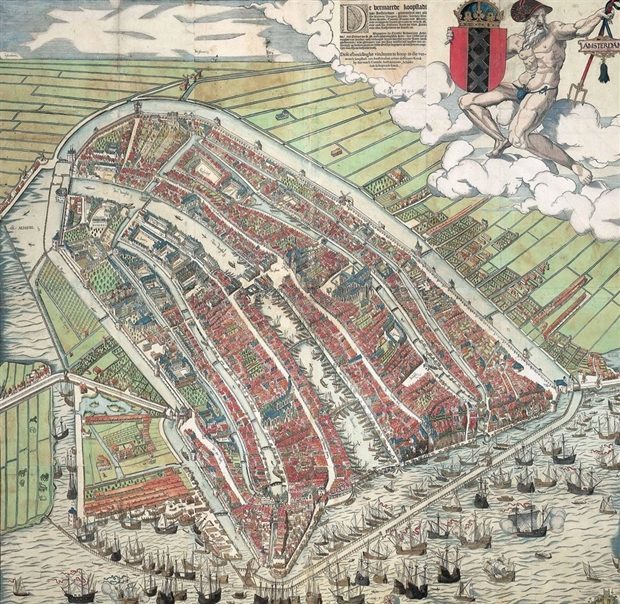
Amsterdam around 1540.
Late July this year, the Netherlands
recorded all-time high temperatures, but has it ever been that hot before, or even hotter?
Take the summer of 1540. It was particularly hot over all of Europe. As Dutch author Jan Buisman of the book
Duizend jaar weer, wind en water in de Lage Landen describes: "Harvest failed, drinking water was hardly available, and diseases were rampant. On top of that, there was also a mouse plague in the Netherlands. A chaplain from the Dutch province of Limburg kept a diary and described how farmers on the land fell dead as a result of the heat while they were mowing."
Many people in Amsterdam succumbed to heat stroke, heart attack or contaminated drinking water. We do not know the exact temperatures of the summer of 1540, but from the described dry rivers, many forest fires and prolonged heat and drought
we can assume that these were certainly not lower than during the past summer. Many sources
speak of seven months of sun-drenched, dry and hot weather.
The heat lasted so long that the year 1540 was recorded in the history books as the "Great Solar Year". Generations will continue to talk about the hottest summer ever, and for modern climatologists the summer of 1540 is still a fascinating benchmark. The following year, the summer of 1541, by the way, reverted straight back to the typical summers in Amsterdam: cold and wet.



















Comment: This is what mathematician Nicholas Lewis wrote about the paper: Indeed, that's too much to hope for. MSM have not retracted their articles about this study, such as CNN.