Science of the SpiritS


Books

Sophrosyne: An ancient Greek virtue that matters more than ever in the age of AI

brain in balance graphic
© PM Images/DigitalVision via Getty ImagesSophrosyne is a constellation of characteristics that includes moderation, reflectiveness and self-knowledge.
Texting while driving. Bullying people on social media. Buying into the latest conspiracy theory. Passing off AI-generated work as your own.

That may seem like a random list of 21st-century vices. But I'd argue they're all examples of the loss of one particular virtue: sophrosyne.

An ancient Greek concept, sophrosyne - pronounced "suh-fros-uh-nee" - is what we might call "sound-mindedness" today. It's a constellation of characteristics, including moderation, reflectiveness and self-knowledge. They're found in the kind of person who can respect and trust herself, and be respected and trusted by others.

As a philosopher and philosophical counselor, I research the connection between virtue and happiness. In particular, I've noticed a connection between sophrosyne and eudaimonia, the Greek philosophical concept for happiness, or living well.

Comment: 8/10. Good advice in the main, but one should not close one's mind to the possibilities at the edges of reality.


Arrow Up

Discipline!

Discipline!
© Shrew Views
Another admirable human trait that has gone the way of the Dodo. It certainly disappeared from my life early on — if it was ever there to begin with. If I had to pick the number one thing that has gotten in the way of my goals, I'd say it's the lack of discipline. For me, it hasn't been a total lack, but it's right up there at the top of the list.

So, exactly what is discipline? A simplistic way to define it would be this: practicing discipline means consistently doing something that doesn't bring immediate pleasure, but in the end delivers the goals you actually want. And here comes instant gratification again — that evil little trickster that seems to be Public Enemy Number One these days.

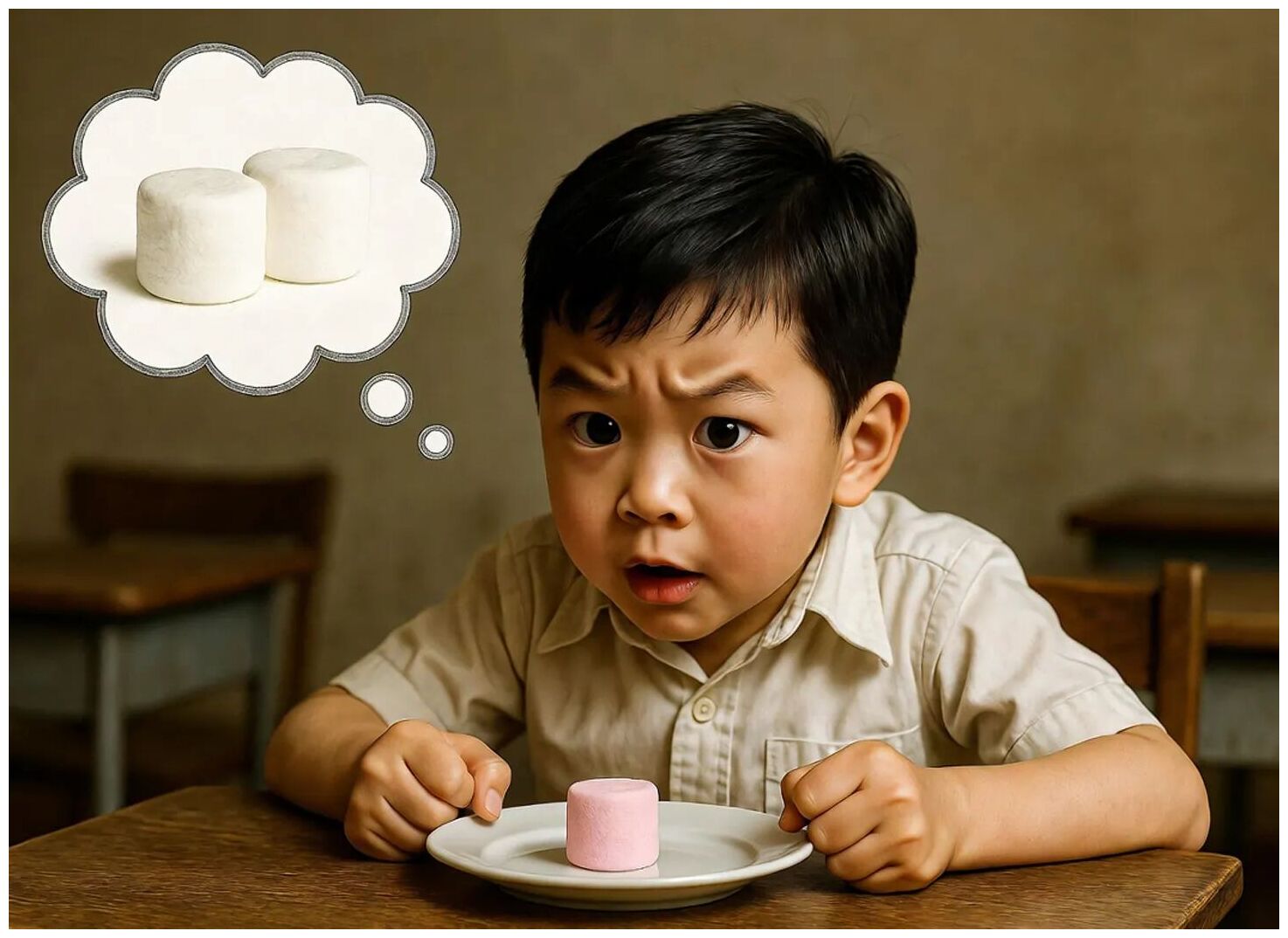
I'm sure you're all familiar with the marshmallow experiment. Conducted in the late 1960s and early 1970s by psychologist Walter Mischel at Stanford University, it tested delayed gratification in preschool-aged children. A kid was left alone in a room with one marshmallow (or sometimes a cookie or pretzel). They could eat it right away, or wait 15-20 minutes for the researcher to return and get two marshmallows instead. Some kids ate it immediately. Others distracted themselves, covered their eyes, or sang songs to resist.

Follow-up studies over decades showed that the children who waited longer tended to have better life outcomes: higher SAT scores, better educational attainment, lower BMI, and fewer issues with impulsivity or addiction later on. It wasn't perfect science — later replications questioned how strongly it predicted success — but the core idea holds: the ability to resist immediate temptation for a bigger future reward matters.

The important thing to note is that this was done with children. As adults, we're supposed to know better — wait, be patient, stay disciplined, and reap greater rewards. Ha ha. I'm sure when I was a kid, I would've scarfed the first marshmallow, and now, if they replaced it with cookies, I'd do the exact same thing.

Cult

Are World Leaders Possessed? The Ancient Technology of Demonic Transfer

World Leaders Possessed
The Vatican just declared a global emergency. Tucker Carlson called the President the Antichrist. A historian who infiltrated a UN-connected mystery school explains what you are watching unfold.

According to the oldest surviving mythology on earth, kings did not rule alone. Each one had a demon assigned to him. The Sumerians called them Apkallu. They were divine counselors, and they whispered in the ear of the ruler. I am a historian who studied inside a UN-connected mystery school. This is what I have spent a decade learning about what you are watching.

The word "museum" comes from the Greek mouseion: a temple where spirits entered the people who came seeking knowledge. Homer did not write the Iliad. He asked a goddess to possess him and use his voice. The opening line is the request: "Sing, O goddess."

Everyone is using the word possessed lately. The more popular term, as of late, has been "Demonic Transfer Technology." They say it like a metaphor. What if there is a pragmatic, even scientific, explanation for what appears to be the demonic possession of our global leaders?

Comment: See also:

Bill and Hillary Clinton delved deeply into Haitian voodoo and black magic ceremonies


Snakes in Suits

The Demonization of Men (and everyone else too)

demonization
© medium.com
Imagine the following message in a public space:

Caution: Area of Frequent Attempts at Reputational Destruction by Females

I have never seen a sign bearing the above message in any public space, nor do I want to. Similarly, I have never seen a sign near a heavily African American neighborhood that says:
"Caution, entering an area in which your chances of being the victim of a violent crime are statistically proven to be much higher than in other places."
And again, I do not want to.

My reasons for not wanting to ever read these things are, or should be, self-evident to any reasonably thoughtful person: it is never permissible in a society that purports to be democratic to have the state apparatus cast moral aspersions upon an entire subset of the culture on the basis of that subset's immutable characteristics.

And yet, in many municipalities in the US and Europe there is a trend toward posting signs in public transport that, in various levels of explicitness, point toward all men as being gropers and harassers in potencia.

Post-It Note

The importance of inexpert opinion

discussion 2 people
© Adobe Stock/KJNDiscussion
I was out with a friend for lunch the other day (yeah, I still have a few of those left). This friend leans more to the liberal side of things.

He certainly doesn't care for Trump, is a vax advocate, etc. A very nice guy, I have to say — a superb artist, an excellent father, and just a good all-around person. I won't go off on a tangent here, but sheep types are typically not bad people.

They are just like us, only asleep. Anyway, I digress.

Needless to say, our conversation focused on music and other safe subjects and didn't venture into the dark zone of world politics, public health, and the like. But he did say one thing that got me thinking. It's something you hear often, and usually when you hear it, the person saying it is rather livid. They just can't believe it, and they present it as if it is one of the main reasons the world is going to shit.
"Why does everyone think they are an expert and run off at the mouth all of the time? Why can't they just shut up and listen to the people who know what they're talking about?"
Quite frankly, I hear this from shrew and sheep alike (though more from sheep, actually — at least they seem more angry about it than shrews do).

People

France: 19-year-old wakes up from 3-week coma, asks to meet her babies who never existed

Mother and child
© imgname-FranceMother? and Child?
In France, when 19-year-old Clélia Verdier woke up from a medically induced coma, her first instinct was to ask for her three daughters. Instead, doctors shattered the reality she had been living in: the children had never existed.

Verdier, from Lyon in France, had slipped into a coma in June 2025 after what she described to the Daily Mail as a "serious suicide attempt by taking a large amount of medication". She remained in a medically induced coma for three weeks — but inside her mind, an entirely different life unfolded.

Unaware that she was unconscious, Verdier experienced what she described as "extremely intense" dreams and nightmares that became indistinguishable from reality. Among them was a vivid and emotional journey of becoming a mother.

Fire

The Noble Savage

the noble savage
Eisenhower warned us: "Beware the military-industrial complex." Those words are widely remembered. Less so the companion warning: "Holding scientific discovery in respect, as we should, we must also be alert to the equal and opposite danger that public policy could itself become the captive of a scientific technological elite."

That second warning may prove the more prophetic. The convergence of those two forces - the industrial machinery of power and the technological elite capable of shaping reality itself - is where we now find ourselves.

The AI singularity is typically described as the point at which artificial intelligence surpasses human intelligence, triggering an uncontrollable "intelligence explosion." At this tipping point, AI becomes capable of recursive self-improvement...designing smarter versions of itself...leading to rapid, unpredictable, and profound and irreversible change in human civilization. We are told this is imminent.

Alarm Clock

We may be entering a second Axial Age

abstract graphic timeline axial age
© Studio Nokori for Noema Magazine
The transition from small hunter-gatherer societies into complex civilizations gave rise to the first Axial Age. Today, the planetary polycrisis of climate chaos, mass migration, increasing warfare and transformative AI represents a rupture of comparable magnitude.

I owe the primary inspiration for my life's work to growing up on a family farm. Sixty-eight years ago, my parents transformed their farming methods from conventional to regenerative, prioritizing long-term soil resilience over short-term crop yields. And what I learned from my father is this: The quality of what grows above the ground depends on the quality of the soil beneath it.

Today, many decades later and many thousands of miles from the farm, my work focuses on cultivating the social soil: the relationships, awareness and shared sensemaking from which all visible social systems grow. When the social soil is healthy — when trust runs deep, when shared reality holds, when people can communicate and sense together and act from it — everything above ground flourishes. When the social soil is depleted, no amount of structural reengineering can compensate. Structures become hollow. Coordination fails. Conflicts and wars increase. The system eats its own foundations.

Info

Can we really trust our feelings?

Feelings
© Shrew Views
Sure, as long as we are conscious of their true origins. And even if not, sometimes we can trust, other times no. Feelings are odd things. They can come out of nowhere, or they can be highly circumstantial — like the rush of extreme fear when a bear jumps aggressively from behind a tree. They can also be mysterious "gut feelings." Usually, we have some awareness of their unconscious underpinnings. We sense whether a feeling is a solid "gut" instinct, something "creepy," or simply "good" — as in, "I just liked that guy; there was something about him that made me feel comfortable and trusting."

But . . . and it's a big "but," we know we have to be careful. The guy or gal who sweeps us off our feet on a first date needs further scrutiny. We have all fallen into that pit, haven't we? It is a deep, dark chasm, and usually very difficult to climb out of. Did you ever wonder why, back in the day, marriage engagements often lasted what seemed an eternity? There were many social and cultural underpinnings, but one major reason was simply to get past the "swept off your feet" syndrome — to make what was largely unconscious, conscious.

So, what's the big deal? If our impressions of things and people rely too heavily on feelings — especially when we are not conscious of their origins — we can end up in serious trouble. Most of the time, it doesn't really matter what our feelings are about other people. We see an actor we like or meet someone in the grocery store we immediately dislike. Actors don't matter much in our daily lives; their entire craft is built on creating impressions based on unsubstantiated feelings.

Most strangers we encounter don't matter much either. But people like our lawyer, our doctor, or our lover, do. With the exception of the latter, we usually have some objective basis for our assessments — what are their credentials? What is their reputation? Has the state licensed them? (As I clear my throat on that one.) We may still have a gut feeling, which remains important given their role in our lives, but we temper the emotional response with at least some objective evaluation.

Life Preserver

Euthanasia is now 6% of all deaths in the Netherlands; experts urge caution against youths choosing to die

contemplation
© Getty ImagesWhen death becomes a choice
Dutch experts have warned that those under the age of 25 in particular do not have the decision-making abilities to properly consider ending their own life.

Euthanasia is now responsible for 6 percent of all deaths in the Netherlands, and this figure is increasing every year.

According to a report by the regional euthanasia review committee (RTE), cited by the news portal Hirado, 10,341 people died by euthanasia in 2025, and while three-quarters of the applicants were over 70 years old, one case involved someone between the age of 12 and 18.

The number of those choosing to die by euthanasia due to mental illnesses decreased by almost a fifth (174 cases), but more than 85 percent suffered from physical diseases such as cancer, nervous system disorders, and lung or cardiovascular diseases.

There were 499 cases of euthanasia performed on patients with dementia, and the RTE investigated 11 cases where the patient was no longer competent. In addition, 475 cases involved the co-existence of multiple age-related illnesses, and 278 cases involved "other reasons."

Comment: Life is choice...on all levels, at all times, in all circumstances.