It's among the 'oldest evidence of architecture' in Europe.
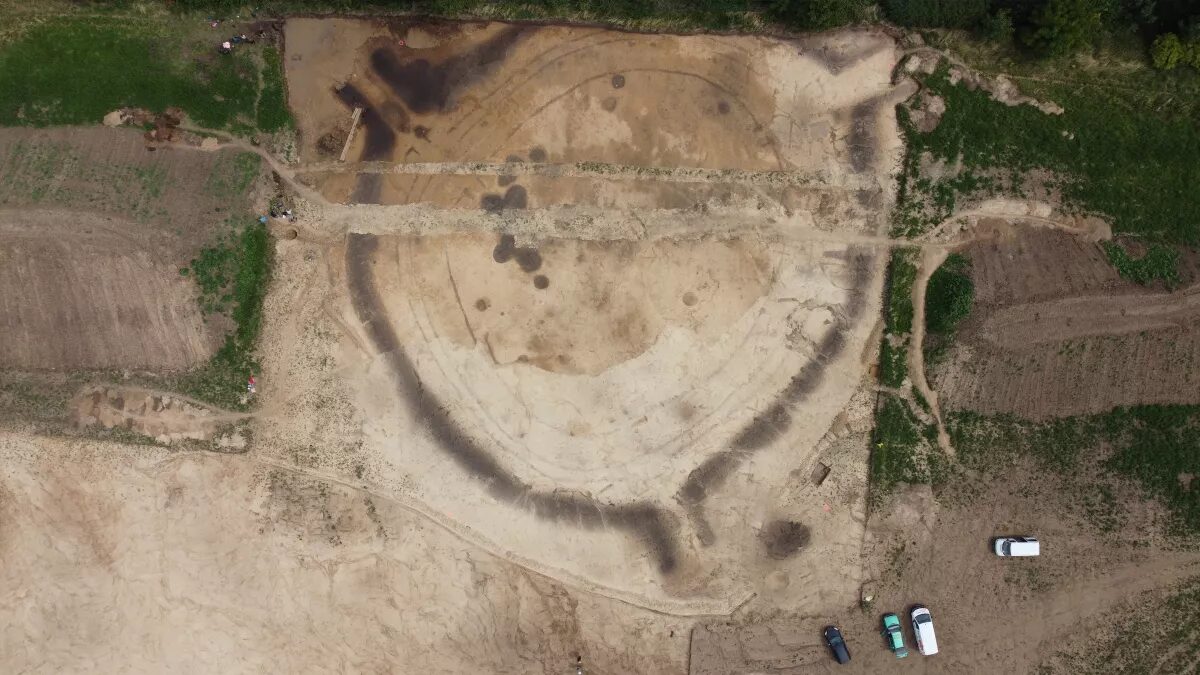
© Institute of Archaeology of the Czech Academy of SciencesAn aerial view of the Vinoř roundel near Prague, showing three separate entrances.
Archaeologists digging near Prague have discovered the
remains of a Stone Age structure that's older than Stonehenge and even the Egyptian pyramids: an enigmatic complex known as a roundel. Nearly 7,000 years ago during the late Neolithic, or New Stone Age, a local farming community may have gathered in this circular building, although its true purpose is unknown.
The excavated roundel is large — about 180 feet (55 meters) in diameter, or about as long as the
Leaning Tower of Pisa is tall,
Radio Prague International reported. And while "it is too early to say anything about the people building this roundel," it's clear that they were part of the
Stroked Pottery culture, which flourished between 4900 B.C. and 4400 B.C., Jaroslav Řídký, a spokesperson for the Institute of Archaeology of the Czech Academy of Sciences (IAP) and an expert on the Czech Republic's roundels, told Live Science in an email.
Miroslav Kraus, director of the roundel excavation in the district of Vinoř on behalf of the IAP, said that revealing the structure could give them a clue about the use of the building. Researchers first learned about the Vinoř roundel's existence in the 1980s, when construction workers were laying gas and water pipelines, according to
Radio Prague International, but the current dig has revealed the structure's entirety for the first time. So far, his team has recovered pottery fragments, animal bones and stone tools in the ditch fill, according to Řídký.
Carbon-dating organic remains from this roundel excavation could help the team pinpoint the date of the structure's construction and possibly link it with a Neolithic settlement discovered nearby.







Comment: See also: Crannogs: Scotland's mysterious ancient artificial islands