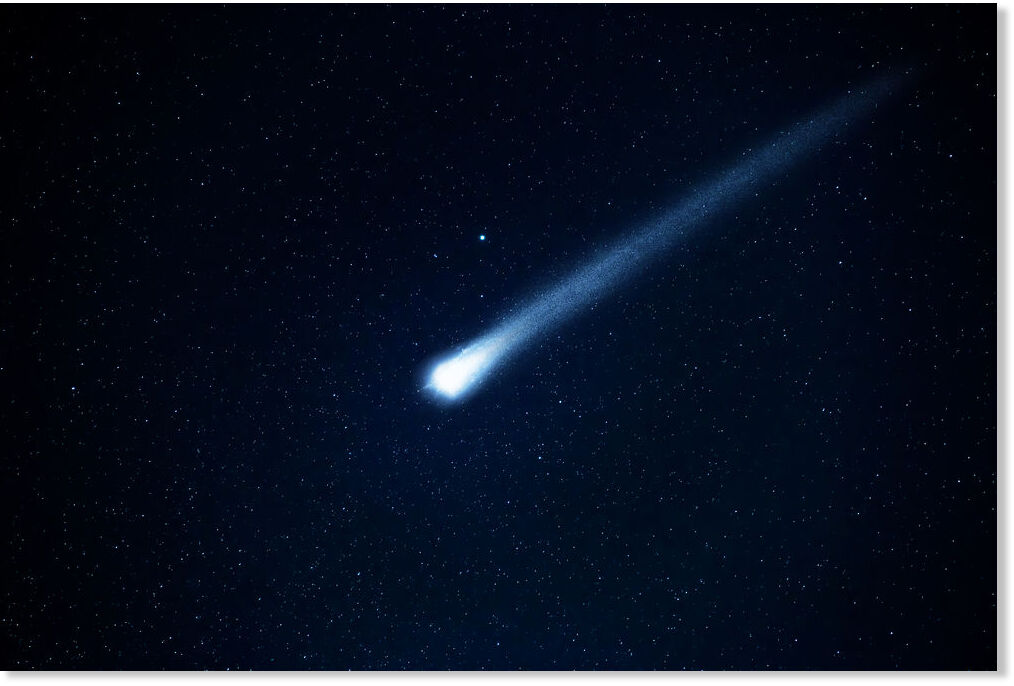
A bolide, or fireball, was captured on camera crossing the night sky on May 28, 2026, near the Popocatépetl volcano as the colossus emitted vapors and incandescent material. This astronomical event was visible from Mexico City and Pachuca around 9:00 p.m.
The moment was shared by the National Coordination of Civil Protection and the National Center for Disaster Prevention (Cenapred) through the social networks of Webcams de México , in a YouTube video and X (Twitter).
At precisely 8:54 PM , the meteor was captured crossing the sky near Don Goyo (Goyo's nickname ) and, seconds later, seemingly just before touching the ground, it vanished. The phenomenon was also seen south of Mexico City and in the area of the Clock Monument in Pachuca, Hidalgo.
We received 7 reports about a fireball seen over Bavaria, Bayern, Nordrhein-Westfalen, Sachsen-Anhalt, Thüringen and Zuid-Holland on Wednesday, May 27th 2026 around 22:51 UT.
For this event, we received one video and 2 photos.
We received 10 reports about a fireball seen over Bayern, Hessen, Niedersachsen, Nordrhein-Westfalen and Thüringen on Monday, May 25th 2026 around 01:49 UT.
For this event, we received 3 videos and 4 photos.
We received 12 reports about a fireball seen over Abruzzo, Basilicata, Lazio, Marche, Puglia, Republika Srpska and Split-Dalmatia County on Monday, May 25th 2026 around 19:30 UT.
Ellalyn De Vera-Ruiz Manila Bulletin Mon, 25 May 2026 18:33 UTC
A meteor was recorded passing over the slopes of Mayon Volcano on Monday evening, May 25, according to the Philippine Institute of Volcanology and Seismology (Phivolcs).
Phivolcs said its Ligñon Hill IP Camera in Legazpi City captured the meteor at around 10:33 p.m., but noted that it disintegrated while still in the atmosphere and did not reach the slopes of Mayon.
At the time of the sighting, the active volcano in Albay was on its 140th consecutive day of effusive eruption, marked by the slow outflow of lava and intermittent pyroclastic density currents.
Earlier in the evening, the volcano generated lava collapse-fed pyroclastic density currents (PDCs), or "uson," along the Mi-isi and Basud gullies, as well as minor strombolian activity, which refers to short explosive bursts that eject glowing volcanic material and produce brief lava fountains.
This bright bolide was spotted from Spain on May 21, at 22:27 local time (equivalent to 20:27 universal time). The fireball was observed by a wide number of casual eyewitnesses, who reported it on social networks.
The event was generated by a rock (a meteoroid) from a comet that hit the atmosphere at about 85,000 km/h. The fireball overflew Jaén and Córdoba (Spain). It began at an altitude of about 89 km over Zocueca (province of Jaén), moved northwest, and ended at a height of around 42 km over Adamuz (province of Córdoba).
This bright meteor was recorded in the framework of the SMART project, operated by the Southwestern Europe Meteor Network (SWEMN) from the meteor-observing stations located at Huelva, La Hita (Toledo), Calar Alto (Almería), Sierra Nevada, La Sagra (Granada), Sevilla, Otura (Granada), and Mazagón (Huelva). The event has been analyzed by the team headed by Dr. Jose M. Madiedo (principal investigator of the SMART project), from the Institute of Astrophysics of Andalusia (IAA-CSIC). Its code in the SWEMN database is: SWEMN20260521_202732.