Puppet MastersS


Gavel

AAG Dhillon wants judge who allegedly attended a Fani Willis event off Georgia election integrity case

U.S. District Judge Eleanor Ross.
© Eleanor L. Ross via CCU.S. District Judge Eleanor Ross.
The judge, whom Dhillon identified as U.S. District Judge Eleanor Ross, allegedly committed judicial misconduct when she attended an event that honored Fulton Count District Attorney Fani Willis.

Assistant Attorney General Harmeet Dhillon filed a memorandum Friday calling for a federal judge to recuse herself from an election integrity case in Georgia after allegedly attending an event that allegedly honored Democratic Fulton County District Attorney Fani Willis.

Dhillon, in the memorandum, says the Eleventh Circuit Judicial Council, the primary governing and administrative body for the U.S. Court of Appeals for the Eleventh Circuit, operating out of Atlanta, found an unnamed judge "committed judicial misconduct by attending a "partisan and political event."

Comment: Improper socializing seems to be Ross' specialty. Just to make things even crazier, she is also embroiled in a sex scandal. Quelle supris . . . .


No Entry

London bans Israel critics Hassan Piker, Cenk Uyghur from entering UK

Hassan Piker banned britain
© Brock Stoneham/NBC NewsHassan Piker
Piker took to social media to slam the UK for banning him and revoking his visa 'at the behest of Israel'

Pro-Palestine streamer and commentator Hassan Piker was banned from visiting the UK by the British Home Office, ahead of his planned meeting with former Labour Party chief Jeremy Corbyn.

Piker was also due to meet with Green Party leader Zack Polanski.

"The UK has revoked my visa as well. All at the behest of Israel. The west is betraying 'liberal values' for a genocidal fascist foreign government. Soon we will all become Israel," Piker said on X on 1 June.

Arrow Down

The Mossad Delusion: Why Israel still thinks Iran will fall

Nations with collective memory do not collapse simply because their enemies misunderstand them.
Mossad Delusion
© Kevork’s Newsletter
One of the most revealing aspects of intelligence agencies is that they often tell you more about themselves than they intend to. Not through leaks, defections, or declassified documents, but through moments of self-congratulation. Moments when they believe they are demonstrating strength and sophistication, yet end up exposing the assumptions, fantasies, and misconceptions that drive their strategy.

That was my reaction when I came across an article in Israel Hayom about a secret Mossad branch dedicated to influence operations against Iran.

And I want to begin with a necessary qualification, because the article itself was published in Israel Hayom, a deeply pro-Israeli outlet. Therefore, everything inside it has to be read carefully, not as neutral journalism, but as a window into how the Israeli security establishment wants to present itself, its successes, its failures, and its ongoing war of aggression against Iran. But precisely because of that, the article matters. It reveals the mentality of the people planning this war. It reveals how Mossad thinks about Iranian society, how it understands psychological warfare, how it tries to manufacture political effects through media, scandals, fake accounts, influencers, and pressure campaigns, and perhaps most importantly, how deeply Israel still believes in the fantasy that Iran can be broken from within.

The central revelation in the article is that Mossad created an influence operations branch under David Barnea, who became Mossad director in 2021. Barnea led a broader reform that placed regime change in Iran much closer to the heart of Mossad's mission. According to the article, this branch was designed to understand public moods, media trends, social pressure points, and vulnerabilities inside Iran, and then weaponize them in ways that could weaken the Islamic Republic psychologically, politically, and socially. In other words, this was a complex political warfare disguised as classical intelligence work.

One of the cases used to illustrate this branch's activity was the operation against Rostam Ghasemi, a senior Iranian military and political figure who had served in the IRGC, fought in the Iran-Iraq War, later became influential in strengthening Iranian military capabilities, and remained close to important circles within the state. According to Israel Hayom, Mossad had obtained a photograph of Ghasemi in Malaysia years earlier, where he appeared with a woman who was not his wife and who was not wearing a hijab. The image was allegedly held for years and then leaked through Iran International during the 2022 protests, at a moment when the hijab issue was already politically explosive inside Iran. The objective, from Mossad's perspective, was to remove a seasoned figure from influence while simultaneously feeding the atmosphere of unrest.

Star of David

Israel's secret bases in Iraq: A new phase of shadow warfare in the Middle East

Map Iraq
The revelation that Israel established secret military bases inside Iraq during the recent war against Iran is far more than another episode in the region's long history of covert operations. It signals a deeper transformation in Middle Eastern geopolitics: the normalization of clandestine cross-border military infrastructures, the erosion of Iraqi sovereignty, and the increasingly blurred line between intelligence operations and open regional warfare.

French television stated that "the United States was, of course, aware" of the operation and that Israel had established two covert positions in the Iraqi desert to prepare for the war against Iran. One base was reportedly located near Najaf, south of Baghdad, and another farther north in Al Anbar Governorate, possibly near Qaem, close to the Syrian border. According to reports first published by The Wall Street Journal and later confirmed in part by the Associated Press, the installations housed Israeli special forces and functioned as logistical hubs for the Israeli Air Force before and during operations against Iran.

Blue Pill

War With a Capital "W"

Guy with cell phone
© Unknown
Media Theater, Proxy Conflict, and the Death of Continuity.

As the Russia-Ukraine conflict drags deeper into proxy-war reality, Western media institutions increasingly appear less interested in describing events than emotionally framing them. What emerges is not simply journalism, but narrative choreography shaped by elite institutional ecosystems, synchronized moral language, and a civilization trapped inside permanent escalation psychology.

The Proxy War Nobody Wants to Name

For years now, politicians and media institutions on all sides have carefully avoided one blunt word to describe what is happening on the steppes of Russia: war.

Instead, the public has been fed a carefully softened vocabulary of "conflict," "security architecture," "rules-based response," and "strategic escalation management." Yet after hundreds of billions spent, infrastructure sabotage, drone strikes deep inside sovereign territory, NATO intelligence involvement, sanctions warfare, industrial mobilization, and continual escalation rhetoric from all sides, pretending the carnage between Ukraine and Russia remains some isolated regional misunderstanding has become increasingly absurd.

Comment: Brilliant definition how programming and perception harness the minds and actions of leadership and societies experiencing war.


Telephone

'You're f***ing crazy!' Trump yelled at Netanyahu for derailing Iran talks - Axios

Trump on phone
© Drew Angerer/File/Getty ImagesUS President Donald Trump
Tehran has warned it could resume direct confrontation if Israel continues its campaign in Lebanon.

US President Donald Trump has lashed out at Israeli Prime Minister Benjamin Netanyahu over Israel's escalation in Lebanon, Axios reported on Monday, citing two American officials and a third source briefed on the call.

Trump allegedly accused Netanyahu of endangering US negotiations with Iran and demanded that Israel halt a planned strike on Beirut, in what Axios described as one of the worst calls between the two leaders since Trump returned to office.

"You're f***ing crazy. You'd be in prison if it weren't for me. I'm saving your ass. Everybody hates you now. Everybody hates Israel because of this," one official summarized Trump's remarks to Netanyahu. A second source briefed on the call said Trump was "pissed" and yelled at Netanyahu: "What the f*** are you doing?"

No Entry

Will Trump sideline Israel in order to make a deal with Iran?

Trump takes questions
© Patrick B. Ruddy/Official White House photoUS President Donald Trump takes questions • South Lawn • White House
Donald Trump reportedly has a deal on the table to suspend fighting and begin negotiations to end the Iran war and the resulting global economic crisis. But Israel and Iran hawks see it as a disaster and are working to undermine it. Who will win out?

According to available reports, the purported agreement on a Memorandum of Understanding (MOU) between the United States and Iran to entrench the current ceasefire was ready to be signed and presented to the public, and Trump was going to retire to his "situation room" to confer with his people and announce it.

If that seemed too good to be true, it turns out it was, at least for the moment.

Eventually, Trump is going to have to decide whether to accept an MOU that will be harshly attacked by Israel and Iran hawks or resume the fighting. Choosing the former is out of character for the beleaguered president, but resuming the fighting will bury him deeper in this quagmire and will intensify the global economic crisis.

What is in the Iran agreement, and what it is not

It's important to recognize that all this MOU would do is formalize and expand the existing ceasefire. In practice, ending the war can only happen if the negotiations stipulated in the MOU come to a successful conclusion.

There's no guarantee of that, from either side.

Comment: Circling the circles is not a plan. The longer it takes to come to terms, the more expensive the finale.


Helm

Arctic route, far from tensions, could be alternative to Hormuz

Arctic Map
© Getty ImagesMap of the Arctic region
The far north of the globe is seeing new maritime routes open as the Arctic ice sheet melts, shortening the distance between China and Europe.

Beijing has seized the opportunity and expanded its operations in the region. The Northern Sea Route is not new, but it offers an opportunity to reduce dependence on trade routes through the Strait of Hormuz, especially during times of conflict, such as the one currently affecting the Middle East.

The Arctic region is undergoing transformations that overcome climatic barriers and enable the flow of large vessels, such as oil tankers, in this transitional scenario, not only in geopolitics but also in foreign trade. The new dynamic underway reinforces Russia's leading role, as it invests in infrastructure and operational capacity in the polar region.

Eight states are located in the Arctic: Iceland, Denmark, Russia, United States, Norway, Sweden, Finland, and Canada. They comprise the Arctic Council. However, China has made intensive use of this maritime route and describes itself as a "near-Arctic" state.

China, the world's largest producer of manufactured goods and a country that needs to move its merchandise, has proposed a new route in partnership with Russia, moving products not only through Asia and Africa but also over the Arctic, colloquially known as the new polar Silk Road.

Attention

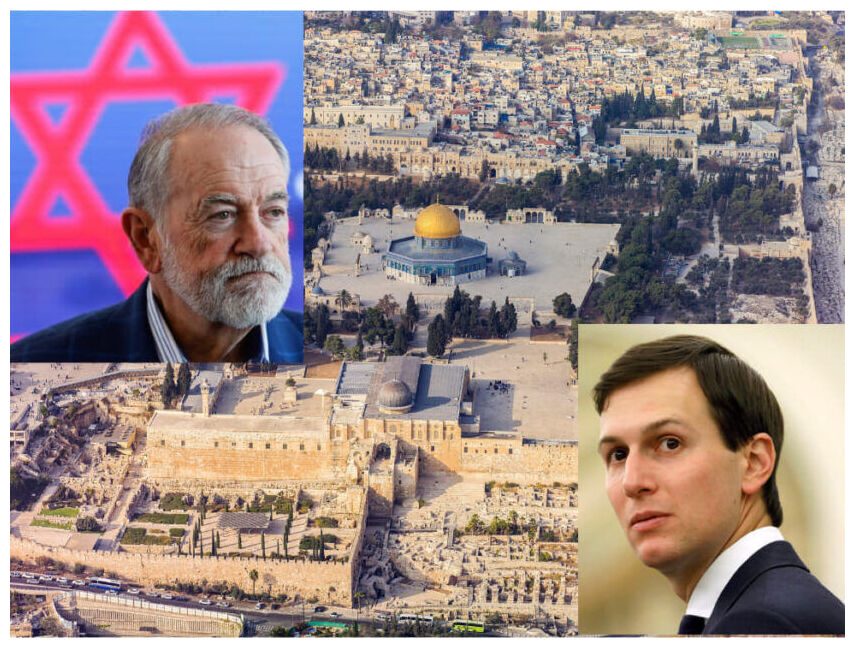
Trump's plan for Al-Aqsa mosque

Trump’s plan for Al-Aqsa mosque
© The Postil Magazine
Of the many outrages that have defined American foreign policy toward the Middle East, few have been as deliberate and as fraught as the reported Trump administration plan to dismantle the Islamic Waqf at the Al‑Aqsa Mosque compound. According to a joint investigation by Middle East Eye, citing American, Jordanian, Palestinian, Gulf, and Western sources, the United States and Israel are "actively working" on a new arrangement to terminate the century‑old Hashemite custodianship of the third‑holiest site in Islam. The reported scheme would replace the Waqf — the Jordanian‑run Islamic trust that has administered the Haram al‑Sharif since the early twentieth century — with an Israeli‑appointed body tasked with redefining the sacred enclosure as a "multi‑faith centre." Under the plan, Jews would receive "equal access" to the compound and would be formally permitted to conduct large‑group prayers on the esplanade; Israel would gain decisive influence over the appointment of imams, mosque administrators, and even the content of Friday sermons.

The proposal stands as an unprecedented assault on the Hashemite Kingdom's historic role — a role anchored in international treaties, including the 1994 Israel‑Jordan peace treaty, which states in Article 9 that "Israel respects the present special role of the Hashemite Kingdom of Jordan in Muslim Holy shrines in Jerusalem." According to the plan, the Al‑Aqsa Mosque complex would be transformed into a "multi‑faith centre," allowing Jews "equal access" to the site and formally permitting large‑group Jewish prayer. It is being pushed not by diplomats grounded in international law, but by two American Zionists whose ideological fervor and financial entanglements render them wholly incapable of acting as honest brokers. The result is a scheme that would not only inflame the Middle East but also seal the Trump administration's legacy as an instrument of Israeli maximalism.

Yet the full measure of this outrage cannot be understood without naming three additional dimensions of the crisis: the long‑term Zionist project to establish Israel as the master of the Muslim world, the perfidy of Kushner and Huckabee — men whose dual loyalties and theological extremism amount to a betrayal of their own government's ostensible responsibilities — and the toothless silence of Arab powers, who possess the economic and diplomatic leverage to stop this plan cold but have instead chosen complicity, cowardice, or quiet consultation.

Oil Pipeline

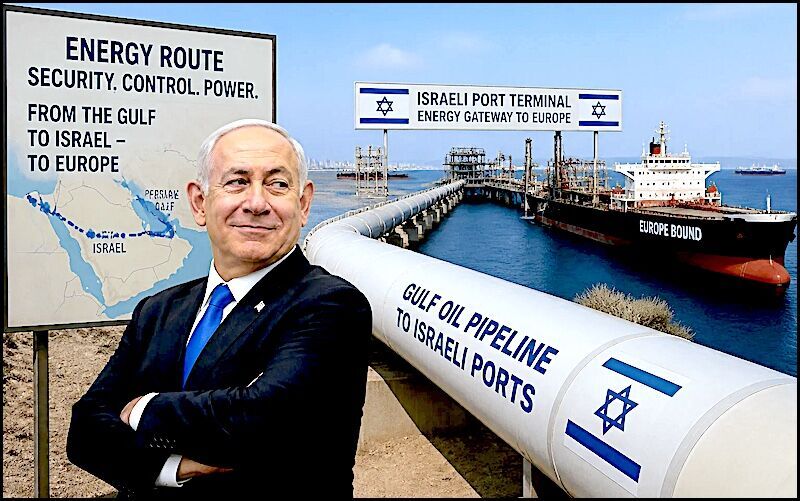
Control of global transit oil communications as a key goal of Israel in the Middle Eastern architecture

Neti and oil pipeline
© UnknownNetanyahu's oil pipe dream
By means of pursuing its aggressive policy in the Middle East, Israel intends to redirect the transit of energy resources through its own territory.

Control over the routes of hydrocarbon supplies to the world markets inevitably increases the economic and political significance of the territories and countries located along these routes.

The Middle East retains its undeniable strategic role not only as the cradle of civilizations and spiritual centers but also as a key crossroads of global trade and transit routes.

Within this geopolitical dynamic, Israel, pursuing an active policy in the region, seeks to reroute the transit of energy resources through its territory.

Comment: As they say: It's about the oil stupid'. Years of set-up, the US was ultimately played...perhaps Neti's finest and most satisfying hour.