Karaganov advocates preemptive Russian nuclear strikes against a Europe he deems bellicose, banking on American
passivity. Scott Ritter believes conventional missiles, not nukes, are the only credible path.
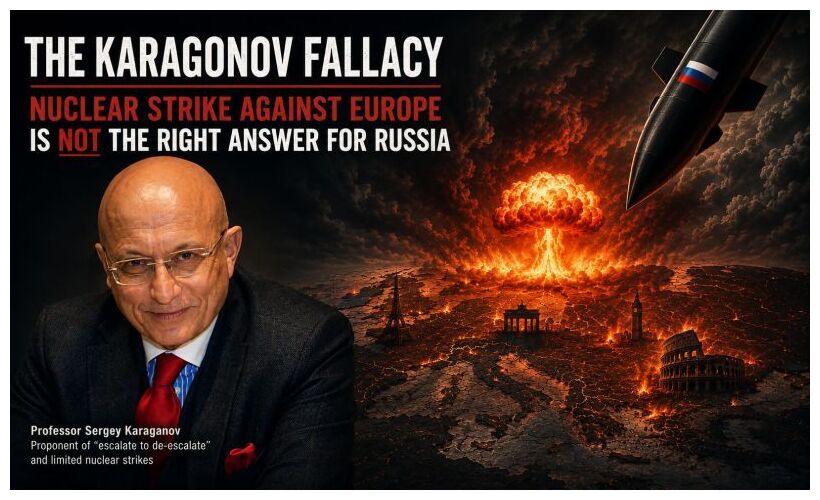
© Forum Geopolitica
Back in the late 1970's and early 1980's, the Wallstreet brokerage firm, E.F. Hutton, came up with one of the most iconic television ad campaigns in history, built around the catch phrase "When E.F. Hutton speaks, people listen."
Sergei Karaganov is the Russian analog to E.F. Hutton — when Karaganov speaks, people listen. The 73-year old political scientist, who currently heads the Council for Foreign and Defense Policy and serves as the dean of the Faculty of World Economy and International Affairs at Moscow's Higher School of Economics, has advised both post-Soviet era Russian Presidents, Boris Yeltsin and Vladimir Putin, and
his opinion continues to carry weight among the senior-most decision making circles of the Russian government.Karaganov has, for the past several years, been warning about the growing threat to Russia from NATO, and in particular the European nations of NATO who have constructed a world view which postulates Russia as an existential threat which must be decisively confronted and defeated.In this Karaganov is not wrong.
The language of the Europeans is self-indicting.
According to a newly published German military strategy, Russia represents "the greatest and most immediate threat for the foreseeable future" to Germany and transatlantic security. The classified strategy concludes by declaring "Russia is laying the groundwork for a military attack on NATO member states."
Germany's chief of defense, General Carsten Breuer furthered this argument in a 2025 statement to the media where he noted that "There's an intent and there's a buildup of the stocks" by Russia for a possible future attack on Nato's Baltic state members.
Brueuer and Germany's defense minister, Boris Pistorious, are using the threat from Russia as an excuse for the rearmament of Germany, with the goal of making the German army the most powerful in Europe by 2029.
Why that date?
According to General Breuer, this is when Russia will attack Europe. "This is what the analysts are assessing," Breuer said, "in 2029. So we have to be ready by 2029."
The German analysis is nearly identical to that of their British allies. Former Chief of the General Staff, General Sir Patrick Sanders, who retired in the summer of 2025, has warned that a war with Putin was a "realistic possibility" by 2030. "If Russia stops fighting in Ukraine," Sanders told the British media, "you get to a position where within a matter of months they will have the capability to conduct a limited attack on a NATO member that we will be responsible for supporting, and that happens by 2030."















Comment: See also:
Part 1: Ukraine and the road to ruin