
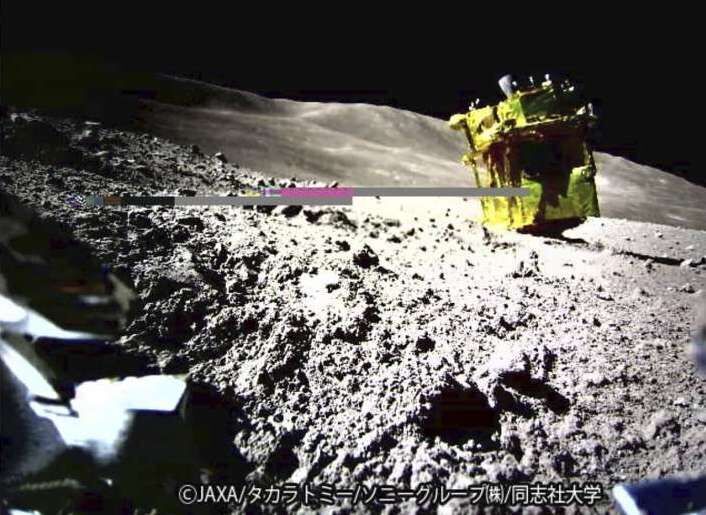
© AXA/Takara Tomy/Sony Group Corporation/Doshisha University via APimage taken by a Lunar Excursion Vehicle 2 (LEV-2) of a robotic moon rover called Smart Lander for Investigating Moon, or SLIM, on the moon.
Japan became the fifth country in history to reach the moon when the Smart Lander for Investigating Moon, or SLIM, touched down on the moon early on Saturday. But trouble with the probe's solar batteries made it hard at first to figure out whether the probe landed in the target zone.
While most previous probes have used landing zones about 10 kilometers (six miles) wide, SLIM was aiming at a target of just 100 meters (330 feet). Improved accuracy would give scientists access to more of the moon, since probes could be placed nearer to obstacles.
One of the lander's main engines lost thrust about 50 meters (54 yards) above the moon surface, causing a harder landing than planned.
A pair of autonomous probes released by SLIM before touchtown sent back images of the box-shaped vehicle on the surface, although it appeared to be upside down.
After a few days of data analysis, the Japan Aerospace Exploration Agency, or JAXA determined that the spacecraft landed about 55 meters (60 yards) away from its target, in between two craters near the Shioli crater, a region covered in volcanic rock. But after the landing mishap, the craft's solar panels wound up facing the wrong direction, and it cannot generate power. Officials said there is still hope the probe will be able to recharge when the moon enters its daytime in the coming days.














Comment: This might not revolutionise where we source our energy in the short term, but it might take us one step further in understanding the workings of nature, and how we can work with and harness that to our advantage: Tomato plants send electrical signals to each other through fungi