
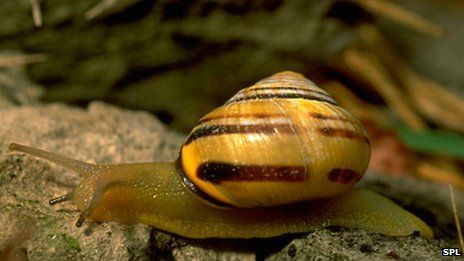
A common garden snail gives insight into human migration to Ireland
The slimy creatures in Ireland today are almost identical to snails in Southern France and Northern Spain.
Whether an accidental visitor on a ship or brought along as a snack, the boat they were carried on did not appear to stop in Britain.
The findings are published in PLOS One.
As Britain emerged from the end of the last Ice Age about 10,000 years ago, sea levels rose and landslides are thought to have triggered a great tsunami. Britain was transformed into an island, separated from mainland Europe and Ireland.
Land-dwelling animals were therefore no longer able to migrate from Europe over the seas without a little help.
It has long perplexed scientists that Ireland has plants and animals that are genetically different, and in some cases are even unique, to ones found in Britain.
Now scientists have found that a common garden snail, Cepaea nemoralis, is almost genetically identical to one found in the Eastern Pyrenees, but seems to have missed Britain on its journey over.















Comment: In fact, it can happen in a matter of months:
Last Ice Age took just SIX months to arrive