
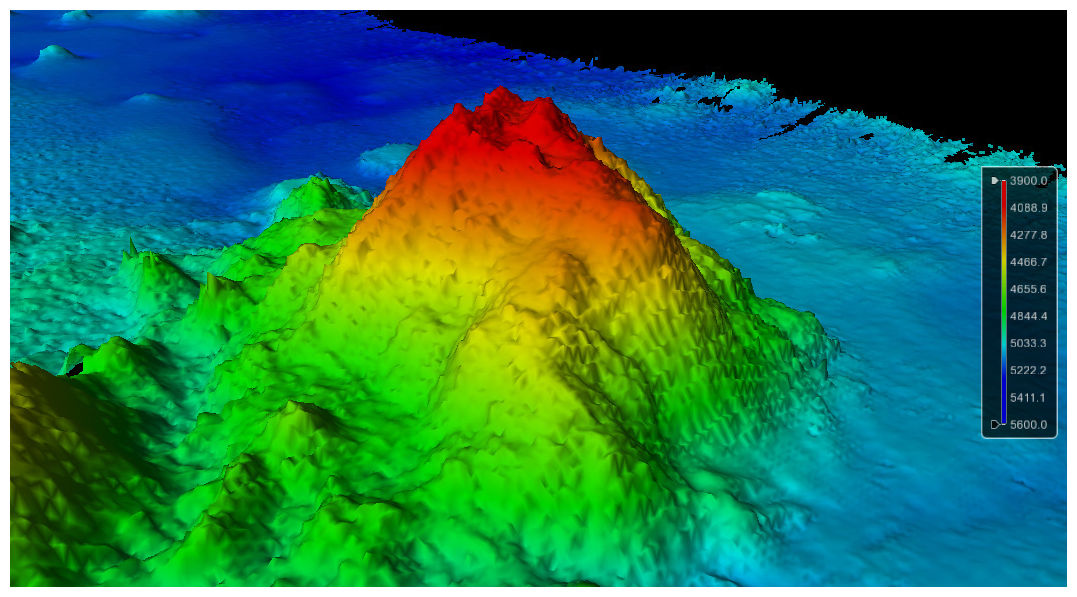
© Image courtesy of the Center for Coastal and Ocean Mapping/Joint Hydrographic CenterThe newly discovered seamount rises up some 3,600 feet (1,100 meters) from the seafloor near the Johnston Atoll, at a depth of about 16,730 feet (5,100 m) under the Pacific Ocean.
The seamount is about two-thirds of a mile high (1.1 kilometers), researchers said. Seamounts, rocky leftovers from extinct, underwater volcanoes, are found on ocean floors around the world. The newly discovered seamount is about 186 miles (300 km) southeast of Jarvis Island, an uninhabited island in a relatively unexplored part of the South Pacific Ocean, experts said.
"These seamounts are very common, but we don't know about them, because most of the places that we go out and map have never been mapped before," James Gardner, a University of New Hampshire research professor who works at the university's NOAA Center for Coastal and Ocean Mapping/Joint Hydrographic Center, said in a statement. [See Images of the Newfound Pacific Ocean Seamount]














Comment: Not only does every cell in our body contain reams of information, our very neurons are capable of performing complex feats of information processing. And yet mainstream science tells us all this information and creativity is the result of bits of matter randomly bumping into other bits of matter. What is the source of information, if not intelligence?