Science & TechnologyS


Bug

Female termites found to clone themselves via asexual reproduction

Image
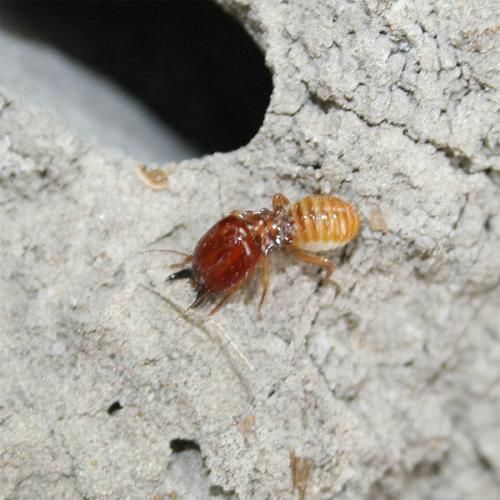
© Wikipedia commonA soldier termite (Macrotermitinae) in the Okavango Delta.
A pair of researches with Kyoto University has found how the queen of one species of termite, Reticulitermes speratus, ensures her genetic lineage continues by creating duplicate copies of herself. In their paper published in Proceedings of the National Academy of Sciences, Toshihisa Yashiro and Kenji Matsuura describe the study they carried out that showed how queens in such colonies reproduce themselves.

Scientists have known since 2009 that R. speratus queens created fatherless offspring which became queens themselves, but until now, the mechanism by which that came about has been a mystery. In this new effort, the researchers took a new look at the structure of the eggs laid by the queen to discover the difference between future queens and ordinary termites. Close inspection revealed tiny channels through the outer lining of the eggs called micropyles. The channels serve as an entry point for sperm, which the queen deposits on the eggs (after obtaining it from a male).

Interestingly, the research pair found that the number of micropyles for any given egg appeared to be random, from one to more than thirty - the average was nine. Even more interesting was that the team soon learned that sometimes there were no micropyles at all in some eggs, which would of course mean that no sperm could enter to fertilize its contents - and the egg still matured and wound up in the creation of offspring. That offspring, because it had no DNA from a male, grew into a new queen. Such a process means that the females are fully in control of both sexual and asexual reproduction.


Magnify

Researchers identify receptors activated by odors

Image
© Petr Kratochvil
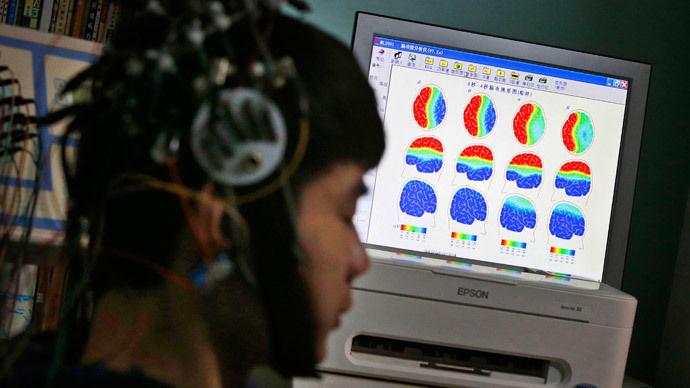
A group of physiologists led by University of Kentucky's Tim McClintock have identified the receptors activated by two odors using a new method that tracks responses to smells in live mice.

Their research was published in the latest edition of The Journal of Neuroscience.

Using a fluorescent protein to mark nerve cells activated by odors, McClintock and his colleagues identified receptors that allow mouse nerve cells to respond to two odors: eugenol, which is a component of several spices, most notably cloves, and muscone, known as musk.

"This new method could help us understand how these receptors allow mice, and eventually humans, to detect and discriminate odors, similar to the way in which the three receptors in the retinas of our eyes allow us to discriminate colors," McClintock said. "But unlike vision and hearing, the details of how the odor receptors discriminate odors, much like color in vision or pitch in sound, are unknown."

"Before we have a medical application in mind, we must first create a roadmap for these receptors."

Magnify

Bioengineering study finds two-cell mouse embryos already talking about their future

Image
© Victor O. LeshykBioengineers at UC San Diego have determined through single-cell-RNA-sequencing that embryonic mouse cells show differences in gene expression as early as the two-cell stage of development.
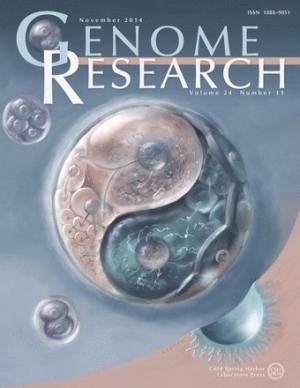
Bioengineers at the University of California, San Diego have discovered that mouse embryos are contemplating their cellular fates in the earliest stages after fertilization when the embryo has only two to four cells, a discovery that could upend the scientific consensus about when embryonic cells begin differentiating into cell types. Their research, which used single-cell RNA sequencing to look at every gene in the mouse genome, was published recently in the journal Genome Research. In addition, this group published a paper on analysis of "time-course"single-cell data which is taken at precise stages of embryonic development in the journal of Proceedings of the National Academy of Sciences.

"Until recently, we haven't had the technology to look at cells this closely," said Sheng Zhong, a bioengineering professor at UC San Diego Jacobs School of Engineering, who led the research. "Using single-cell RNA-sequencing, we were able to measure every gene in the mouse genome at multiple stages of development to find differences in gene expression at precise stages."

The findings reveal cellular activity that could provide insight into where normal developmental processes break down, leading to early miscarriages and birth defects.

The researchers discovered that a handful of genes are clearly signaling to each other at the two-cell and four-cell stage, which happens within days after an egg has been fertilized by sperm and before the embryo has implanted into the uterus. Among the identified genes are several genes belonging to the WNT signaling pathway, well-known for their role in cell-cell communications.

Laptop

It's official: Automation makes us dumb and leads to 'skill fade'

cubicles
© Luci Gutiérrez Computers are taking over the kinds of knowledge work long considered the preserve of well-educated, well-trained professionals.
Artificial intelligence has arrived. Today's computers are discerning and sharp. They can sense the environment, untangle knotty problems, make subtle judgments and learn from experience. They don't think the way we think - they're still as mindless as toothpicks - but they can replicate many of our most prized intellectual talents. Dazzled by our brilliant new machines, we've been rushing to hand them all sorts of sophisticated jobs that we used to do ourselves.

But our growing reliance on computer automation may be exacting a high price. Worrisome evidence suggests that our own intelligence is withering as we become more dependent on the artificial variety. Rather than lifting us up, smart software seems to be dumbing us down.

Telescope

Black hole loses its appetite for gassy cloud

Image
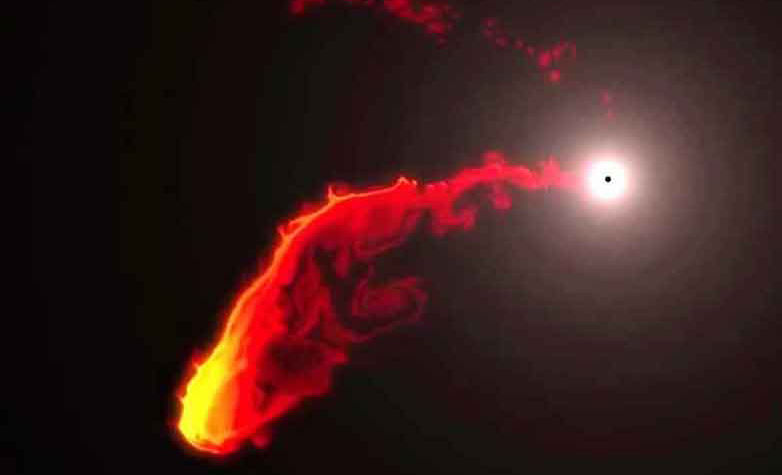
© ESO/MPE/Marc SchartmannThis simulation shows the possible behavior of a gas cloud (G2) that has been observed approaching the black hole at the center of the Milky Way.
In a showdown of black hole versus G2 - a cloud of gas and dust - it looks like G2 won.

Recent research shows that G2 came within 30 billion kilometers of the super-massive black hole at the center of our galaxy, yet managed to escape from the gravitational pull of the black hole.

Initially, a supercomputer simulation prepared by two Lab physicists and a former postdoc more than two years ago suggested that some of G2 would survive, although its surviving mass would be torn apart, leaving it with a different shape and questionable fate.

The findings are the work of computational physicist Peter Anninos and astrophysicist Stephen Murray, both of AX division within the Weapons and Complex Integration Directorate (WCI), along with their former postdoc Chris Fragile, now an associate professor at the College of Charleston in South Carolina, and his student, Julia Wilson.

The team's simulations allowed the members to more efficiently follow the cloud's progression toward the black hole.

Comet 2

New Comet: C/2014 W2 (PANSTARRS)

CBET nr. 4019, issued on 2014, November 21, announces the discovery of a comet (magnitude ~18.7) by PANSTARRS survey in four w-band CCD exposures taken with the 1.8-m Pan-STARRS1 telescope at Haleakala on Nov. 17. The new comet has been designated C/2014 W2 (PANSTARRS).

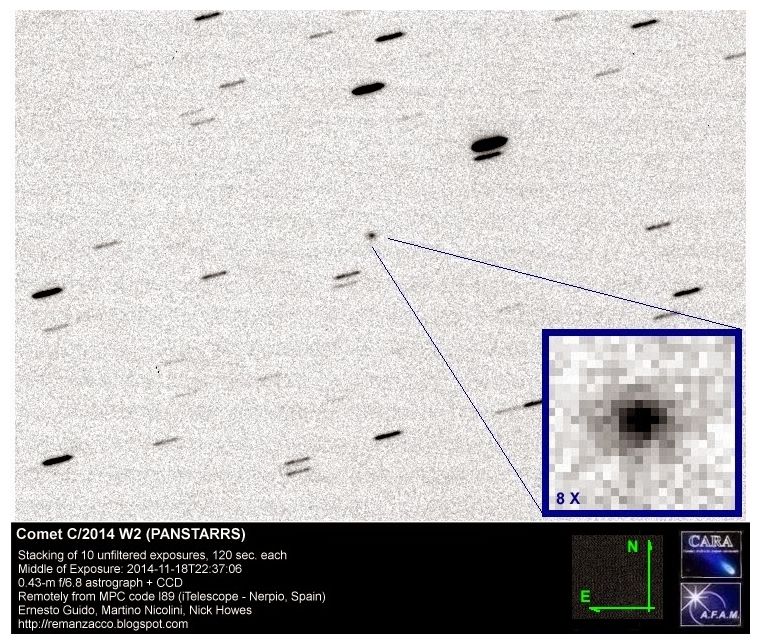
We performed follow-up measurements of this object, while it was still on the neocp. Stacking of 10 unfiltered exposures, 120-sec each, obtained remotely on 2014, November 18.9 from I89 (iTelescope network - Nerpio) through a 0.43-m f/6.8 reflector + CCD, shows that this object is a comet: diffuse coma about 6" in diameter.

Our confirmation image (click on it for a bigger version)
Comet C/2014 W2
© Remanzacco Observatory
M.P.E.C. 2014-W55 (including pre-discovery Catalina Sky Survey observations, identified by T. Spahr, on Oct. 26.3, when the comet was at mag 17.7-18.0, and on Nov. 16.3 at mag 17.3-17.5) assigns the following elliptical orbital elements to comet C/2014 W2: T 2016 Mar. 19.554; e= 0.95; Peri. = 85.90; q = 2.67; Incl.= 81.04

Galaxy

Two exocomet families found around baby star system

Image
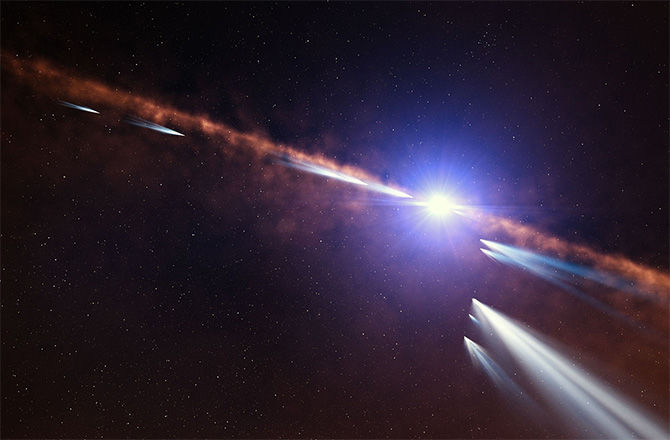
© ESO/L. CalçadaThis artist’s impression shows exocomets orbiting the star Beta Pictoris. Astronomers analysing observations of nearly 500 individual comets made with the HARPS instrument at ESO’s La Silla Observatory have discovered two families of exocomets around the young star.
Scientists have found two families of comets in the developing Beta Pictoris star system, located about 64 million light-years from Earth, including one group that appears to be remnants of a smashed-up protoplanet.

The discovery bolsters our theoretical understanding of the violent processes that led to the formation of Earth and the other terrestrial planets in the solar system.

"If you look back at the solar system when it was only 22 million years old, you might have seen phenomena that's a like more like what's happening in Beta Pic," astrophysicist Aki Roberge, with NASA Goddard Space Flight Center, Greenbelt, Md., told Discovery News.

"Rocky planets like the Earth, or any kind of solid planet, are built up out of comets and asteroids. It's the collisions of those bodies that build up the planets in the first place," she said.

Astronomers found the exocomets by analyzing eight years of archived data collected by the HARPS instrument on ESA's 3.6-meter telescope at La Silla Observatory in Chile. They were focusing on small, evaporating bodies that passed across the face of their parent star, relative to the telescope's line of sight.

Pyramid

Japanese company plans 9 mile long undersea city

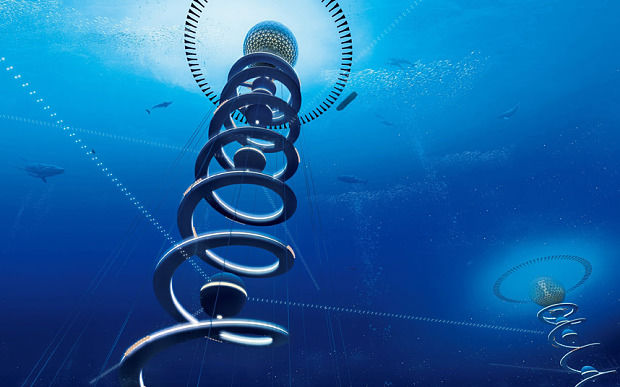
Japanese firm devises plan for an Ocean Spiral community that descends nine miles to the seabed.

ocean spiral
© Shimizu Corp/AFP/Getty ImagesAn artist impression of Ocean Spiral.
With dry land increasingly at a premium, a Japanese construction company has come up with a plan to sink a spiralling city into the depths of our oceans.

Each Ocean Spiral will be home to about 5,000 people, according to Shimizu Corp., with each structure also incorporating business and office facilities, hotel and entertainment facilities.

A blueprint for the city of the future was unveiled in Tokyo this week, with Shimizu confidently predicting that the first of its underwater cities would be ready for residents to move in as early as 2030.

At the surface, the city will have a vast floating dome that could be made watertight and retracted beneath the surface in bad weather.

Comment: Good luck with that.


Snowflake

Lake effect snow: Nature's greatest snow machine

Buffalo snowstorm
© Jeff Suhr
The above photo, taken from a plane above Buffalo yesterday by photographer Jeff Suhr, shows the brutal lake effect snow storm in effect over Western New York right now. Some areas are expecting up to six feet of snow by the end of the week. These snowstorms are among the most intense in the world, and the processes that create them are pretty spectacular.

The Great Lakes

Lake effect snow is possible in cold spots around the world, but this post will focus on the extreme weather that's often centered around the Great Lakes. The five lakes in the Upper Midwest - Superior, Michigan, Huron, Erie, and Ontario - are the perfect size and in the perfect location to maximize the impact of this annual snow bonanza.

As prevailing winds are most commonly from the north and west, the southern and eastern shores of each respective lake are known as the "snowbelt" because they take the brunt of most heavy lake effect snow events.

Comment: The articles below show the effects of nature's snow machine on Buffalo, NY this week:


Beaker

Tapeworm lives 4 years in British man's brain

Image
© Reuters / Kim Kyung-Hoon
A British man has become the first person in the country to be diagnosed with a rare tapeworm in his brain. The worm was discovered after the 50-year-old man complained about headaches and strange smells.

The rare type of parasitic worm had burrowed its way from one side of the man's brain to the other, and had been there for four years. Doctors treating the man were puzzled by the ring-like patterns moving through the patient's brain.

A series of scans revealed the 1cm worm had been slowly tunneling through the man's brain. It was extracted during a biopsy at Addenbrooke's Hospital in Cambridge.

Experts identified the parasite as Spirometra erinaceieuropaei; an extremely rare tapeworm.

According to the health service tapeworms are parasites that can live in a person's intestine (bowel). They don't always cause symptoms and when they do they are often mistaken for another illness.

Parasitic worms are most common in developing countries and are rare in the UK.

Tapeworms can be caught be touching or consuming anything containing contaminated feces, or by eating raw contaminated pork, beef or fish, and can grow up to 9 meters in length.