

© ESO/J. GirardThe SPHERE instrument is shown shortly after it was installed on ESO's VLT Unit Telescope 3. The instrument itself is the black box, located on the platform to one side of the telescope.
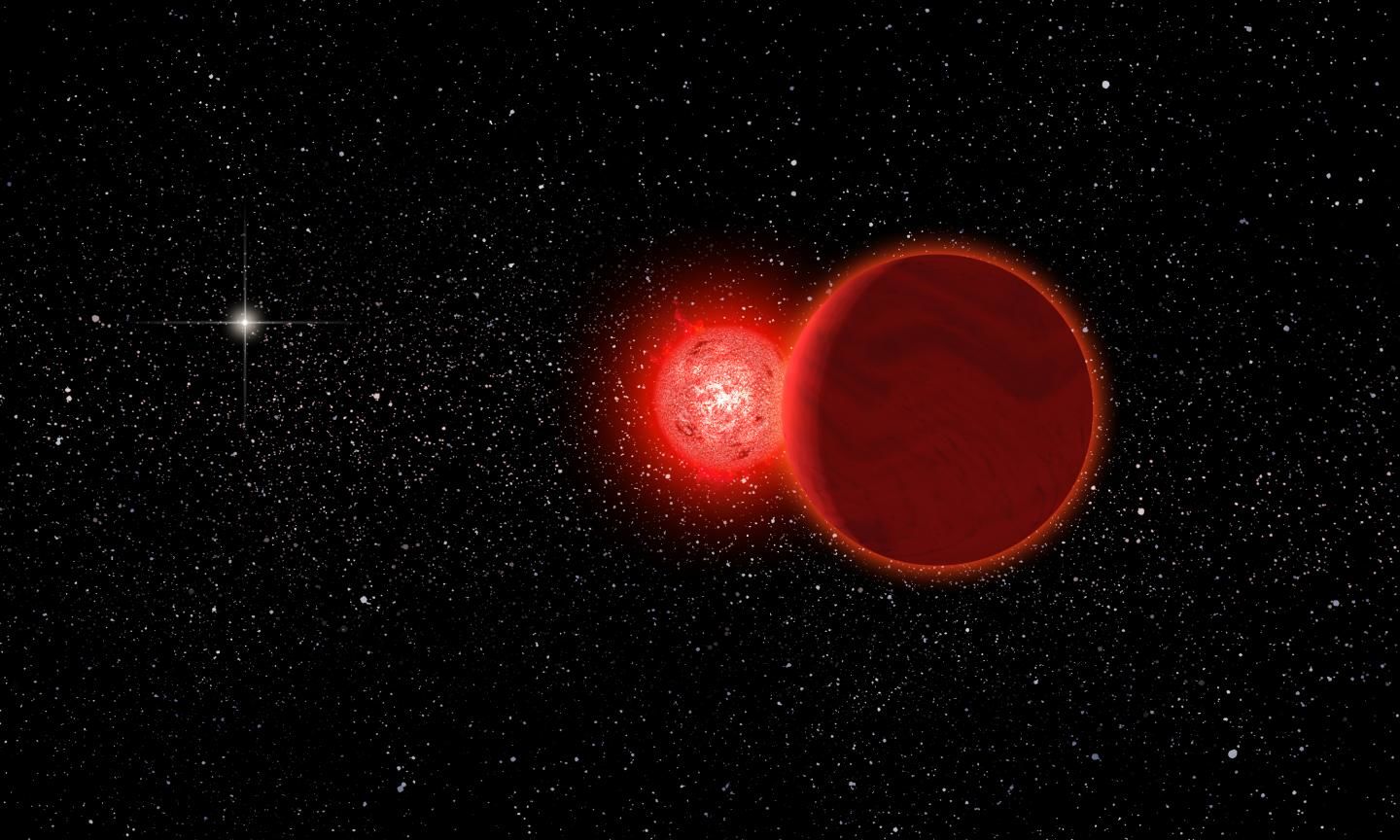
Some pairs of stars consist of two normal stars with slightly different masses. When the star of slightly higher mass ages and expands to become a red giant, material is transferred to other star and ends up surrounding both stars in a huge gaseous envelope. When this cloud disperses the two move closer together and form a very tight pair with one white dwarf , and one more normal star.
One such stellar pair is called V471 Tauri. It is a member of the Hyades star cluster in the constellation of Taurus and is estimated to be around 600 million years old and about 163 light-years from Earth. The two stars are very close and orbit each other every 12 hours. Twice per orbit one star passes in front of the other—which leads to regular changes in the brightness of the pair observed from Earth as they eclipse each other.
A team of astronomers led by Adam Hardy (Universidad Valparaíso, Valparaíso, Chile) first used the ULTRACAM system on ESO's New Technology Telescope to measure these brightness changes very precisely. The times of the eclipses were measured with an accuracy of better than two seconds—a big improvement on earlier measurements.















Comment: When the "conventional explanation" is "wrong", it may be time to incorporate that data into the winning Electric Universe theory and review what you thought you knew about how the cosmos actually works...
Earth Changes and the Human-Cosmic Connection
Could the "odd changes to the orbit of the binary" be caused by the close approach of the system's Twin Sun?
Nemesis: Does the Sun Have a 'Companion'?
Perhaps something wicked this way comes: