

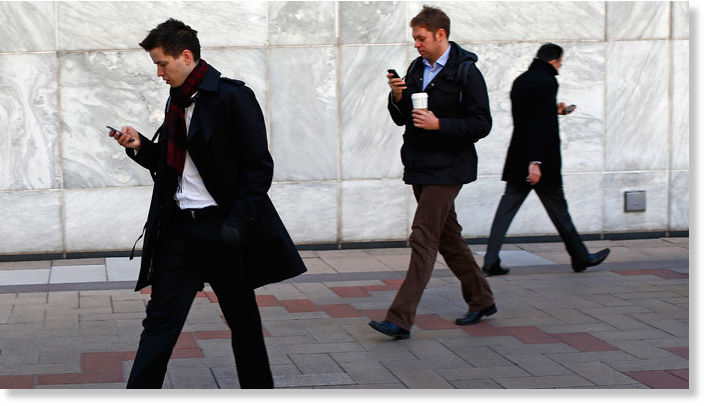
© Reuters / Eduardo Muno
The findings were carried out by a group of researchers at Stanford University and the Israeli defense company Rafael. They created a technique, which they have named PowerSpy and can gather information concerning the location of Android phones. It does this by simply tracking how much power has been used over a certain time.
How much power is used depends on a number of factors. For example, the further away the phone is from a transmitter, the more power is needed to get a signal. Physical objects such as mountains or buildings also have an impact on the amount of battery needed as these obstacles can block the phone's signal, meaning there are temporary 'power drains' on the devices.
"A sufficiently long power measurement (several minutes) enables the learning algorithm to 'see' through the noise," the researchers said, which was reported by Wired. "We show that measuring the phone's aggregate power consumption over time completely reveals the phone's location and movement."















Comment: There just seems to be no way around it; use a cell phone and know that you can be tracked.