Science & TechnologyS


Comet 2

New Comet: P/2014 L2 (NEOWISE)

Cbet nr. 3901, issued on 2014, June 15, announces the discovery of a comet (~ magnitude 16.5) by the Near-Earth Object Wide-field Infrared Survey Explorer (NEOWISE) team on images taken with the NEOWISE satellite on 2014, June 07.4. The new comet has been designated P/2014 L2 (NEOWISE).

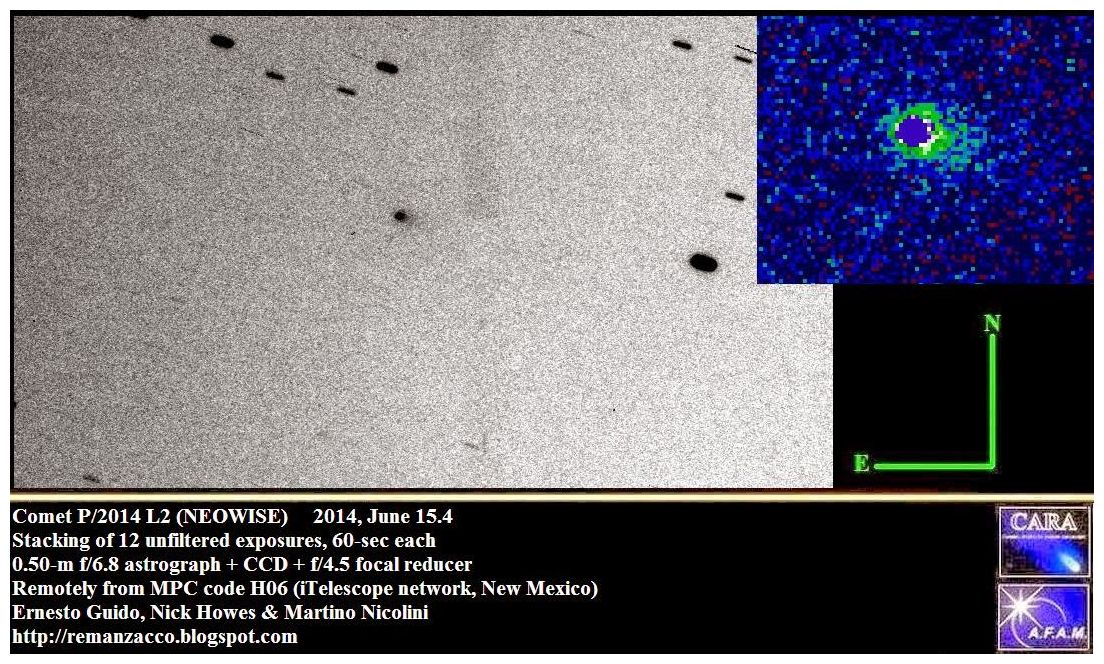
We performed follow-up measurements of this object, while it was still on the neocp. Stacking of 12 unfiltered exposures, 60-sec each, obtained remotely on 2014, June 15.4 from H06 (iTelescope network, New Mexico) through a 0.50-m f/6.8 astrograph + CCD + f/4.5 focal reducer, shows that this object is a comet with a tail nearly 15" long in PA 250 with coma about 8" in diameter.

Our confirmation image (click on it for a bigger version)
P/2014 L2, Neowise
© Remanzacco Observatory
M.P.E.C. 2014-L61 assigns the following preliminary elliptical orbital elements to comet P/2014 L2: T 2014 Aug. 4.59; e= 0.43; Peri. = 190.6; q = 2.11; Incl.= 5.20

Info

Earth's continental drift may be speeding up

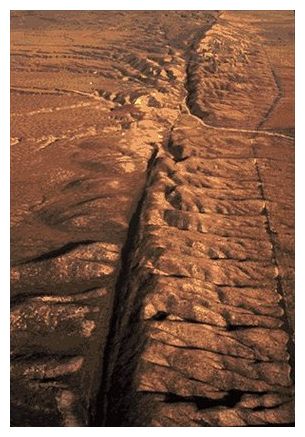
Continental Drift
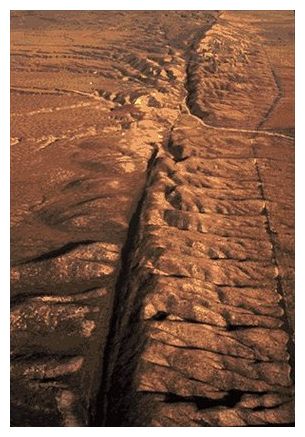
© Robert E Wallace/USGSScientists has discovered that continental drift could be accelerating, research will now focus on trying to determine why.
The movement of Earth's major continental tectonic plates is speeding up, suggests a new study.

The study, presented at the Goldschmidt Geochemistry Conference in Sacramento California, challenges the idea that the rate of plate movement remains stable.

"This is quite mind boggling," says Professor Kent Condie of the New Mexico Institute of Mining and Technology, who led the study.

"It's different from what most people thought because Earth is cooling and everybody assumed plate movements would slow down."

Continental drift is caused by heat deep in the planet, driving the convection of material in the Earth's mantle.

The eight major and numerous minor tectonic plates on the planet's surface are moved by these convection currents.

Condie's research, which has been submitted for publication in the Precambrian Research Journal, examines how supercontinents assemble and break up.

To identify how continents have moved, Condie and colleagues looked at the geomagnetic record in the Earth's crust to see how much it has changed over time.

The researchers found the frequency with which continents have been colliding has been increasing over at least the last two billion years maybe longer.

They also found the a rate at which new supercontinents form has been increasing, and the length of time ocean basins last has been decreasing.

"All of these lines of evidence indicate plate tectonics is speeding up, not slowing down," says Condie.

Why continental drift is accelerating, however, is a mystery, says Condie.

Cassiopaea

SOTT Focus: Behind the Headlines: Earth changes in an electric universe: Is climate change really man-made?

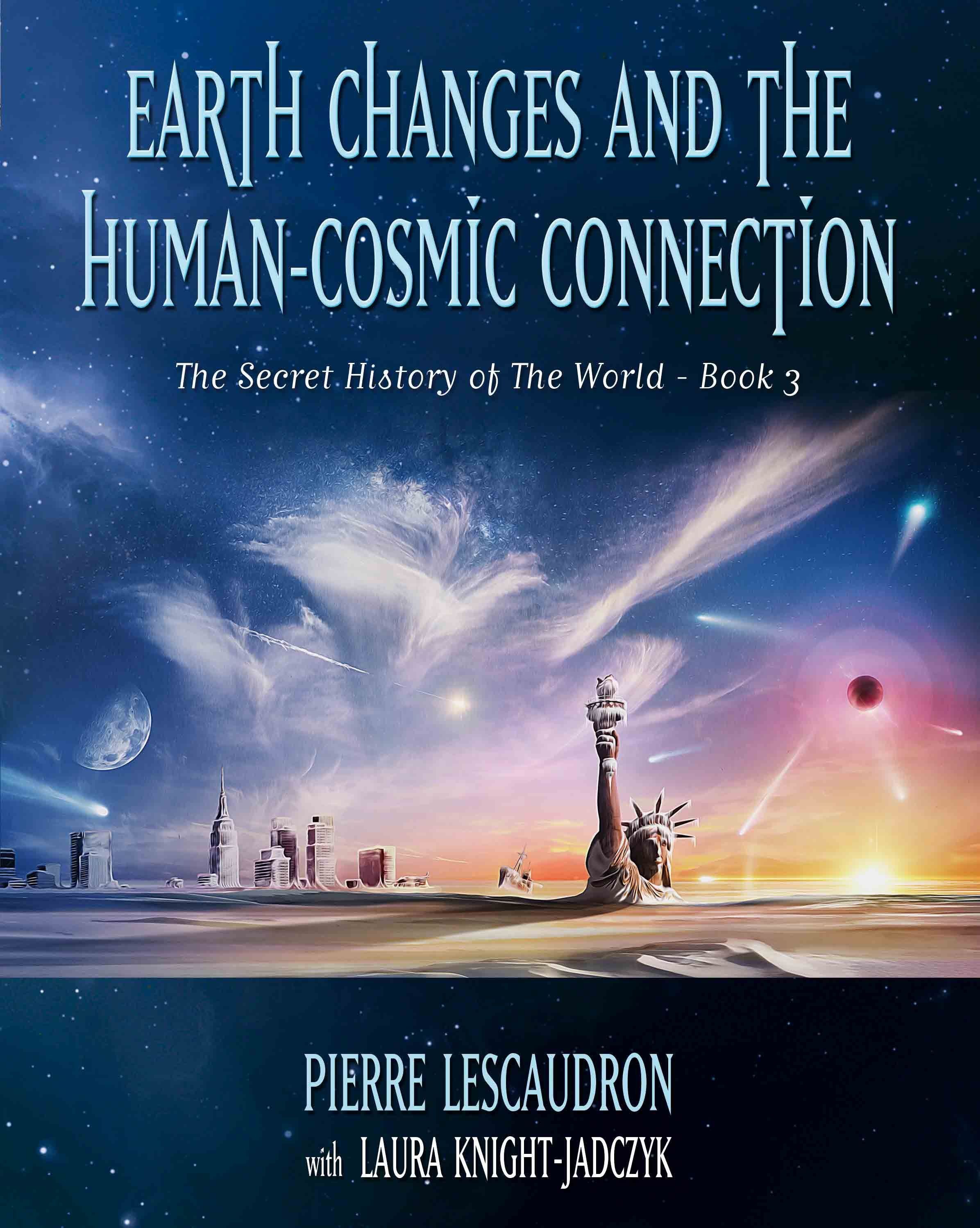
ECHCC_front_low_def_CoverBook
© SOTT.net/Red Pill Press

This week on SOTT Talk Radio we discussed the recently released book by SOTT.net editors Pierre Lescaudron and Laura
Knight-Jadczyk, Earth Changes and the Human-Cosmic Connection.

While official science portrays the crazy weather, more frequent sinkholes, increased meteor fireball activity, and intensifying earthquakes as phenomena that are unrelated, research put together by Pierre and Laura strongly suggests that all this (and more!) is intimately connected and may stem from a common cause.

In times past, people understood that the human mind and states of collective human experience influence cosmic and earthly phenomena. How might today's 'wars and rumors of wars', global 'austerity measures', and the mass protest movements breaking out everywhere play into the climate 'changing'?

Running Time: 01:59:00

Download: MP3


Comment: Continue to Part Two: The Hazard to Civilization From Fireballs and Comets

See also:

Black Death found to be Ebola-like virus

New Light on the Black Death: The Cosmic Connection

New Light on the Black Death: The Viral and Cosmic Connection

Related:

Happy New Year 2014?


Family

The ways fatherhood changes a male brain

fatherhood
© Getty
Studies suggest there's a parenting brain network common to both sexes.

Fatherhood can change a man's life. It also changes his brain, in ways that it seems to equip dads with the very same "baby sense" that's often attributed to moms.

From an animal kingdom perspective, human dads are unusual. They belong to a group of less than 6 percent of mammal species in which fathers play a significant role in rearing offspring. In these species, paternal care often involves the same behaviors as maternal care, with the exception of nursing.

But how does fatherhood change a man's brain? Science has only recently delved into the neural and hormonal mechanisms of paternal care, but so far the evidence suggests that mothers' and fathers' brains use a similar neural circuitry when taking care of their children. Moms and dads also undergo similar hormonal changes that are linked to their brain and behavior changes.

Here are five ways men's brains change when they become fathers:

Dad's brain looks like mom's

Taking care of a child reshapes a dad's brain, causing it to show the same patterns of cognitive and emotional engagement that are seen in moms.

In one recent study, researchers looked at brain activity in 89 new parents as they watched videos, including some that featured the parents' own children. The study examined mothers who were their children's primary caregivers, fathers who helped with childcare and gay fathers who raised a child without a woman in the picture.

All three groups of parents showed activation of brain networks linked to emotional processing and social understanding, according to the findings published May 27 in the Proceedings of the National Academy of Sciences. In particular, fathers who were their children's primary caregivers showed the kind of activation in emotional processing seen mostly in primary caregiver moms. The results suggest there's a parenting brain network common to both sexes.

Igloo

Frozen underworld discovered beneath Greenland ice sheet

Greenland
© Kirsty Tinto/Earth Institute/Columbia UniversityThe flat topography seen from a plane over Greenland is in sharp contrast to the jagged features found to be underlying much of the ice sheet.
Scientists have discovered a frozen underworld beneath the ice sheet covering northern Greenland.

The previously unknown landscape, a vast expanse of warped shapes including some as tall as a Manhattan skyscraper, was found using ice-penetrating radar loaded aboard Nasa survey flights.

The findings and the first images of the frozen world more than a mile below the surface of the ice sheet are published on Sunday in the journal Nature Geoscience.

Scientists said the findings could deepen understanding of how the ice sheets of Greenland and Antarctica respond to climate change.

"We see more of these features where the ice sheet starts to go fast," Robin Bell, the study's lead author and a geophysicist at Columbia University's Lamont Doherty Earth Observatory, said in a statement. "We think the refreezing process uplifts, distorts and warms the ice above, making it softer and easier to flow."

Until recently, scientists studying the Greenland ice sheet for evidence of change under global warming had thought the shapes they discerned beneath the ice sheet were mountain ranges.

But with sophisticated new gravity-sensing and radar operating from Nasa's airborne surveys of the ice sheet over the last 20 years, scientists eventually concluded the formations were ice - not rock.

Telescope

Introducing Earth's bigger, older brother: planet Kapteyn b

Kapteyn_Earth
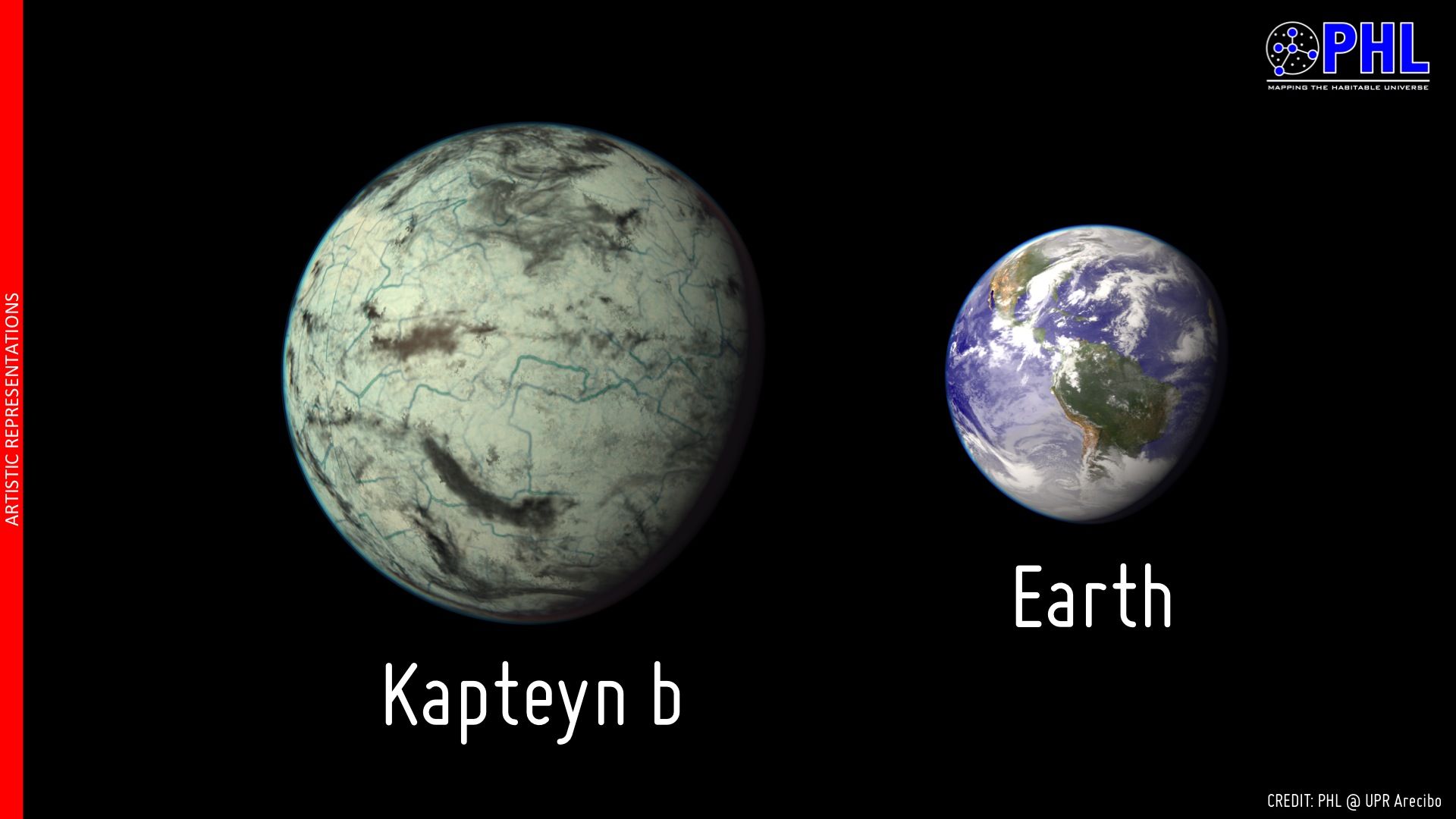
© UPR AreciboArtistic representation of the potentially habitable exoplanet Kapteyn b as compared with Earth. Kapteyn b is represented here as an old and cold ocean planet with a network of channels of flowing water under a thin cloud cover. The relative size of the planet in the figure assumes a rocky composition but could be larger for a ice/gas composition.
We now know of a potentially habitable planet five times the size of Earth that has existed for more than twice as long.

A mere thirteen light years away, Kapteyn b is now the oldest known possibly rocky planet in a habitable zone. This 5-Earth-mass planet orbits swiftly: once every 48 days around its parent star. Kapteyn itself is no slouch: it flies across the sky faster than almost any other nearby star.

Telescope

Aromatic flavors of haze on Saturn's largest moon, Titan, recreated

Image
© NASA/Goddard/JPLIn lab experiments NASA scientists matched the spectral signature of an unknown material the Cassini spacecraft detected in Titan's atmosphere at far-infrared wavelengths. The material contains aromatic hydrocarbons that include nitrogen, a subgroup called polycyclic aromatic nitrogen heterocycles.
NASA scientists have created a new recipe that captures key flavors of the brownish-orange atmosphere around Saturn's largest moon, Titan.

The recipe is used for lab experiments designed to simulate Titan's chemistry. With this approach, the team was able to classify a previously unidentified material discovered by NASA's Cassini spacecraft in the moon's smoggy haze.

"Now we can say that this material has a strong aromatic character, which helps us understand more about the complex mixture of molecules that makes up Titan's haze," said Melissa Trainer, a planetary scientist at NASA's Goddard Space Flight Center in Greenbelt, Maryland.
The material had been detected earlier in data gathered by Cassini's Composite Infrared Spectrometer, an instrument that makes observations at wavelengths in the far infrared region, beyond red light. The spectral signature of the material suggested it was made up of a mixture of molecules.

To investigate that mixture, the researchers turned to the tried-and-true approach of combining gases in a chamber and letting them react. The idea is that if the experiment starts with the right gases and under the right conditions, the reactions in the lab should yield the same products found in Titan's smoggy atmosphere. The process is like being given a slice of cake and trying to figure out the recipe by tasting it. If you can make a cake that tastes like the original slice, then you chose the right ingredients.

Question

Busting the megalodon myth: Did a 3m shark get eaten by an even bigger shark?

Image
Sometimes the internet goes a little crazy with quirky, fantastical, scary stories. Take for example the recent hoax, 'huge sting ray attacks man', which turned out to be a great video of a man diving around the shadow of a kite.

So, what can we make of the mysterious discovery of a CSIRO shark tag washed up on a beach that had some fairly typical data recorded on it? Some are incorrectly interpreting the data and speculating that this is evidence of the existence of a megalodon, an ancient extinct species of shark that lived millions of year ago. The megalodon was huge, around 15-24 metres in length... eek. White sharks grow up to 6 m in length.

People want to know the truth about the shark-eating-shark, so here it is.

In late 2003 we tagged a white shark approximately 3m in length off south-west Western Australia with a tag that collects data on swim depth, water temperature and light levels. The tag records data at regular intervals against a date/time stamp. The tag was programmed to release from the shark on a pre-programmed date, float to the surface and transmit the data collected back to us via satellite. These 'archival' tags are commercially produced and are in common use by researchers around the world.

Gold Coins

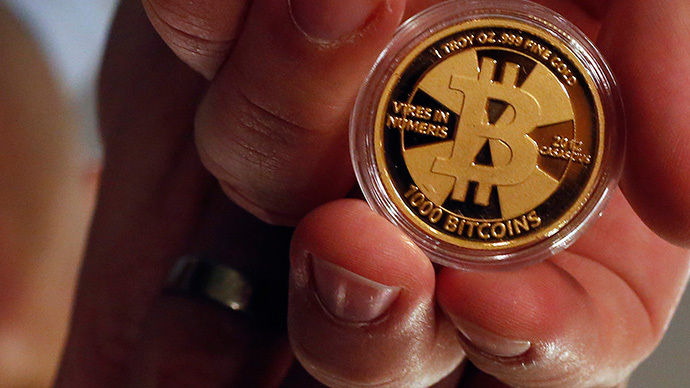
New bitcoin app provides financial incentive for future leakers

Image
© Unknown
A pair of software developers has unveiled a piece of open source technology that aims to make it possible for anyone hoping to leak secret information to be paid in bitcoin, a model that could make for-profit classified disclosures a thing of the future.

Amir Taaki and Peter Todd told Wired magazine they are still at work on the program known as PayPub, but hope that the prototype creates the notion that information will become even more decentralized. Chelsea Manning, Edward Snowden, and other whistleblowers have traditionally been motivated by their ideals, although PayPub creates the possibility that money will be a major incentive for future leakers.

Comment: While interesting, this app may not be very useful in the "times" to come. The chances of having the technological infrastructure to support humanitarian innovations such as this seem slim to none.


Wolf

Dogs like to earn treats by solving problems, rather than receiving handouts

Image
Researchers in Sweden have found that dogs are happier when they solve problems to get a treat rather than just being given a reward, much like how humans have a 'eureka moment'. Pictured here is a stock image of a three year-old beagle being given a reward after making a find of illegally imported food
* Researchers in Sweden say dogs like to solve problems just like humans

* They found the pets were visibly happier when they had a 'eureka moment'

* In experiments 12 beagle dogs were trained to use pieces of equipment

* Half had to use the equipment to get a reward while the other half didn't

* And the scientists found those that had to earn their reward were happier

In humans the 'eureka moment' is a commonly known feeling that occurs when we solve a particularly troubling problem.

But new research suggests that we're not the only animals to experience this - dogs, too, gain pleasure from solving a tricky task.

In a series of experiments, scientists found dogs were happier when they earned a reward by performing a task, rather than just being handed a treat.