
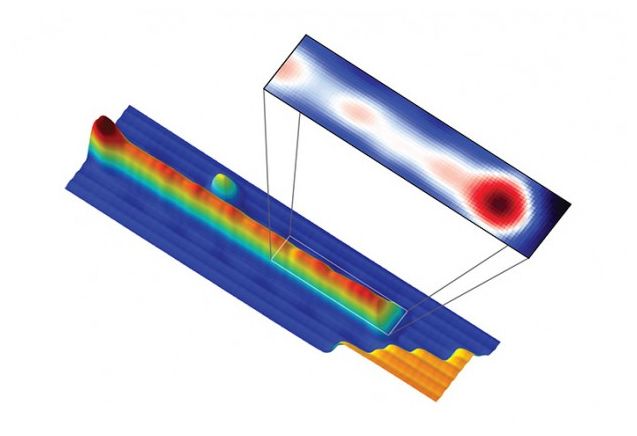
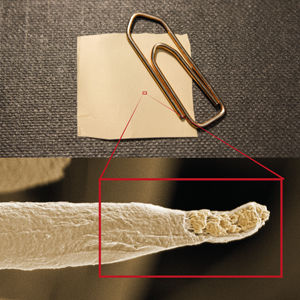
© Ali Yazdani Lab The experiment revealed the atomic structure of the iron wire on a lead surface. The zoomed-in portion of the image depicts the probability of the wire containing the Majorana fermion. Importantly, the image pinpoints the particle to the end of the wire, which is where it had been predicted to be over years of theoretical calculations.
The particle, which is known as a Majorana fermion, was detected and imaged using a two-story-tall microscope floating in an ultralow-vibration lab, the researchers explained. Not only is the discovery "an exciting step forward for particle physics, explained Macrina Cooper-White of The Huffington Post, but it could also impact quantum computer development.
"This is the most direct way of looking for the Majorana fermion since it is expected to emerge at the edge of certain materials," Princeton physics professor and lead investigator Ali Yazdani said in a statement Thursday. "If you want to find this particle within a material you have to use such a microscope, which allows you to see where it actually is."














Comment: Which means that those whose healthcare choices go against the mainstream, i.e. anti-vaccine advocates, will be duly noted. But of course, the NSA is already using Facebook to hack into individual computers, so in all likelihood such information has been stored for future need.
Surveillance state: NSA using Facebook to hack into your computer