
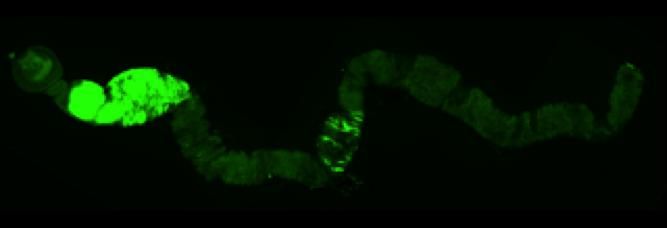
© Andreu CasaliThis is a 4-week-old Drosophila gut with a large Apc-Ras tumor (in green).
Colorectal cancer leads to more than half a million deaths worldwide each year. The disease originates in the epithelial cells of the gastrointestinal track mainly due to aberrations in the molecular signaling activities of cells.
"We have been able to use flies as a model system to study molecular events that are very similar to the steps that take place in colorectal cancer in humans and we have been able to use this system to identify new genetic regulations relevant to human disease," says Andreu Casali, lead author of the study and a research associate at the Institute for Research in Biomedicine in Barcelona.

















Comment: After the IAU decision to downgrade Pluto by four percent of its members, most of whom are not planetary scientists, it was immediately opposed in a formal petition by hundreds of professional astronomers. Part of the issue is that the term "minor planet" is a synonym for asteroids and comets, bodies too small to be rounded by gravity. Regardless of its size, Pluto still meets much of the planetary "criteria." The recent feel-good vote was not official nor binding.
As the bumpersticker says: Honk if Pluto is still a planet...
The video of the debate and audience vote can be seen on YouTube at https://www.youtube.com/user/ObsNights.