Science & TechnologyS


Doberman

Caretakers baffled as abandoned dogs in Chernobyl turn blue

dogs turn blue chernobyl
© Jam Press/@dogsofchernobylThe group, called Dogs of Chernobyl, shared a video showing several packs of dogs with at least one completely blue
The caretakers of the dogs that have made a home at the site of Chernobyl have spotted some canines with blue fur, a first at the disaster zone.

The group, called Dogs of Chernobyl, shared a video showing several packs of dogs with at least one completely blue.

'They were not blue last week. We do not know the reason, and we are attempting to catch them so we can find out what is happening,' the team shared in the video caption.

'Most likely, they're getting into some sort of chemical.'

The organization, an affiliate of the non-profit Clean Futures Fund, added that while the color was alarming to see, the dogs appear to be 'very active and healthy.'

Comet 2

A meteor's glow appears to coil around Comet Lemmon (C/2025 A6) over Earth

On 24 Oct. 2025, while imaging comet C/2025 A6 Lemmon, we captured a meteor crossing the same field of view. Soon after, its red afterglow showed so nicely, adding its intriguing, fast evolving shape to the scene.
Comet C/2025 A6 Lemmon
© Virtual Telescope ProjectComet C/2025 A6 Lemmon and a meteor red afterglow 24 October 2025.
During the imaging session of comet C/2025 A6 Lemmon on the evening of October 24, I had the good fortune to witness a truly fascinating phenomenon — one that, by sheer chance, I was able to capture.

Between 17:39:30 and 17:41:30 UT, a meteor passed right through the region of the sky where Lemmon was visible.

At that moment, a sequence of wide-field images was being acquired using the astrograph that is part of the Virtual Telescope Project instrumentation, installed in Manciano (Grosseto), in the beautiful Maremma region. In the frame taken between 17:43:33 and 17:45:33 UT, the persistent trail left by the meteor is clearly visible, with a distinct reddish hue. The faint, fan-like structure is likely due to some light which reached the imaging device while capturing the picture.

Galaxy

Rare, stunning 'red sprites' captured in New Zealand skies

new zealand red sprites
© Dan ZafraPhotographers Tom Rae, Dan Zafra and José Cantabrana captured the red sprites – or red lightning - when shooting the Milky Way in New Zealand, October 11, 2025
A trio of photographers in New Zealand have captured images of "red sprites", or red lightning, one of the rarest light phenomena in the world, in which luminous crimson flashes appear in the sky.

New Zealand photographer Tom Rae and Spanish photographers Dan Zafra and José Cantabrana set out to shoot the Milky Way over the Ōmārama Clay cliffs in the South Island on 11 October, when they chanced upon the extraordinary event.

The photographers thought they would be lucky to get clear skies that evening, but their night turned into "an unforgettable one", Rae told the Guardian.

Telescope

Desert radio telescope spots signs from the early universe

early universe map radio waves
© ICRARAn image of part of the sky seen in radio wavelengths. New research removed many sources of nearby radio "noise" to focus on some of the earliest light in the universe.
Long before starlight filled the cosmos for the first time, the young universe may have been simmering, according to a new study.

The findings suggest that about 800 million years after the Big Bang, energy from newborn black holes and the fading embers of the first stars was already warming vast clouds of intergalactic hydrogen gas, offering a rare glimpse into a largely uncharted chapter of the universe's youth.

Astronomers know that the universe began in an extremely hot, dense state, the Big Bang, about 13.8 billion years ago, and then cooled rapidly as it expanded. Roughly 400,000 years later, temperatures dropped enough for protons and electrons to merge into neutral hydrogen atoms, and the cosmos slipped into the "cosmic dark ages" — a long, lightless stretch when space was veiled by a dense fog of hydrogen gas.

Jet5

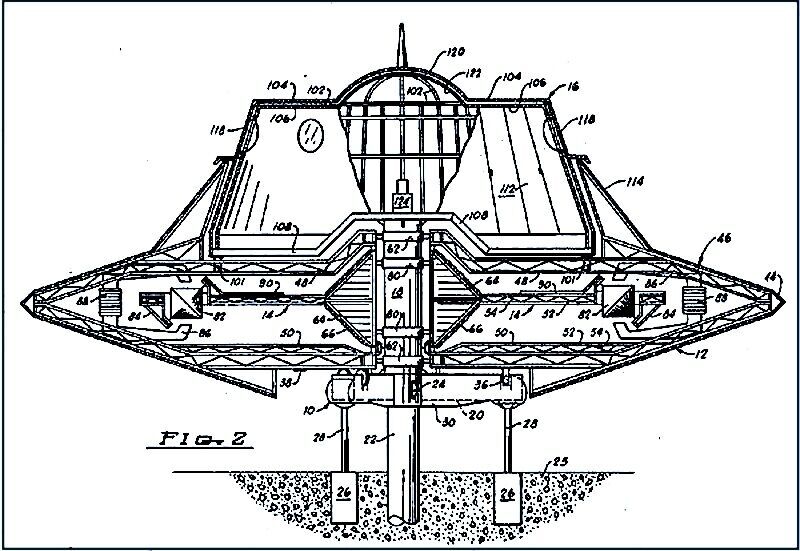
What you need to know about Tesla's antigravity technology: Creating the perfect UFO

Tesla diagram
© TeslaTesla's Perfect UFO
TV, AC electricity, the Tesla Coil, fluorescent lighting, neon lights, Radio controlled devices, robotics, X-rays, radar, microwave and dozens of other amazing inventions were invented by one of the most incredible geniuses to have lived on Earth, Nikola Tesla.

His inventions had no limits, his imagination did neither. He was cataloged by many as a 'mad scientist' but he was more than that. Today we can say that Nikola Tesla is without a doubt, the father of modern technology.

Among his non-conventional inventions, we can add two that are super-duper advanced: Antigravity technology and Tesla's UFO, or rather IFO.

Tesla had a great interest in Flight, pace and specifically Antigravity, in this article we bring you everything you need to know about Tesla's Antigravity technology.

Better Earth

NASA finds hidden portals in Earth's magnetic field

A portal
© Capture-173A Portal
A portal is considered a shortcut, a guide, a door into the unknown. But portals, as we know them, are only present in sci-fi movies...right? Well, according to scientists it turns out that portals actually exist, and not only that, NASA-funded researchers at the University of Iowa to figure out what was going on.

Jack Scudder of the University of Iowa, explains:
"We call them X-points or electron diffusion regions. They're places where the magnetic field of Earth connects to the magnetic field of the Sun, creating an uninterrupted path leading from our own planet to the sun's atmosphere 93 million miles away."
It's a shortcut worthy of the best portals of fiction, only this time the portals are real. And with the new "signposts" we know how to find them.

Better Earth

Plants self-organize in a 'hidden order,' echoing pattern found across nature

Namibia's fairy circles
© StuPorts/Getty ImagesNamibia's fairy circles are among the world's drylands that appear to follow a "hidden order" seen across nature.
Scientists have uncovered a "hidden order" in drylands across the planet, where plants follow disordered hyperuniformity — a layout that looks random and disorganized up close but adheres to a clear pattern when viewed from farther away.

The findings explain phenomena like "tiger bush" in West Africa, where bands of plants look like tiger stripes from above, or "fairy circles" in Namibia that look like spots from far away but are actually clumps of plants. These plants are self-organized in a way that helps them cope with drought and function in extreme conditions.

"It was a genuine surprise," study co-author Quan-Xing Liu, a mathematician at the Shanghai Jiao Tong University in China, told Live Science in an email. "We expected to find either a completely random distribution or a regular, clumped pattern... instead, we uncovered a perfect disordered hyperuniform pattern — a form of hidden order no one had recognized before in plant communities."

Archaeology

6,000-year-old Columbian skeletons have distinctive DNA with no link to modern humans

columbia dna mystery no descendents
© Ana Maria Groot/Universidad Nacional de ColumbiaThe skeletons of two hunter-gatherer individuals excavated at the Checua archaeological site (Bogotá Altiplano) were found to have no relationship to current Columbian indigenous groups.
Archaeologists have uncovered 6,000-year-old skeletons in Colombia that belonged to a mysterious group of people that could rewrite human history.

The remains, discovered at the ancient preceramic site of Checua near Bogotá, were of hunter-gatherers whose DNA does not match that of any known Indigenous population in the region today.

Instead, their genetic signature reveals a distinct and now-extinct lineage that may have descended from the earliest humans to reach South America, one that diverged early and remained genetically isolated for thousands of years.

By analyzing ancient DNA from 21 individuals who lived in the Bogotá Altiplano between 6,000 and 500 years ago, researchers reconstructed a rare genetic timeline spanning nearly six millennia.

Galaxy

Discovery Alert: 'Baby' planet photographed in a ring around a star for the first time!

WISPIT 2
© NASA/JPL-Caltech/R. Hurt (IPAC)This artist's concept depicts the protoplanet WISPIT 2b accreting matter as it orbits around its star, WISPIT 2
The Discovery:

Researchers have discovered a young protoplanet called WISPIT 2b embedded in a ring-shaped gap in a disk encircling a young star. While theorists have thought that planets likely exist in these gaps (and possibly even create them), this is the first time that it has actually been observed.

Key Takeaway:

Researchers have directly detected - essentially photographed - a new planet called WISPIT 2b, labeled a protoplanet because it is an astronomical object that is accumulating material and growing into a fully-realized planet. However, even in its "proto" state, WISPIT 2b is a gas giant about 5 times as massive as Jupiter. This massive protoplanet is just about 5 million years old, or almost 1,000 times younger than the Earth, and about 437 light-years from Earth.

Pi

The world's hottest engine is smaller than a cell and hotter than the sun's corona

smallest hottest engine thermodynamics physics
© King's College LondonA graphic representation of a microscopic engine that leverages microscopic physics to generate a remarkable amount of heat.
The breakthrough redefines how physicists imagine engine builds.

A graphic representation of a microscopic engine that leverages microscopic physics to generate a remarkable amount of heat. Credit: King's College London Comments (13)

Technically speaking, an engine is a device that converts some form of energy into mechanical energy. Taking that definition to heart, physicists harnessed the strange rules of microscopic physics and created the hottest engine ever — which also happens to be the smallest engine ever made.

In a forthcoming paper for Physical Review Letters, researchers describe a tiny engine crammed inside a microscopic particle trapped in electrical limbo. Using this setup, the engine reportedly achieved a temperature of 10 million Kelvins, or about 18 million degrees Fahrenheit — colder than the Sun's core (27 million degrees F) but much hotter than the corona (up to 3.5 million degrees F).

Comment: New Scientist elaborates:
A thermodynamic engine is the simplest machine that can reveal how the laws of physics dictate the transformation of heat into useful work. It has a hot part and a cold part, which are connected by a "working fluid" that contracts and expands in cycles. Molly Message and James Millen at King's College London and their colleagues built one of the most extreme engines ever by using a microscopic glass bead in place of the working fluid.

They used an electric field to trap and levitate the bead in a small chamber made from metal and glass that was almost completely devoid of air. To run the engine, they changed the properties of the electric field to tighten or loosen its "grip" on the bead. The very few leftover air particles in the chamber acted as the engine's cold part, while controlled spikes in the electric field played the hot part. These spikes made the particle briefly move far more rapidly than the very few air particles surrounding it. Because hotter particles jiggle faster - for instance, in a gas - the glass particle here behaved as if its temperature had momentarily risen to 10 million Kelvin, or around 2000 times the temperature of the sun's surface, although it would have been cool to touch.

This glass bead engine operated in a highly unusual way. During some cycles it seemed to be impossibly efficient, with the glass bead moving faster than expected given the strength of the electric field. This meant the engine effectively put out more energy than was input. But during other cycles, the efficiency became negative, as if the bead was cooling down under conditions that should have made it extra hot. "Sometimes you think you're putting in the right energy, you're putting the right mechanisms in to run a heat engine, and you end up running a fridge," says Message. The bead's temperature also varied based on its position within the chamber, which was unexpected because the engine was built so the bead would have either the temperature of the engine's hot or cold part.

These oddities could be chalked up to the engine's size: it was so small, even a single air particle randomly hitting the bead could radically change the engine's functioning - including momentarily turn it into a fridge, says Millen.