Science & TechnologyS


Eye 1

Psychopath's brain structurally different - can't understand punishment

Image

Psychopathic violent offenders have abnormalities in the parts of the brain related to learning from punishment
, according to an MRI study led by Sheilagh Hodgins and Nigel Blackwood.

"One in five violent offenders is a psychopath. They have higher rates of recidivism and don't benefit from rehabilitation programmes. Our research reveals why this is and can hopefully improve childhood interventions to prevent violence and behavioural therapies to reduce recidivism," explained Professor Hodgins of the University of Montreal and Institut universitaire en santé mentale de Montréal. "Psychopathic offenders are different from regular criminals in many ways. Regular criminals are hyper-responsive to threat, quick-tempered and aggressive, while psychopaths have a very low response to threats, are cold, and their aggressivity is premeditated," added Dr. Nigel Blackwood, who is affiliated with King's College London. "Evidence is now accumulating to show that both types of offenders present abnormal, but distinctive, brain development from a young age."

Comment: The vast majority of psychopaths never get in contact with the criminal system, but still leave a trail of psychological and economical destruction behind. The criminal psychopath is a "failed psychopath".

To learn more about this eminently important topic, see:

Ponerology 101: The Psychopath's Mask of Sanity


Bug

Spider able to weave nano-scale filaments

Image
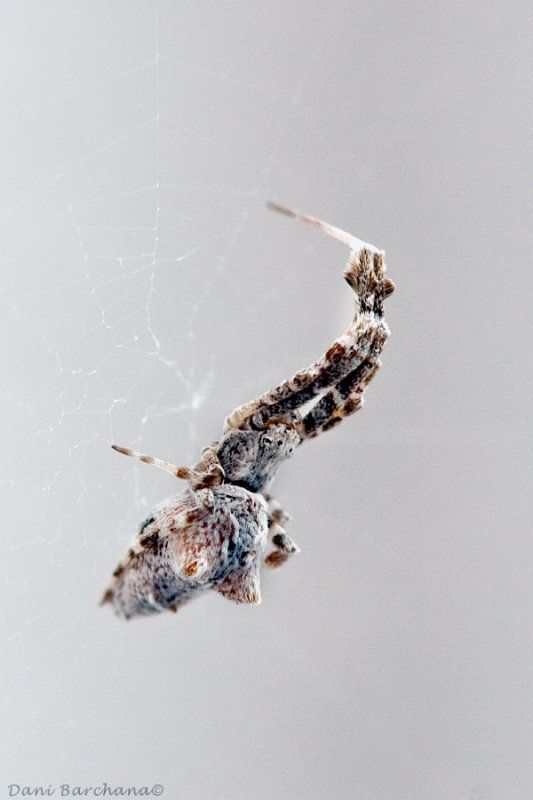
A spider commonly found in garden centres in Britain is giving fresh insights into how to spin incredibly long and strong fibres just a few nanometres thick.

The majority of spiders spin silk threads several micrometres thick but unusually the 'garden centre spider' or 'feather-legged lace weaver' Uloborus plumipes can spin nano-scale filaments. Now an Oxford University team think they are closer to understanding how this is done. Their findings could lead to technologies that would enable the commercial spinning of nano-scale filaments.

The research was carried out by Katrin Kronenberger and Fritz Vollrath of Oxford University's Department of Zoology and is reported in the journal Biology Letters.

Instead of using sticky blobs of glue on their threads to capture prey Uloborus uses a more ancient technique -- dry capture threads made of thousands of nano-scale filaments that it is thought to electrically charge to create these fluffed-up catching ropes.

To discover the secrets of its nano-fibres the Oxford researchers collected adult femaleUloborus lace weavers from garden centres in Hampshire, UK. They then took photographs and videos of the spiders' spinning action and used three different microscopy techniques to examine the spiders' silk-generating organs. Of particular interest was the cribellum, an ancient spinning organ not found in many spiders and consisting of one or two plates densely covered in tiny silk outlet nozzles (spigots).

'Uloborus has unique cribellar glands, amongst the smallest silk glands of any spider, and it's these that yield the ultra-fine 'catching wool' of its prey capture thread,' said Dr Katrin Kronenberger of Oxford University's Department of Zoology, the report's first author. 'The raw material, silk dope, is funnelled through exceptionally narrow and long ducts into tiny spinning nozzles or spigots. Importantly, the silk seems to form only just before it emerges at the uniquely-shaped spigots of this spider.'

Saturn

Astronomers find a solar system more than double ours in age

new solar system
© www.theprovince.comNewly discovered solar system is nearly as old as the universe. Photograph by: Tiago Campante, Peter Devine , AP
A newly discovered solar system - with five small rocky planets - makes ours look like a baby.

An international team of astronomers announced Tuesday that this extrasolar system is 11.2 billion years old. With the age of the universe pegged at 13.8 billion years, this is the oldest star with close-to-Earth-size planets ever found.

By comparison, our solar system is 4.5 billion years old.

The five planets are smaller than Earth, with the largest about the size of Venus and the smallest just bigger than Mercury. These planets orbit their star in less than 10 days at less than one-tenth the Earth's distance from the sun, which makes them too close for habitation, said the University of Sydney's Daniel Huber, part of the team.

"We've never seen anything like this - it is such an old star and the large number of small planets make it very special," Huber said in a statement. "It is extraordinary that such an ancient system of terrestrial-sized planets formed when the universe was just starting out, at a fifth its current age."

Comment: Another knowledge-stretching discovery! Why is "science" always so surprised?


Saturn

Gigantic ring system around J1407b much larger, heavier than Saturn's

Image
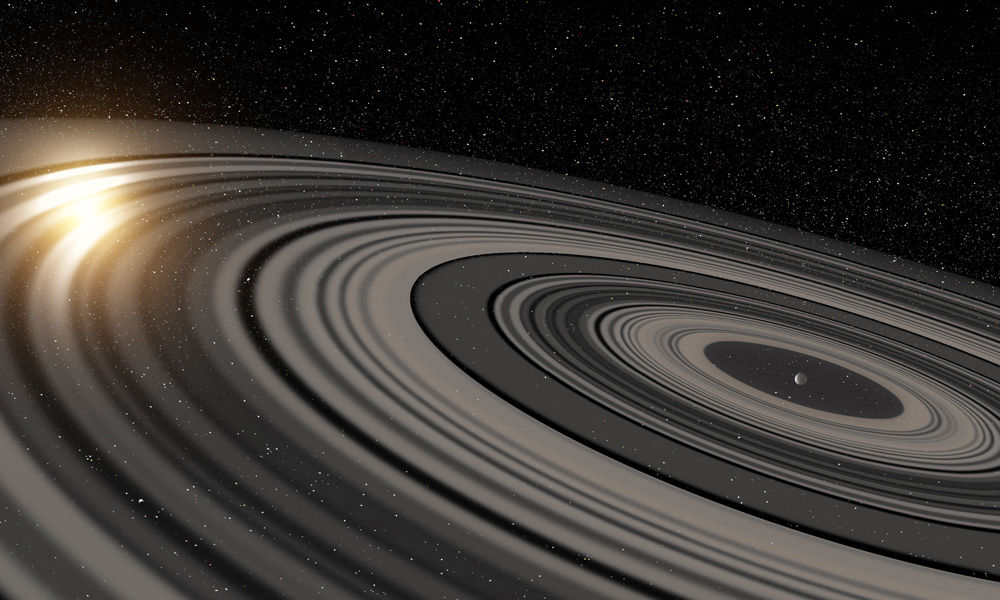
© Ron MillerArtist’s conception of the extrasolar ring system circling the young giant planet or brown dwarf J1407b. The rings are shown eclipsing the young sun-like star J1407, as they would have appeared in early 2007.
Astronomers at the Leiden Observatory, The Netherlands, and the University of Rochester, USA, have discovered that the ring system that they see eclipse the very young Sun-like star J1407 is of enormous proportions, much larger and heavier than the ring system of Saturn. The ring system - the first of its kind to be found outside our solar system - was discovered in 2012 by a team led by Rochester's Eric Mamajek.

A new analysis of the data, led by Leiden's Matthew Kenworthy, shows that the ring system consists of over 30 rings, each of them tens of millions of kilometers in diameter. Furthermore, they found gaps in the rings, which indicate that satellites ("exomoons") may have formed. The result has been accepted for publication in the Astrophysical Journal.

Fireball

Asteroid flying past Earth today has mini-moon!

2004 BL86
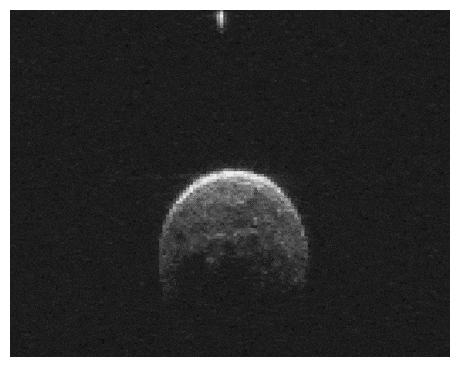
© NASA/JPL-CaltechThis animation, created from 20 individual radar images, clearly show the rough outline of 2004 BL86 and its newly-discovered moon. Click for larger animation.
Wonderful news! Asteroid 2004 BL86, which passed closest to Earth today at a distance of 750,000 miles (1.2 million km), has a companion moon. Scientists working with NASA's 230-foot-wide (70-meter) Deep Space Network antenna at Goldstone, California, have released the first radar images of the asteroid which show the tiny object in orbit about the main body.

While these are the first images of it, the "signature" of the satellite was seen in light curve data reported earlier by Joseph Pollock (Appalachian State University, North Carolina) and Petr Prave (Ondrejov Observatory, Czech Republic) according to Lance Bennerwho works with the radar team at Goldstone.

2004 BL86 measures about 1,100 feet (325 meters) across while its moon is approximately 230 feet (70 meters) across. The asteroid made its closest approach today (Jan. 26th) at 10:19 a.m. (CST), however it will peak in brightness this evening around 10 p.m. (4:00 UT) at magnitude +9.0. Unlike some flybys, 2004 BL86 will remain within a few tenths of a magnitude of peak brightness from 6 p.m. tonight (CST) through early tomorrow morning, so don't miss the chance to see it in your telescope.

Black Magic

Biotech firm using climate change hysteria to persuade Florida residents to accept GMO mosquitoes

gmo mosquitoes
© Reuters / Ricardo Rojas
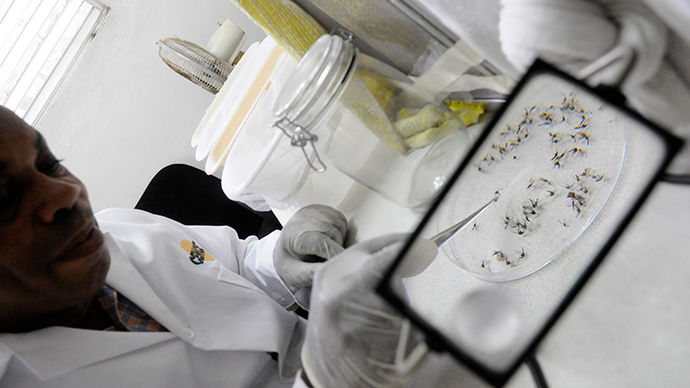
Pointing to climate change and the rise of tropical diseases, British researchers hope to sell their idea of releasing millions of genetically modified mosquitoes in the Florida Keys. Almost 140,000 people have signed a petition against the plan.

For many years, the neighborhoods of the Florida Keys have been sprayed with insecticides to ward off a host of bugs, including perhaps the mother of all pests, the mosquito. Over time, however, Aedes aegypti, a mosquito that can spread the dengue fever, chikungunya, and yellow fever viruses has built up resistance to many of the insecticides used to kill them.

The rising risk of a mosquito infestation and disease outbreak presents an opportunity for one British firm, Oxitec, which has developed a method for breeding Aedes aegypti that kills mosquito larvae, AP reported.

According to Oxitec's website, the process involves injecting a "lethal gene" into either the male sperm or female egg that eventually kills the offspring.

Comment: Last year a town in Brazil issued an emergency decree due to the abnormal situation characterized as a biological disaster of dengue epidemic during a trial of GM mosquito releases. Even though concerns were raised by biologists who reported that in some circumstances releases of these GM mosquitoes could make dengue worse, they were ignored. The corporations developing and promoting GM organisms always claim that such organisms are safe, yet no independent risk studies have been undertaken. Thus people are left to rely on the word of the profiteers whose research is kept secret.

Fooling Mother Nature with Genetically Modified Mosquitoes


Question

Mystery galactic bubble traveling at breakneck speed

Gas Bubbles
© NASA, ESA and A. Field (STScI) This NASA graphic shows how scientists used Hubble Space Telescope observations of a distant quasar to discover that two giant gas bubbles are erupting from the Milky Way's core at 2 million mph. In this graphic, material shown in blue is moving toward the observer, while material in red is traveling away.
Giant bubbles of gas that erupted from the core of the Milky Way galaxy millions of years ago are expanding out into space at mind-blowing speeds, according to new observations that may help reveal how the strange balloon-like lobes formed.

Scientists using the Hubble Space Telescope have clocked the speed of gas bubbles, known as Fermi bubbles, at a whopping 2 million mph (3.2 million km/h). The giant structures now extend 30,000 light-years above and below the plane of the Milky Way.

"A few million years ago, there was a very energetic event at the galactic center, and we're seeing a remnant," lead author Andrew Fox, of the Space Telescope Science Institute in Baltimore, Maryland, said at a press conference this month.

Fox presented the new Hubble observations at the 225th meeting of the American Astronomical Society in Seattle, revealing the age of the Fermi bubbles.

Magic Wand

Gergely Bogányi's classical piano makeover

GB and new piano
© fr.euronews.comA new Hungarian-developed concert piano developed under the inspiration of acclaimed classical pianist Gergely Bogányi.
So many of life's familiar objects are constantly redesigned according to the whims of fashion and the latest trends. But the curves of a classical music instrument seem almost sacred, inviting design changes that tend to be of the nip-and-tuck variety, preserving familiar forms and ageless appeal. Even Liberace's piano, after all, is really only a tarted-up version of a classical shape.

front view
© www.dezeen.comBold new design!
But this week Hungarian pianist Gergely Bogányi unveiled a radical redesign of the grand piano, a project he initiated in order to make it sound the way he heard it in his head. Produced by Louis Renner, a world-renowned German company that specializes in making piano actions and hammerheads, Bogányi and a team of designers and engineers spent more than a decade rethinking the piano's 18,000 parts from the inside out.

Bogányi writes on the piano's promotional website that he is following in the footsteps of the great Hungarian composer and pianist Franz Liszt, who worked with 19th-century piano manufactures to improve the instrument's sound to match the expectations he had in his mind. The new piano, Bogányi says, "is born out of deep love, and humble respect for classical piano tradition, built upon a lifetime desire to improve upon it with fresh innovation in sound and design."

Bogányi's piano incorporates a weather-resistant composite soundboard within a modified traditional iron-and-wood piano frame that creates a stable, clear sound in all climates and allows the instrument to stay in tune longer than a traditional piano. Bogányi says he was inspired by traveling the world with his piano tuner, who was constantly trying to create a consistent, quality sound in every piano. "It was always so difficult with each concert hall having such different conditions that affected the piano," Bogányi says. "Dryness, dust, humidity were always a factor. Could we find a way to keep this quality consistent?" It's difficult to get a sense of how the redesign affects sound quality by watching the brief promotional video below, in which the human playing the piano is strangely absent.


Comment: You may like or not the shape of the new piano, but regardless, the sound is amazing! There are several excerpts to choose from.


Nebula

Does the universe naturally produce complexity and reason?

Image

Recent developments in science are beginning to suggest that the universe naturally produces complexity.
The emergence of life in general and perhaps even rational life, with its associated technological culture, may be extremely common, argues Clemson researcher Kelly Smith in a recently published paper in the journal Space Policy.

What's more, he suggests, this universal tendency has distinctly religious overtones and may even establish a truly universal basis for morality.

Smith, a Philosopher and Evolutionary Biologist, applies recent theoretical developments in Biology and Complex Systems Theory to attempt new answers to the kind of enduring questions about human purpose and obligation that have long been considered the sole province of the humanities.

He points out that scientists are increasingly beginning to discuss how the basic structure of the universe seems to favor the creation of complexity. The large scale history of the universe strongly suggests a trend of increasing complexity: disordered energy states produce atoms and molecules, which combine to form suns and associated planets, on which life evolves. Life then seems to exhibit its own pattern of increasing complexity, with simple organisms getting more complex over evolutionary time until they eventually develop rationality and complex culture.

Comment: Another author has coined a similar approach as "Rational Design Theory":

He puts forth his scientifically testable Rational Design Hypothesis at a time when mainstream science relegates any design theory as unscientific. His reverse engineering analysis of biological life confirms convincingly the validation of classical Darwininan evolution (of species), while at the same time questioning the whole neo-Darwinian notion of chemical evolution upon which the chemical soup theory of life's origins hangs its collective hat.

Shiller leaves speculation about the identity of the designer largely to the reader, but predicts that one important key to uncovering the signature will be the study of introns.

Image


Attention

California considering more government access to cars' on-board computers

Stopped motorist
© www.autoblog.comEarned ticket or routine stop with discretionary citation?
At a traffic school my wife once attended after getting a ticket, the instructor warned the class there are so many driving rules and so much discretion in enforcing them that any driver can be cited for something at any time. Drivers, he said, always are at the mercy of the traffic cop.

Even if that's an exaggeration, the general point seems true. We can drive without being obsessively concerned about getting pulled over because there (thankfully) aren't enough California Highway Patrol officers to stop us every time the speedometer hits 75 mph.

But what if the traffic cop were a computer that always is transmitting data about our driving habits to a government agency? That question increasingly is being asked given technological advancements and a new proposal by the state's air-quality control agency to expand the information your car's computer would be required to collect and potentially transmit to officials.

Currently, drivers get red-light citations via mail because of cameras placed at intersections. USA Today reported that some eastern states have suspended drivers from using toll lanes after their transponders showed them to be speeders. Private fleets often closely monitor, control and punish the behavior of their drivers. What's next?

The On Board Diagnostics computer systems on all of our late-model cars now collect a wide range of information mostly related to a car's emissions. When something is amiss, your dashboard flashes with a "check engine" light and you head to a repair shop to fix it. The goal is to assure cars aren't polluting the air.

But now the California Air Resources Board is proposing regulations (for a May board hearing) requiring manufacturers to significantly expand the kind of information on-board computer software collects about our driving habits.

Comment: One more way to tax or fine citizens. One more way to monitor and control population on an individual basis. One more way to make humans in the workforce obsolete. One more link in the fence. Belief in statistics far outweighs belief in humanity. We are morally and functionally stripped.