
A super El Niño like this one in 1997 is now forming in the Pacific Ocean.
Headlines are buzzing with news that a super El Niño is forming in the Pacific Ocean. A solar physicist saw it coming 3 years ago.
A super El Niño like this one in 1997 is
now forming in the Pacific Ocean.
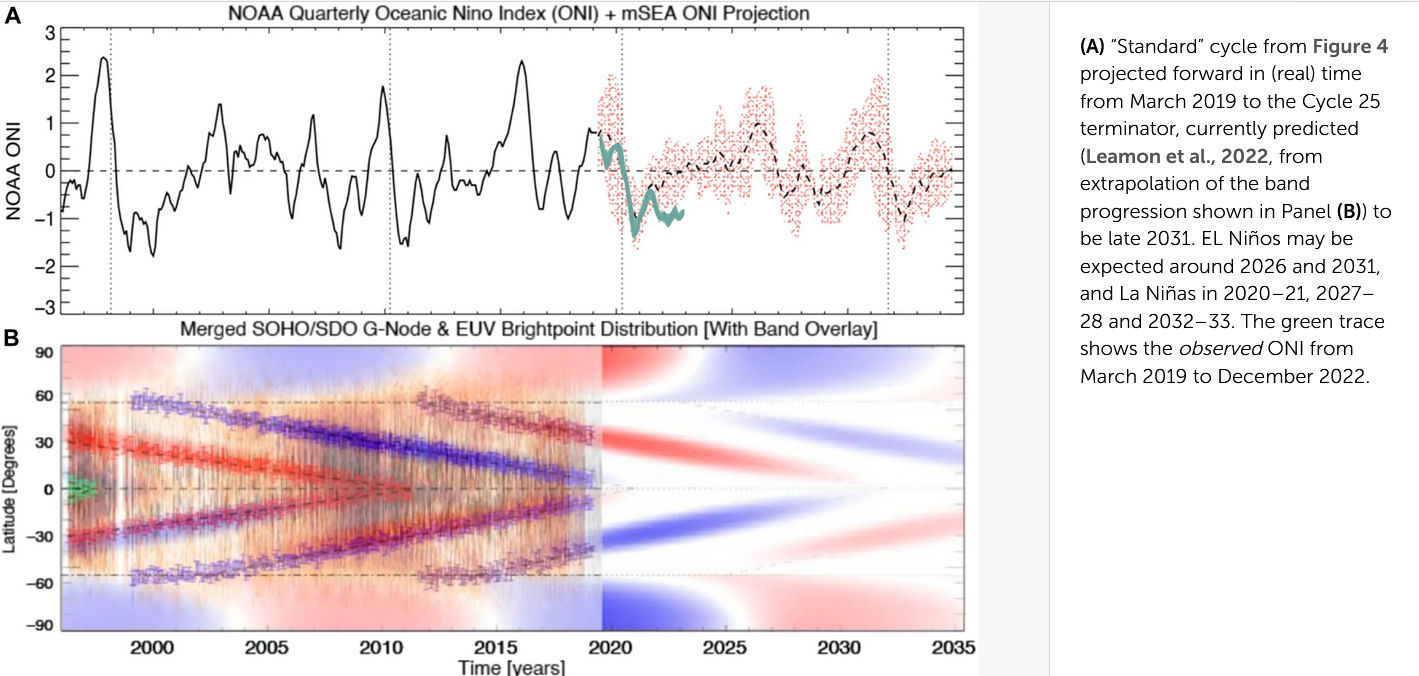
In a 2023 paper, Robert Leamon of NASA and the University of Maryland (Baltimore County) made a striking prediction: The next El Niño would arrive in 2026. He based it on the Terminator,
a magnetic event on the sun that ends one solar cycle and ignites the next.
Averaging the past five solar cycles into a "standard cycle" and projecting it forward, Leamon found that El Niños follow about five years after a Terminator. The most recent termination event happened in December 2021, putting the next El Niño squarely in 2026. His model says nothing about the strength of this El Niño, but the timing is spot-on.
Leamon and his colleague Scott McIntosh had previously shown that every Terminator since the 1960s coincided with a flip from El Niño to La Niña. Their work correctly predicted the onset of a triple-dip La Niña in 2020 and revealed an unexpected connection between the sun and the
ENSO (El Niño-Southern Oscillation).
Adapted from
Fig. 5 of
Leamon (2023), this chart highlights two apparently successful predictions based on the Terminator

Adapted from Fig. 5 of Leamon (2023), this chart highlights two apparently successful predictions based on the Terminator
No one knows how the sun exerts control over the ENSO. Most researchers favor "top-down" models: Solar activity alters the top of Earth's atmosphere, making changes that percolate down to affect the weather we experience near Earth's surface. But the actual mechanism is unknown.









Comment: The Dark Age was exacerbated not only by volcanic explosions: 536 AD, the year the sky went dark