
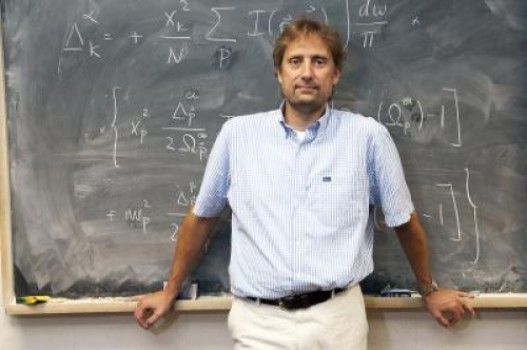
© Credit: Photo: Roberta Dupuis-Devlin/UIC Photo ServicesThis is UIC physicist Dirk Morr, who worked with researchers at Brookhaven National Laboratory, says the findings were the result of 'the close collaboration of theory and experiment.'
The research, published online in the Proceedings of the National Academy of Sciences, is a collaboration between theoretical physicists led by Dirk Morr, professor of physics at the University of Illinois at Chicago, and experimentalists led by Seamus J.C. Davis of Cornell University and Brookhaven National Laboratory.
The earliest superconducting materials required operating temperatures near absolute zero, or −459.67 degrees Fahrenheit. Newer unconventional or "high-temperature" superconductors function at slightly elevated temperatures and seemed to work differently from the first materials. Scientists hoped this difference hinted at the possibility of superconductors that could work at room temperature and be used to create energy superhighways.















Comment: For information on the Electric Universe model and much more related phenomena, read Pierre Lescaudron and Laura Knight-Jadczyk's new book.