Science & TechnologyS


Meteor

Flashback Scientist reveals cause of lost magnetism at meteorite site

lost magnetism
© Gunther KletetschkaGeologists inspect an outcrop near the sample collection site.
A University of Alaska Fairbanks scientist has discovered a method for detecting and better defining meteorite impact sites that have long lost their telltale craters. The discovery could further the study of not only Earth's geology but also that of other bodies in our solar system.

The key, according to work by associate research professor Gunther Kletetschka at the UAF Geophysical Institute, is in the greatly reduced level of natural remanent magnetization of rock that has been subjected to the intense forces from a meteor as it nears and then strikes the surface.

Rocks unaltered by manmade or non-Earth forces have 2% to 3% natural remnant magnetization, meaning they consist of that quantity of magnetic mineral grains — usually magnetite or hematite or both. Kletetschka found that samples collected at the Santa Fe Impact Structure in New Mexico contained less than 0.1% magnetism.

Moon

Large new crater discovered on the moon - Impact likely occurred in last 2 years

New crater moon 2
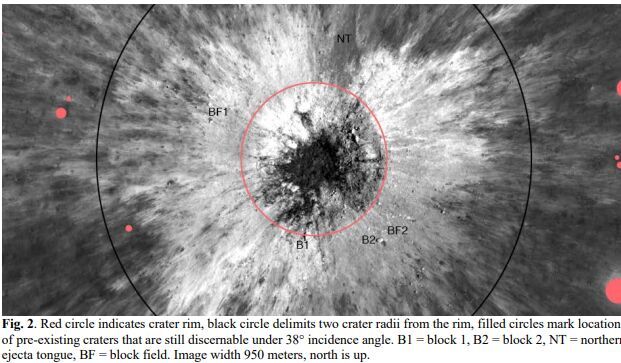
© Intuitive MachinesRed circle indicates crater rim, black circle delimits two crater radii from the rim, filled circles mark locations
of pre-existing craters that are still discernable under 38° incidence angle. B1 = block 1, B2 = block 2, NT = northern ejecta tongue, BF = block field. Image width 950 meters, north is up.
A once-in-a-century crater formed on the moon right under our noses. A routine search of images from NASA's Lunar Reconnaissance Orbiter camera found a fresh crater as wide as two American football fields, planetary scientist Mark Robinson reported March 17 at the Lunar and Planetary Sciences Meeting in The Woodlands, Texas.

The crater is 225 meters wide and formed in April or May 2024, Robinson said. According to predictions based on other lunar landmarks, a crater that big should form only once in 139 years. The discovery can help highlight the risks impacts pose to future astronauts.

Comment: Careful with the 'once-in-a-century' assumption. In fact, now that this new bar has been set, here's a 'joke' for moon researchers: expect more lunar impacts in the coming years, and maybe months.

See also: The mystery of the Ohio and Texas fireballs


Tornado1

Surviving inside a tornado

tornado with tornado chaser
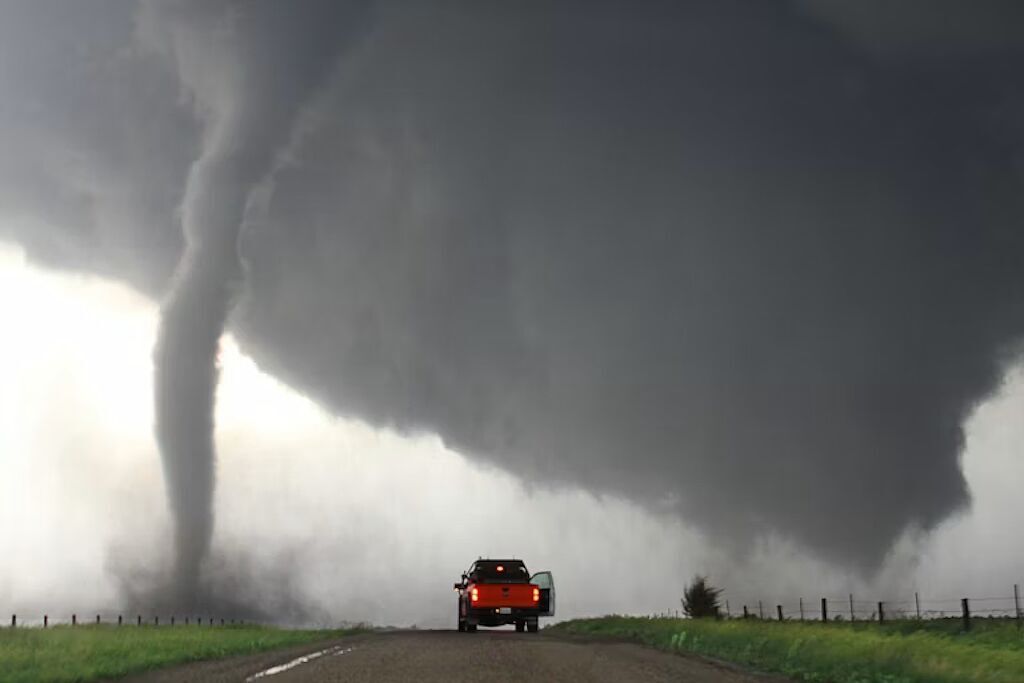
© Brent Koops/NOAA Weather in Focus Photo Contest 2015Tornadoes can be erratic and extremely dangerous.
This scientist did by accident - he's lucky to be alive

I have seen the center of a monster. Most people describe the sound of a tornado as like a freight train, but up close, it's more like a thousand screaming jet engines. I am one of the few people on Earth who has driven into a tornado and lived to tell the tale.

While it might sound like a scene from a Hollywood blockbuster involving a high-tech armored truck, my experience was much more dangerous and terrifying.

I am an atmospheric scientist who studies tornadoes, but I am only alive today because of split-second decisions and a massive amount of dumb luck. Believe me, I do not want to ever be in that situation again.

Fireball

Naked-eye comet on the way

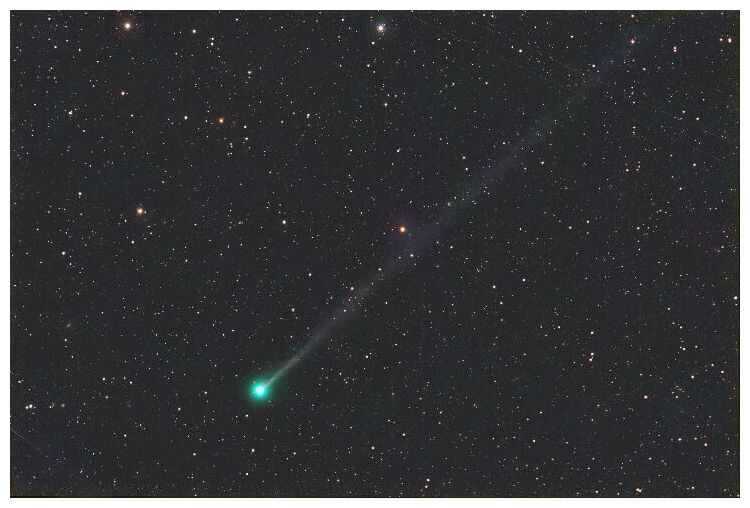
A visitor from the outermost reaches of the solar system is about to become a naked-eye object. Introducing Comet Pan-STARRS (C/2025 R3):

Comet Pan-STARRS (C/2025 R3)
© Taken by Michael Jaeger, Gerald Rhemann on March 23, 2026 @ Weißenkirchen, AustriaOne week after the full moon in April, Comet C/2025 R3 Panstarrs is expected to become visible to the naked eye. On March 23, it reached a magnitude of 7.8 for the first time, and its brightness has increased significantly in recent weeks. It will not reach its perihelion—nor its closest approach to Earth—for another month. The image was taken with an 11"RASA and a color CMOS camera
Michael Jaeger and Gerald Rhemann photographed the comet (magnitude +7.8) from Weißenkirchen, Austria: "The comet's brightness has increased significantly in recent weeks," they say. "One week after the full moon in April, it is expected to become visible to the naked eye."

Discovered by the Pan-STARRS survey in Sept. 2025, the comet is diving toward its closest approach to the sun (0.50 AU) on April 19th, bringing it well inside the orbit of Venus. If current trends continue, the comet could brighten to magnitude +2, easily seen and photographed in the pre-dawn sky.

Comet 2

The mystery of the Ohio and Texas fireballs

Fireballs Reports
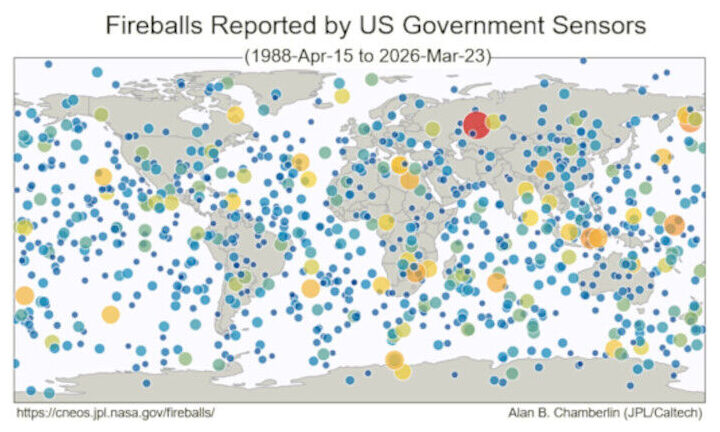
© NASA
Is Earth under siege? If you've been reading headlines about space rocks falling over Ohio and Texas, you might be wondering what's going on. According to NASA, it's nothing unusual, yet still a little mysterious.

"Spring is fireball season," says Bill Cooke of the NASA Meteoroid Environment Office. "For reasons we don't fully understand, the rate of very bright meteors climbs 10% to 30% during weeks around the vernal equinox."

The Ohio and Texas meteors landed squarely in the middle of the season. Onlookers saw the Ohio fireball on March 17th only 3 days before the equinox. The Texas fireball appeared one day after the equinox on March 21st. Both were visible in broad daylight, with sonic booms and meteorites. One fragment reportedly punched through the roof of a home in suburban Houston.

"Meteorite falls--fragments that actually hit the ground--are more common in spring as well," says Cooke.

Comment: The previous narrative used to be 'once in a lifetime'. Fast forward to multiple witnesses in over 15 states, as well as in Canada, Europe and Russia, all within less than one month. The narrative is obviously now "it's nothing unusual". See also:

Fire in the Sky

Caltech astrophysicist fatally shot on porch of his rural home
At the time of his death, he was focused on studying comets and asteroids that could pose a hazard to Earth.


Evil Rays

Data centers suspected of producing mysterious 'hum' heard across several US states

data center new jersey mysterious hum
© Data OneThe 2.4 million-square-foot data center is being built on South Lincoln Avenue in Vineland, New Jersey. It is owned by the company Data One
Residents report vibrating homes and sleepless nights

A mysterious humming noise has been reported in neighborhoods across several US states, rattling homes and leaving residents struggling to sleep.

The latest reports come from Vineland, New Jersey, where locals say the sound began after construction started on a massive 2.5-million-square-foot data center, though officials have not confirmed a direct link.

Residents say the constant noise is disrupting daily life. 'That is not construction, and that monstrosity is only partially built,' Scott Montgomery told ABC 6. 'It is infringing on our peace of mind and our tranquility.'

Similar complaints have surfaced in parts of Virginia, home to hundreds of data centers, and in Connecticut earlier this year, though officials in those areas have yet to identify a confirmed source.

Experts noted that data centers can produce continuous low-frequency humming caused by powerful cooling systems and electrical equipment operating around the clock.

Comment: The problem is likely vibration in the infrasound range. Wind turbines are another culprit. Some frequencies of infrasound have been found to produce negative effects on biological organisms.


Nearby wind park blamed for health issues and cow deaths by French farmer
Infrasound and your health: What scientists know about its effects


Snowflake Cold

Snow flies found to create their own heat plus other strategies to avoid freezing

snow fly close up
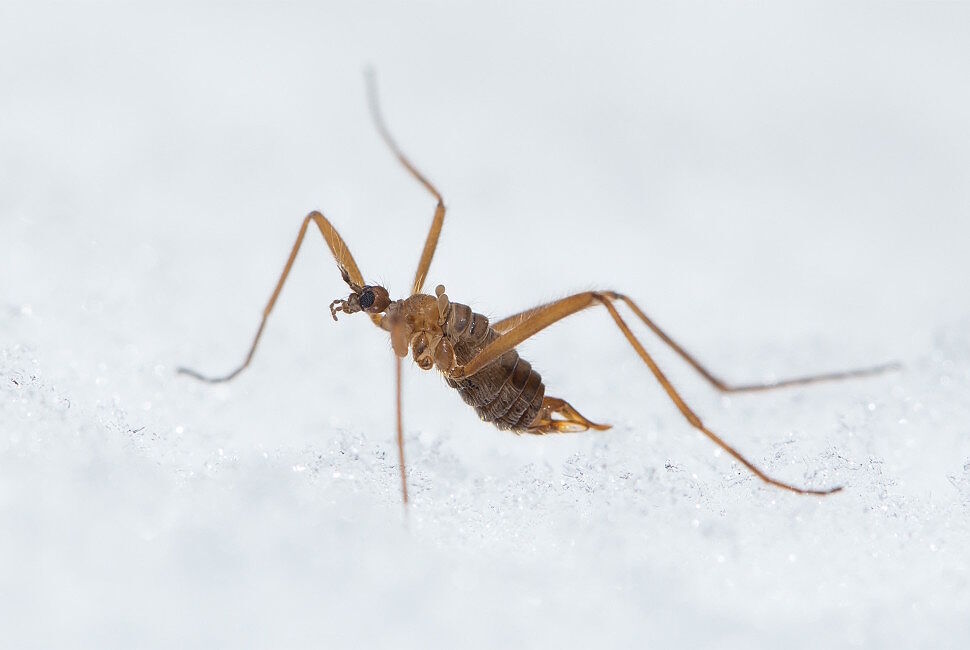
© Håkan SöderholmThe first study to sequence the snow fly’s genome shows the insects use a surprising combination of strategies to survive in freezing conditions. The findings shed light on how life has adapted to survive extreme environments and could inform new strategies for protecting cells, tissues and materials from cold damage.
New study finds specialized 'snow flies' produce bursts of heat and antifreeze proteins

Snow flies might be undergoing an identity crisis.

In a new study, Northwestern University scientists explored how snow flies — small, wingless insects that crawl across snow to find mates and lay eggs — survive in freezing cold temperatures. They discovered this snow-dwelling fly uses a surprising combination of strategies: it generates its own body heat like a mammal and produces antifreeze proteins like an Arctic fish.

While sub-zero temperatures are a death sentence for most other insects, these adaptations allow snow flies to remain active at temperatures as low as -6 degrees Celsius (or 21.2 degrees Fahrenheit).

The findings, published in the journal Current Biology, shed light on how life has adapted to survive in extreme environments and potentially could inform new strategies for protecting cells, tissues and materials from cold damage.

Bulb

High school student invents filter that eliminates 96 percent of microplastics from drinking water

microplastics
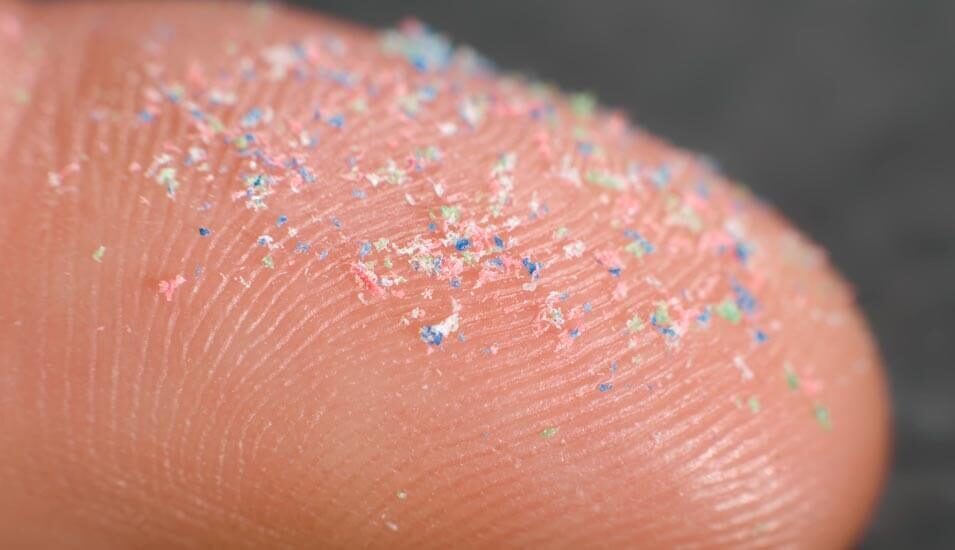
Microplastics now contaminate the entire planet, from the summit of Mount Everest to the deepest oceans.
Virginia teenager Mia Heller's filtration system harnesses the power of ferrofluid, a magnetic oil that binds to microplastics in flowing water

A few years ago, teenager Mia Heller came across an article in her local newspaper about ongoing water quality issues in her neighborhood in Warrington, Virginia. Tests had revealed that the water available for daily consumption was highly contaminated with PFAS and microplastic pollution. The article further reported that government agencies would not be providing any funds for filtering the water.

"It was up to people to provide their own filtration," says Heller.

Not long after the article came out, Heller's parents invested in an advanced water filtration system at her home. The system, however, required constant upkeep. Seeing her mother replace the water filter membranes time and again, Heller set out to find a better solution.

Saturn

More moons for Jupiter and Saturn! New totals here

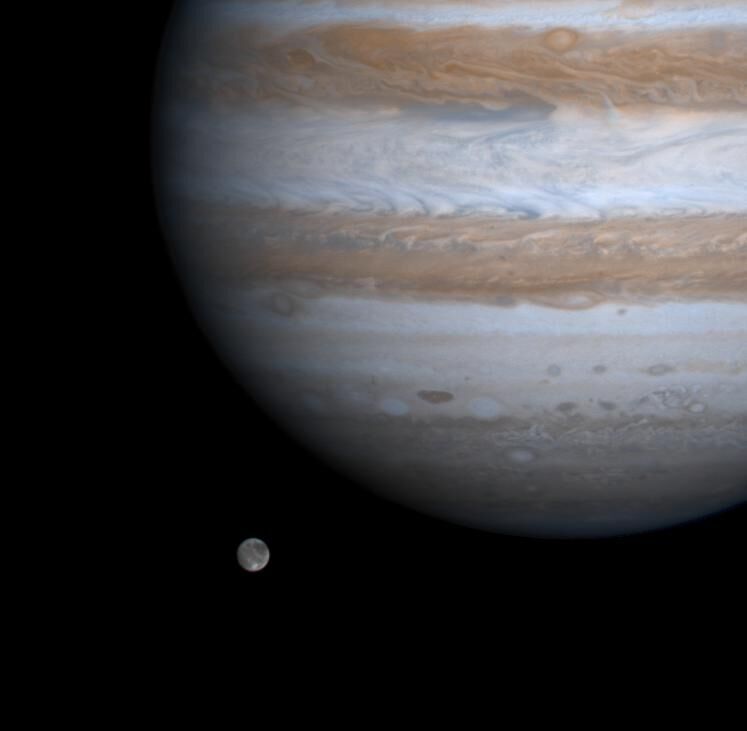
Jupiter’s largest moon, Ganymede
© NASAOnly the largest and brightest moons of Jupiter and Saturn get proper names. For example, Jupiter’s largest moon, Ganymede, has a proper name. The Cassini spacecraft captured this image of the pair on December 3, 2000.
On March 16, 2026, the Minor Planet Center announced an additional 11 moons for Saturn, bringing its total to a whopping 285. Plus, Jupiter's moon count has finally cracked 100, with the addition of four newly discovered moons. Jupiter's grand total now stands at 101.

The newly discovered moons are all quite small, at least as far as moons are concerned. That's why they haven't been discovered until now. These faint, distant space rocks are around 2 miles wide (3 km) with magnitudes of +25 to +27. The lower the number, the brighter it is. And truly bright objects even have negative numbers, like the sun (-26) and Venus (-4). So these moons are extraordinarily faint. They also orbit far from their planet, making them harder to track down.

In fact, the moons of Saturn are so spread out, they span the width of about five full Earth moons as seen from our location here on Earth. So, as you look toward the ringed planet, imagine its entourage of satellites extending for vast distances on either side of it.

Info

BIG NEWS: 3 million year old ice cores flummox researchers — CO2 is irrelevant

For the first time Antarctic ice core teams have got hold of ice that is 3 million years old and the results have confounded them.
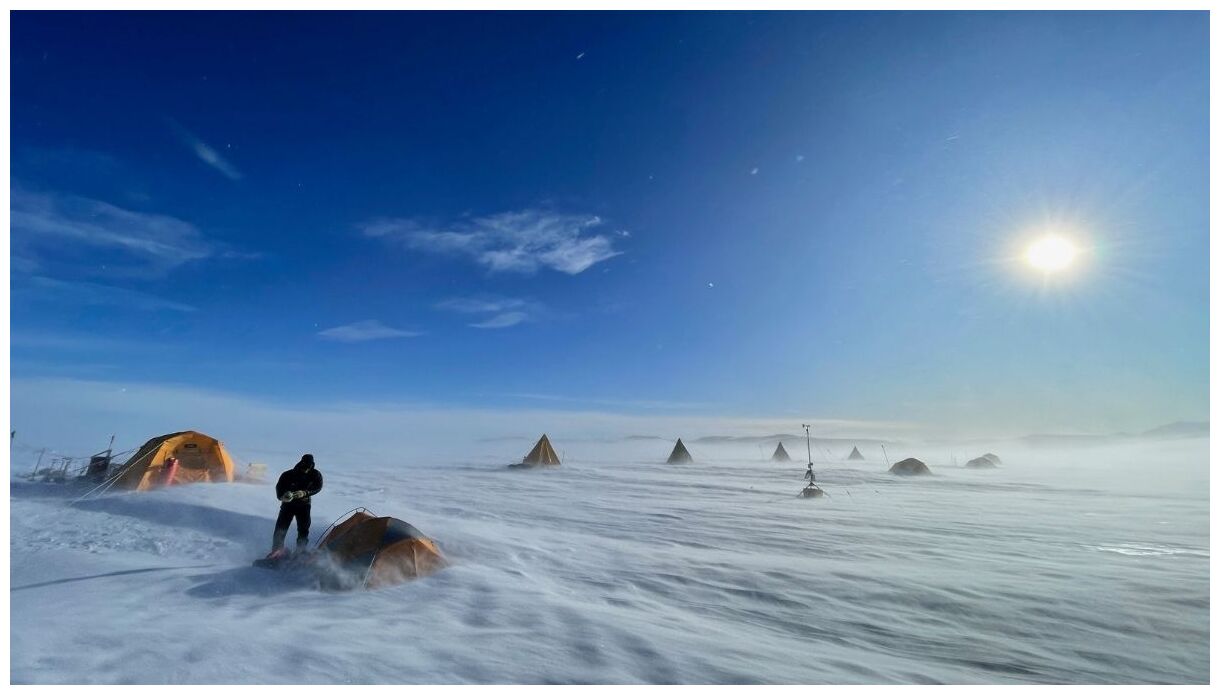
A windy day at Allan Hills in December 2022.
The way CO2 responds in ice cores is canon to "the faith" so this is more important than it seems at first glance. Believers are really struggling.

Three million years ago the world was warmer, and about to cool into the violent ice age cycles. The ice core experts were expecting to confirm that CO2 levels were about 400ppm, as other proxies had shown, and they thought that greenhouse gases might fall and lead the cooling shift. But instead of CO2 being at 400 parts per million, and then leading the cooling, the bubbles trapped in ice were only 250 parts per million to start with and they stayed constant through important temperature swings. Sacre Bleu! CO2 did not appear to have any role in causing the warmth that was, or the cooling that followed. And nor did methane. O' the dilemma?

Some sacred cows have to be sacrificed. Either CO2 is not a major driver of climate change, or the ice cores are wrong (or both!).

Watch the last few addicts coping with this news. Follow the 'reasoning' — it still "might" be worse than we thought, you know! I mean, it's possible, that tiny changes in CO2 that are too small to measure could be affecting the Earth...

It's like the homeopathy of climate science, except homeopathy has more data to support it.