Science & TechnologyS


Telescope

NASA's telescopes find coldest known brown dwarf

brown dwarf concept art
This artist's conception shows the object named WISE J085510.83-071442.5,
NASA's Wide-field Infrared Survey Explorer (WISE) and Spitzer Space Telescope have discovered what appears to be the coldest "brown dwarf" known - a dim, star-like body that, surprisingly, is as frosty as Earth's North Pole.

Images from the space telescopes also pinpointed the object's distance to 7.2 light-years away, earning it the title for fourth closest system to our sun. The closest system, a trio of stars, is Alpha Centauri, at about 4 light-years away.

"It's very exciting to discover a new neighbor of our solar system that is so close," said Kevin Luhman, an astronomer at Pennsylvania State University's Center for Exoplanets and Habitable Worlds, University Park. "And given its extreme temperature, it should tell us a lot about the atmospheres of planets, which often have similarly cold temperatures."

Comet

Comet PANSTARRS K1 swings by the Big Dipper this week, sprouts second tail

Comet C/2012 K1
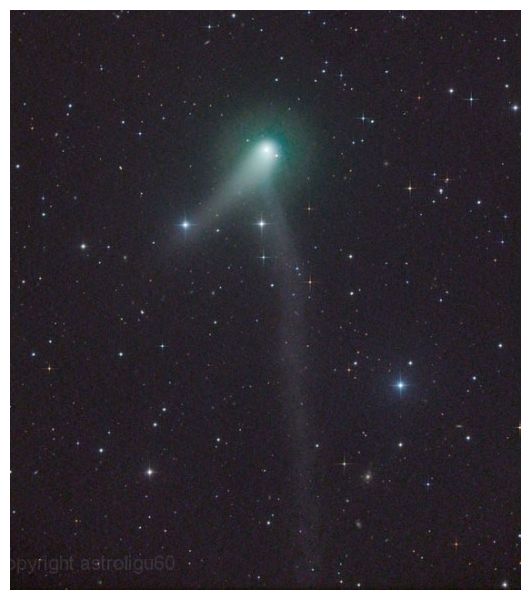
© Rolando LigustriComet C/2012 K1 PANSTARRS displays two tails in this excellent image taken remotely with a telescope in New Mexico. The shorter, brighter spike is the dust tail; the longer is the ion tail with distinct kinks caused by interactions with the solar wind.
Comets often play hard to get. That's why we enjoy those rare opportunities when they pass close to naked eye stars. For a change, they're easy to find! That's exactly what happens in the coming nights when the moderately bright comet C/2012 K1 PANSTARRS slides past the end of the Big Dipper's handle. I hope Rolando Ligustri's beautiful photo, above, entices you roll out your telescope for a look.

Info

Spooky atmospheric 'teleconnections' link North and South Poles


Long-distance atmospheric connections between the North and South poles are linking weather and climate in distant parts of the globe, according to data from a NASA spacecraft.

These so-called "teleconnections" explain why the winter air temperature in Indianapolis, Ind., during the so-called polar vortex correlated with a reduction in high-altitude clouds over Antarctica, thousands of miles away, researchers say.

"Changes in the polar regions in the North were 'communicated' all the way over to the other side of the globe," said Cora Randall, an atmospheric scientist at the University of Colorado, Boulder and a member of the Aeronomy of Ice in the Mesosphere (AIM) spacecraft's science team.

Info

Gravitational lensing confirmed as source of super-luminous supernova

Type Ia Supernova
© Kavli IPMU Artist's conception of Type Ia Supernova.
Four years ago a team of scientists observed a supernova - PS1-10afx - shining brighter than any other in its class. Reporting the observation last year in the Astrophysics Journal Letters, University of Tokyo researchers said they had discovered the first Type Ia Supernova (SNIa) that exploded more than nine billion years ago.

Now, the same team of researchers, led by Robert Quimby, of the University of Tokyo's Kavli Institute for the Physics and Mathematics of the Universe, said the exceptionally bright supernova they reported in 2013 is so luminous because a lens in the sky amplified its light. The discovery settles an important controversy in the field of astronomy.

"PS1-10afx is like nothing we have seen before," said Quimby.

Its exceptional glow was very puzzling, leading some to conclude it was a new type of extra-bright supernova, while others suggested it was a normal SNIa magnified by a lens in the form of a massive object, such as a nearby supermassive black hole.

"The team that discovered it," Quimby said, "proposed that it was a new type of supernova, one that no theory predicted."

The PS1-10afx supernova is 30 times brighter than any supernova found before it and the research team now say this SNIa is the first example of strong gravitational lensing of a supernova, confirming the team's previous explanation for the unusual properties of this supernova.

The team's research has further shown that such discoveries of SNIa can be made far more common than previously thought possible.

Beaker

'Cloud' of bacteria surround the earth - survives at 33,000 feet

high altitude bacteria
© Gary Meek/Georgia Tech
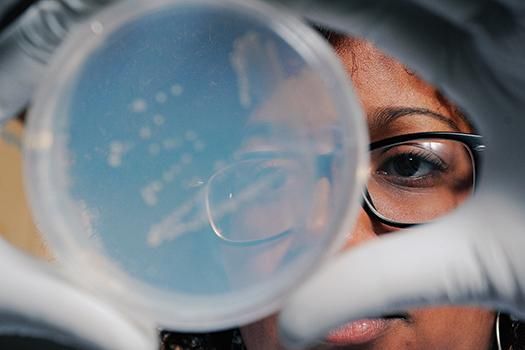
In the midst of airborne sea salt and dust, researchers from Georgia Tech unexpectedly found thousands of living fungal cells and bacteria, including E. coli and Streptococcus.
In the midst of airborne sea salt and dust, researchers from Georgia Tech unexpectedly found thousands of living fungal cells and bacteria, including E. coli and Streptococcus. Earth's upper atmosphere - below freezing, nearly without oxygen, flooded by UV radiation - is no place to live. But last winter, scientists from the Georgia Institute of Technology discovered that billions of bacteria actually thrive up there. Expecting only a smattering of microorganisms, the researchers flew six miles above Earth's surface in a NASA jet plane. There, they pumped outside air through a filter to collect particles. Back on the ground, they tallied the organisms, and the count was staggering: 20 percent of what they had assumed to be just dust or other particles was alive. Earth, it seems, is surrounded by a bubble of bacteria.

Now what?

Scientists don't yet know what the bacteria are doing up there, but they may be essential to how the atmosphere functions, says Kostas Konstantinidis, an environmental microbiologist on the Georgia Tech team. For example, they could be responsible for recycling nutrients in the atmosphere, like they do on Earth. And similar to other particles, they could influence weather patterns by helping clouds form. However, they also may be transmitting diseases from one side of the globe to the other. The researchers found E. coli in their samples (which they think hurricanes lifted from cities), and they plan to investigate whether plagues are raining down on us. If we can find out more about the role of bacteria in the atmosphere, says Ann Womack, a microbial ecologist at the University of Oregon, scientists could even fight climate change by engineering the bacteria to break down greenhouse gases into other, less harmful compounds.

Comment: See more about the possibility of new pathogens arriving on Earth via cometary dust.

New Light on the Black Death: The Cosmic Connection


Galaxy

Milky Way galaxy structure mapped in unprecedented detail

Milky way Galaxy 1
© Sean ParkerThe Milky Way arches over an old windmill near Paulden, Arizona.
Astronomers are one step closer to solving a longstanding mystery - just what our Milky Way galaxy looks like.

It may seem odd that a comprehensive understanding of the Milky Way's structure has so far eluded researchers. But it's tough to get a broad view of the galaxy from within.

"We are fairly confident that the Milky Way is a spiral galaxy, but we don't know much in detail. At the most basic level, we'd like to be able to make a map that would show in detail what it looks like," said Mark Reid of the Harvard-Smithsonian Center for Astrophysics, who led the new study.

Comet

Asteroid study group revises city-destroying threat-level down from 1-in-3000 year events to 1-in-100 years

Image
Lots more where that came from
Space rocks big enough to destroy a city hit the Earth much more often than thought, according to an estimate by a private group devoted to preventing disaster from such orbital killers.

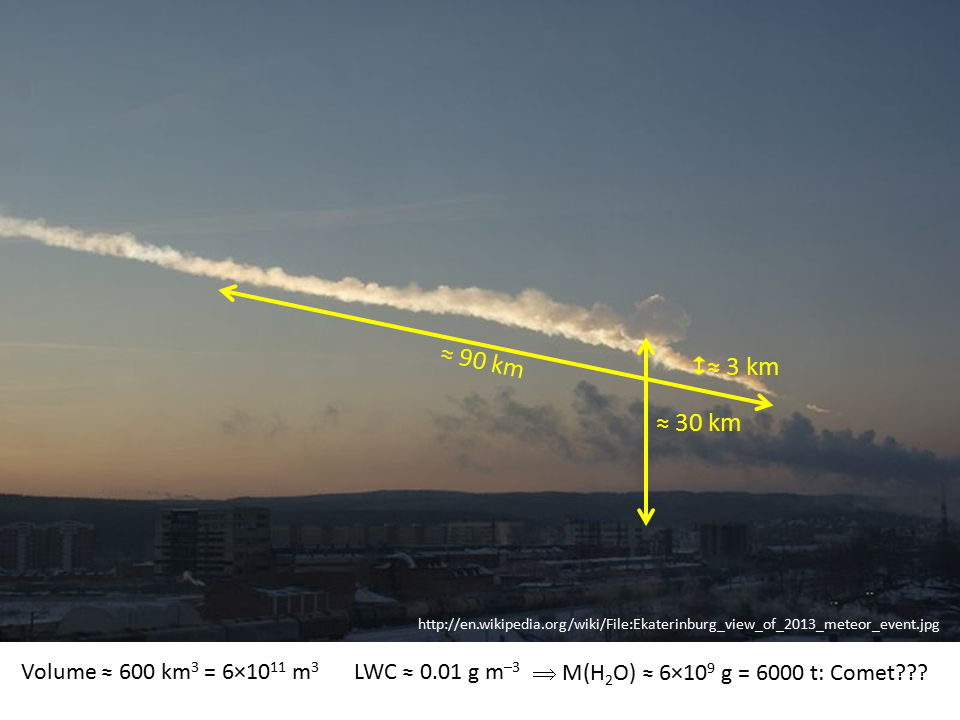
It took a space rock the size of San Francisco to finish off the dinosaurs 65 million years ago, but a decent-sized metropolis could be reduced to smoldering ruins by a boulder that could fit inside a soccer field. The strike rate for such large space rocks, properly known as asteroids, has been estimated at once every 3,000 years, but the B612 Foundation, a planetary defense group, says the true figure could be as high as once a century. Outside scientists say that frequency is plausible but could well be too high.

"There are people who say, 'Oh, once every million years we have something we have to worry about.' That couldn't be more wrong," says physicist and former space shuttle astronaut Ed Lu, chief executive officer of the B612 Foundation. "Eventually you're going to get hit, because it's just a matter of time."

Network

Brazil: Congress passes 'internet constitution' bill

Image
© Reuters / Nacho DocePeople hold a banner protesting against surveillance on the Internet during the NETmundial: Global Multistakeholder Meeting on the Future of Internet Governance in Sao Paulo April 23, 2014
Ahead of a two-day Net Mundial international conference in Sao Paulo on the future of the Internet, Brazil's Senate has unanimously adopted a bill which guarantees online privacy of Brazilian users and enshrines equal access to the global network.

The bill known as the "Internet constitution" or Marco Civil was first introduced in the wake of the NSA spying scandal and has now been signed into law by President Dilma Rousseff - one of the primary targets of the US intelligence apparatus, as leaks by former NSA analyst Edward Snowden revealed.

Rousseff presented the law on Wednesday at a global Net Mundial Internet conference in Sao Paulo.

Info

Science just discovered a brand new shape

You probably thought you learned all the shapes - your circles, your squares, your triangles and rhombi - sometime in elementary school. You'd be mistaken. Using complex materials such as rubber bands, plastic cups, and paper clips, researchers at Harvard University have just observed and recreated an entirely new shape: the hemihelix.

It's true, you probably won't see the new shape much in nature (if at all), but, just in case, it looks like this:
Hemihelix
© PLOS ONE
In fact, it can be recreated fairly easily with some rudimentary materials, which we'll get to in a minute.

Why bother doing something like this at all? Like many things in science, it was kind of an accident. The Harvard team, led by Katia Bertoldi, a professor of applied mechanics, was setting out to try to create a new type of spring. To do that, they were intertwining two different strips of rubber bands that were different lengths and widths. During one of the tests, they accidentally formed a hemihelix, which is like a corkscrew that changes its chirality, or the way it's proverbially screwing, halfway through. Think of it as a if someone put a mirror in the middle of a corkscrew.

Info

DNA nanobots can fool the immune system by disguising themselves as viruses

Nanobot
© Steven Perrault/Harvard's Wyss Institute
Sometimes to help the body, you have to fool the body, which is why researchers from Harvard's Wyss Institute of Biologically Inspired Engineering modeled their latest DNA nanodevice after those great immune-system evaders, viruses.

The whole project, outlined in a new paper published at ACS Nano, is pretty bizarre and cool - back in February 2012, researchers at Wyss announced that they had developed a robotic device fashioned out of DNA. They described how one day the tiny devices could be used for targeting specific, undesirable cells within the body.

The DNAbots were shaped like an open barrel whose two halves are closed by a hinge. When the barrel rolls across, say, a leukemia or lymphoma cell, the special DNA latches could recognize the cell-surface proteins, and the two halves of the barrel could swing open to deliver the DNAbot's payload, which could include molecules with encoded instructions that would interact with specific cell surface signaling receptors, all to give the cells the order to self-destruct. That's the idea, anyway.

The approach was already modeled on the seek-and-destroy methods of our body's own white blood cells. However, rather than being flattered by the mimicry, the immune system reacted to the DNA bots in a pretty hostile manner when they were injected into mice. When researchers covered the bots in fluorescent dye and injected them into the rodents' bloodstreams, the bots showed up glowing in their bladders pretty quickly. They were getting caught, filtered, and marked for expulsion.