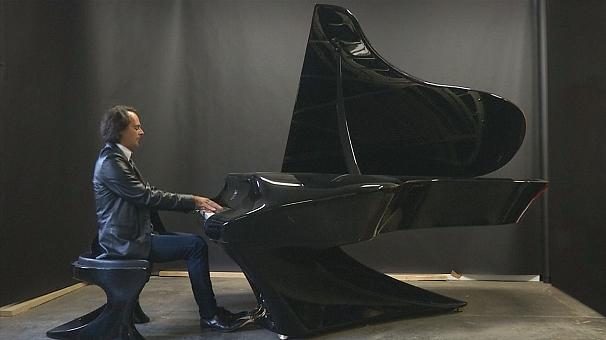
© fr.euronews.comA new Hungarian-developed concert piano developed under the inspiration of acclaimed classical pianist Gergely Bogányi.
So many of life's familiar objects are constantly redesigned according to the whims of fashion and the latest trends. But the curves of a classical music instrument seem almost sacred, inviting design changes that tend to be of the nip-and-tuck variety, preserving familiar forms and ageless appeal. Even Liberace's piano, after all, is really only a tarted-up version of a classical shape.

© www.dezeen.comBold new design!
But this week Hungarian pianist Gergely Bogányi unveiled a radical redesign of the grand piano,
a project he initiated in order to make it sound the way he heard it in his head. Produced by Louis Renner, a world-renowned German company that specializes in making piano actions and hammerheads,
Bogányi and a team of designers and engineers spent more than a decade rethinking the piano's 18,000 parts from the inside out.Bogányi writes on the piano's promotional website that he is following in the footsteps of the great Hungarian composer and pianist Franz Liszt, who worked with 19th-century piano manufactures to improve the instrument's sound to match the expectations he had in his mind.
The new piano, Bogányi says, "is born out of deep love, and humble respect for classical piano tradition, built upon a lifetime desire to improve upon it with fresh innovation in sound and design." Bogányi's piano incorporates a weather-resistant composite soundboard within a modified traditional iron-and-wood piano frame that
creates a stable, clear sound in all climates and allows the instrument to stay in tune longer than a traditional piano. Bogányi says he was inspired by traveling the world with his piano tuner, who was constantly trying to create a consistent, quality sound in every piano. "It was always so difficult with each concert hall having such different conditions that affected the piano," Bogányi says. "Dryness, dust, humidity were always a factor. Could we find a way to keep this quality consistent?" It's difficult to get a sense of how the redesign affects sound quality by watching the brief promotional video below, in which the human playing the piano is strangely absent.























Comment: The vast majority of psychopaths never get in contact with the criminal system, but still leave a trail of psychological and economical destruction behind. The criminal psychopath is a "failed psychopath".
To learn more about this eminently important topic, see:
Ponerology 101: The Psychopath's Mask of Sanity