
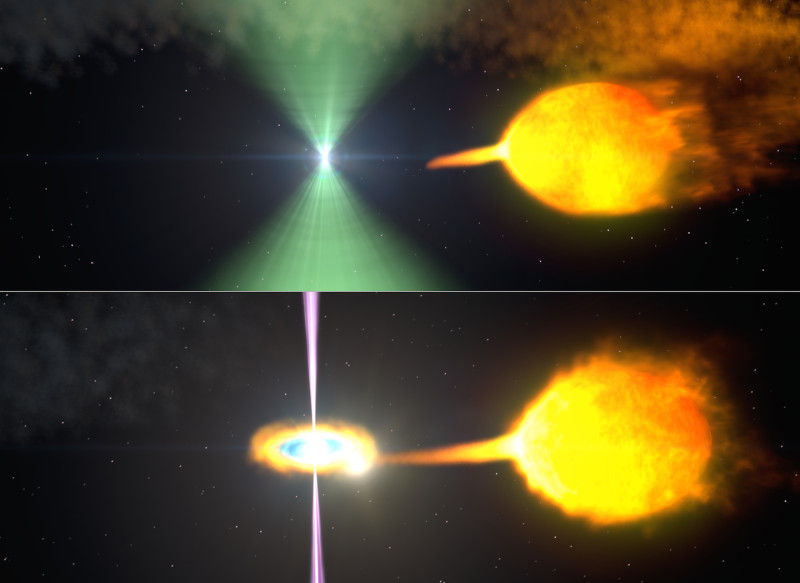
© NASA's Goddard Space Flight CenterThese artist's renderings show one model of pulsar J1023 before (top) and after (bottom) its radio beacon (green) vanished. Normally, the pulsar's wind staves off the companion's gas stream. When the stream surges, an accretion disk forms and gamma-ray particle jets (magenta) obscure the radio beam.
"It's almost as if someone flipped a switch, morphing the system from a lower-energy state to a higher-energy one," said Benjamin Stappers, an astrophysicist at the University of Manchester, England, who led an international effort to understand this striking transformation. "The change appears to reflect an erratic interaction between the pulsar and its companion, one that allows us an opportunity to explore a rare transitional phase in the life of this binary."
A binary consists of two stars orbiting around their common center of mass. This system, known as AY Sextantis, is located about 4,400 light-years away in the constellation Sextans. It pairs a 1.7-millisecond pulsar named PSR J1023+0038 -- J1023 for short -- with a star containing about one-fifth the mass of the sun. The stars complete an orbit in only 4.8 hours, which places them so close together that the pulsar will gradually evaporate its companion.


















Comment: For a lot more information about our 'electric universe' including solar cycles, plasma phenomenon, the Sun's dark companion and the cyclical impact on humanity, read: Earth Changes and the Human Cosmic Connection: The Secret History of the World - Book 3