New images show that
comet C/2025 K1 (ATLAS) has fragmented after passing its closest point to the sun, ahead of its close approach to Earth later this month. This is not the interstellar comet 3I/ATLAS.
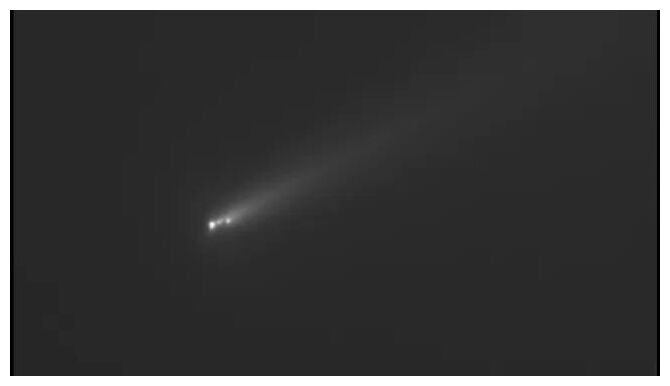
© Gianluca Masi / The Virtual Telescope ProjectA new telescope image of the comet C/2025 K1 (ATLAS) shows it has broken into pieces following its recent close approach to the sun. The comet is not related to the interstellar comet 3I/ATLAS.
The "other" Comet ATLAS has fragmented, transforming into a cloud of debris that's streaming into space, new observations have revealed.
The comet, called
C/2025 K1 (ATLAS), was discovered in May by astronomers at the Asteroid Terrestrial-impact Last Alert System (ATLAS) and passed perihelion, or closest point to the sun, on Oct. 8. It has no relation to the famous
interstellar comet 3I/ATLAS, other than having been discovered by the same telescope network around the same time.
Initial observations appeared to suggest that Comet K1 survived its passage around our star at a minimum distance of 31 million miles (50 million kilometers), or roughly four times closer than
Comet 3I/ATLAS got.
However, new
observations taken by astronomer Gianluca Masi in Manciano, Italy, show that the gravitational strain of its voyage around the sun was too much for the comet, causing it to
fragment into several pieces, or clouds."Several parts (sub-nuclei or clouds of debris) are visible, also a plume just below the leading (the first from the left) fragment,"
Masi, an astronomer at the Astronomical Observatory of Campo Catino and the founder of
The Virtual Telescope Project, wrote in an
update.



















Comment: More research on animal navigation. The ability to orient via Earth's magnetic fields has been conserved for millions of years: